 2 citations
,
September 2014 in “PubMed”
2 citations
,
September 2014 in “PubMed” Low-level laser or light devices could be a cheaper, side-effect free treatment for hair loss, but more research is needed to confirm their effectiveness.
1 citations
,
January 2016 in “Journal of Advanced Plastic Surgery Research” The laser treatment effectively reduced hair growth in women with hirsutism, with temporary side effects.
 January 2019 in “Springer eBooks”
 PRP and LLLT can improve hair growth in AGA, but more research needed.
 1 citations
,
January 2020 in “ARC Journal of Dermatology”
1 citations
,
January 2020 in “ARC Journal of Dermatology” Oral zinc and Nd:YAG laser therapy effectively treated primary cicatricial alopecia in five patients.
June 2026 in “Dermatologic Clinics”  May 2017 in “Journal of The American Academy of Dermatology”
 Combining microneedling with Q-switched laser treatment for tattoo removal did not improve results and caused more pain.
Low level laser therapy effectively treats alopecia areata on the scalp.
 November 2023 in “Journal of medical and health studies”
 Combining low-level laser therapy with scalp microneedling and a clobetasol solution significantly improves androgenetic alopecia.
12 citations
,
January 2021 in “Dermatology Research and Practice” The 1927 nm Thulium laser effectively and safely treats postinflammatory hyperpigmentation in darker skin tones.
15 citations
,
August 2011 in “Lasers in medical science” The 755-nm alexandrite laser effectively and quickly treats trichostasis spinulosa with minimal pain and no side effects.
 May 2023 in “Photobiomodulation, photomedicine, and laser surgery”
 The 675 nm laser treatment significantly increased hair density and reduced symptoms of androgenetic alopecia in both men and women, with no side effects.
 July 1998 in “Proceedings of SPIE”
 Low-power laser therapy is an effective, side-effect-free treatment that speeds up hair regrowth and crural ulcer healing.
 January 2023 in “Our Dermatology Online”
 Laser hair removal is effective but may have side effects.
11 citations
,
January 2022 in “Journal of Healthcare Engineering” The combined treatment is more effective and safer for improving sunken acne scars.

Laser treatments effectively increase hair growth in hair loss conditions.
31 citations
,
January 2019 in “Frontiers in Veterinary Science” Laser therapy improved surgical scar healing in dogs.
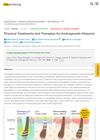
Low-level laser therapy is the most effective for hair loss, but other treatments also show promise.
39 citations
,
June 1999 in “Seminars in cutaneous medicine and surgery” Optical hair removal devices showed potential for long-term hair removal in 1999.
46 citations
,
December 2000 in “Seminars in Cutaneous Medicine and Surgery” Laser and light treatments offer quick, long-lasting hair removal for large areas.
 1 citations
,
April 2022 in “The Egyptian Journal of Hospital Medicine ”
1 citations
,
April 2022 in “The Egyptian Journal of Hospital Medicine ” Fractional laser therapy may help regrow hair in alopecia areata.
47 citations
,
November 2000 in “Archives of dermatology” Pulsed infrared laser can effectively reduce symptoms of pseudofolliculitis barbae.
57 citations
,
December 2011 in “Lasers in Surgery and Medicine” Selective photothermolysis can target sebaceous glands and may treat acne effectively.
 April 2018 in “Journal of Cosmetic and Laser Therapy”
 The editorial introduces studies on various cosmetic and laser treatments, their effectiveness, and posttreatment care.
 February 2025 in “Journal of Biophotonics”
 Dual-wavelength laser therapy promotes better hair regrowth than single-wavelength treatments.
 6 citations
,
September 2018 in “Journal of Dermatological Treatment”
6 citations
,
September 2018 in “Journal of Dermatological Treatment” LLLT devices for hair loss need more research to define proper guidelines.
 August 2025 in “Journal of Cosmetic Dermatology”
 Topical treatments and lasers can improve axillary hyperpigmentation, but no best method is established yet.
January 2017 in “Surgical and Cosmetic Dermatology” Combining laser therapy with drug injections effectively treats androgenetic alopecia.
 June 2011 in “CRC Press eBooks”
 Low-Level Laser Therapy can stimulate healing and cell function, potentially leading to wider medical use.
 August 2025 in “Photodermatology Photoimmunology & Photomedicine”
 LED therapy is a promising, non-invasive skin treatment, but needs standardization and personalization.
1 citations
,
May 2017 in “Journal of cosmetic and laser therapy” Lasers can help reduce skin side effects from cancer treatment.