 6 citations
,
December 2018 in “International Journal of Cosmetic Science”
6 citations
,
December 2018 in “International Journal of Cosmetic Science” Mexican women's hair is between Asian and Caucasian hair in thickness and shape, with varied strength and some damage.

Human hair keratins can self-assemble and support cell growth, useful for biomedical applications.
 19 citations
,
March 2019 in “International Journal of Dermatology”
19 citations
,
March 2019 in “International Journal of Dermatology” The tattoo machine method safely delivers an average of 1,175 µg/cm² of medication into the skin.
 November 2024 in “Image Analysis & Stereology”
 The method improves hair image segmentation accuracy while reducing annotation costs.
 6 citations
,
January 2020 in “Czech Journal of Animal Science”
6 citations
,
January 2020 in “Czech Journal of Animal Science” The FAT1 gene and its variations can help improve wool quality in Chinese Merino sheep through selective breeding.
 117 citations
,
November 2006 in “Experimental Dermatology”
117 citations
,
November 2006 in “Experimental Dermatology” The article concludes that the wool follicle is a valuable model for studying tissue interactions and has potential for genetic improvements in wool production.
 January 2014 in “Sen i Gakkaishi”
 Liposome-encapsulated thioglycolic acid improves hair perming effectiveness and durability.
5 citations
,
April 2024 in “Animals” Younger cashmere goats produce more and better-quality fiber due to higher active hair follicles and antioxidant capacity.
4 citations
,
May 2024 in “Genes” KRT81 gene variations in sheep affect wool weight but not fiber length or thickness.
September 2025 in “Genes” Certain gene variations in Jiangnan cashmere goats are linked to important traits like birth weight and fiber quality, useful for breeding.
9 citations
,
June 2024 in “Genes” Key genes linked to wool quality in Spanish Merino sheep can improve fine wool production.
December 2025 in “Animals” TGFBR1 slows down cell growth in fine-wool sheep hair follicles.
 5 citations
,
November 2022 in “Genetics selection evolution”
5 citations
,
November 2022 in “Genetics selection evolution” Low-coverage sequencing is a cost-effective way to find genetic factors affecting rabbit wool traits.
November 2025 in “Agriculture” Machine learning can effectively identify genes to improve wool quality in sheep.
 September 2025 in “Animals”
 Key proteins and pathways are crucial for wool fineness, but more research is needed.
 9 citations
,
January 2011 in “Skin Research and Technology”
9 citations
,
January 2011 in “Skin Research and Technology” The new automatic tool accurately measures hair thickness and is reliable.
 3 citations
,
September 2020 in “Journal of cosmetic dermatology”
3 citations
,
September 2020 in “Journal of cosmetic dermatology” Coconut oil makes hair stronger and more flexible than mineral oil.
 16 citations
,
April 2017 in “ACM Transactions on Graphics”
16 citations
,
April 2017 in “ACM Transactions on Graphics” Light scatters differently from elliptical hair fibers than from circular ones, and a new model better predicts this behavior, especially for shiny highlights.
 4 citations
,
November 2004 in “Clinical and Experimental Dermatology”
4 citations
,
November 2004 in “Clinical and Experimental Dermatology” Hair length and thickness are related, with thickness peaking at about a quarter of the hair's maximum length.
 4 citations
,
November 2017 in “Journal of Cosmetic Dermatology”
4 citations
,
November 2017 in “Journal of Cosmetic Dermatology” Certain polymers can stick to hair and increase volume, working best at a pH of 7 to 9.
 21 citations
,
January 1995 in “Journal of the American Institute for Conservation”
21 citations
,
January 1995 in “Journal of the American Institute for Conservation” A new method extracts red dyes from wool without damaging it, although it slightly weakens the wool.
 13 citations
,
January 1995 in “Journal of the American Institute for Conservation”
13 citations
,
January 1995 in “Journal of the American Institute for Conservation” Researchers developed a less damaging way to extract red dyes from wool using EDTA and DMF, preserving the fiber's strength for further analysis.
 14 citations
,
September 1954 in “Textile Research Journal”
14 citations
,
September 1954 in “Textile Research Journal” Hair absorbs different substances from solutions based on pH levels.
 12 citations
,
October 1954 in “Textile Research Journal”
12 citations
,
October 1954 in “Textile Research Journal” Hair absorbs alkali bromide salts and water, affecting its structure, with absorption decreasing at higher temperatures.
 161 citations
,
July 2003 in “ACM Transactions on Graphics”
161 citations
,
July 2003 in “ACM Transactions on Graphics” Researchers developed a new model for more realistic computer graphics rendering of hair by considering how light scatters on hair fibers.
Researchers developed a new model for more realistic computer graphics of hair by considering how light scatters on hair fibers.
 43 citations
,
September 2001 in “Scanning”
43 citations
,
September 2001 in “Scanning” Hair treatments like bleaching increase friction by exposing tiny pores on the hair surface.
 29 citations
,
August 2005 in “Biopolymers”
29 citations
,
August 2005 in “Biopolymers” L-cysteine slows down the breaking of bonds in hair due to electrostatic interactions.
 8 citations
,
November 2019 in “Journal of Natural Fibers”
8 citations
,
November 2019 in “Journal of Natural Fibers” Adding human hair to clayey soil makes it stronger, even after freeze-thaw cycles, and is eco-friendly and cheap.
 1 citations
,
July 2019 in “Microscopy Today”
1 citations
,
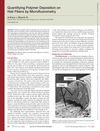
July 2019 in “Microscopy Today” Microfluorometry effectively measures how much polymer coats and penetrates hair, useful for evaluating hair products.