 1 citations
,
April 2019 in “JAAD case reports”
1 citations
,
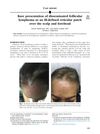
April 2019 in “JAAD case reports” A woman with lymphoma had a rare skin rash on her scalp and forehead, which was hard to diagnose but responded well to treatment.
October 2025 in “Australasian Journal of Dermatology” Combination therapies may be more effective for treating Folliculitis Decalvans than antibiotics alone.
June 2025 in “Indian Journal of Dermatology” A rare skin condition was identified and planned for treatment in an elderly man.
 78 citations
,
August 2002 in “Experimental Dermatology”
78 citations
,
August 2002 in “Experimental Dermatology” Researchers developed a quick and easy way to get and grow cells from the base of human hair follicles.
 May 2025 in “Journal of Clinical Images and Medical Case Reports”
 Hair transplants can trigger a rare scarring hair loss that is hard to treat.
July 2024 in “LA CIENCIA AL SERVICIO DE LA SALUD Y NUTRICIÓN” The condition is harmless, doesn't worsen, and needs no invasive treatment.
 30 citations
,
December 2017 in “Journal of The American Academy of Dermatology”
30 citations
,
December 2017 in “Journal of The American Academy of Dermatology” New criteria for diagnosing frontal fibrosing alopecia include specific scalp and eyebrow hair loss as major factors and other hair loss areas and hair analysis as minor factors.
 8 citations
,
April 2020 in “Facial Plastic Surgery Clinics of North America”
8 citations
,
April 2020 in “Facial Plastic Surgery Clinics of North America” Follicular Unit Transplantation is a reliable hair restoration method with a high success rate and minimal scarring.
2 citations
,
November 2023 in “Skin Research and Technology” RCM and dermoscopy help identify different types of hair loss in children.
 February 2026 in “Dermatology Reports”
 Trichoscopy helps diagnose and treat dissecting cellulitis early, preventing scarring.
Alopecia areata is reversible because hair follicles can regenerate due to stem cells.
 June 2023 in “Zenodo (CERN European Organization for Nuclear Research)”
 Inflammation in hair follicles is a key risk factor for developing common baldness.
 March 2024 in “Bioimpacts”
 400 nm particles penetrate hair follicles best, but mouse models aren't fully reliable for human studies.
25 citations
,
April 2008 in “Clinical and experimental dermatology” EFFC might be common but underreported.
February 2025 in “Archives of Dermatological Research” Fibrosing alopecia can be diagnosed without typical signs of lichen planopilaris.
 January 2012 in “Yearbook of Dermatology and Dermatologic Surgery”
 The study concluded that a 'Swiss cheese' pattern in hair follicles is a useful sign for diagnosing alopecia areata.
1 citations
,
January 2021 in “Figshare” The conclusion is that surgical removal of solitary fibrofolliculoma is effective with no relapses, and diagnosis requires a biopsy due to varied symptoms.
 April 2019 in “Journal of Medical Science And clinical Research”
 The grey patch variant of tinea capitis is most common, mainly spread through family and animals.
8 citations
,
January 2017 in “Indian dermatology online journal” Traumatic anserine folliculosis is a skin condition caused by friction, treatable with topical cream and avoiding trauma.
 1 citations
,
December 2018 in “Journal of cutaneous pathology”
1 citations
,
December 2018 in “Journal of cutaneous pathology” Some skin growths with mucin can form hair follicles and resemble skin cancer, but a special stain can help tell them apart.

Early and accurate identification of primary scarring alopecias is crucial to prevent permanent hair loss.
 56 citations
,
January 2019 in “Skin appendage disorders”
56 citations
,
January 2019 in “Skin appendage disorders” The most common hair loss type at specialist clinics is androgenetic alopecia, especially in younger men, followed by alopecia areata and telogen effluvium, with differences seen across regions.
 June 2022 in “bioRxiv (Cold Spring Harbor Laboratory)”
 ILC1-like cells can cause alopecia areata by attacking hair follicles.
 January 2025 in “Indian Journal of Dermatology”
 Frontal fibrosing alopecia is a challenging hair loss condition with no known cause or definitive treatment.

Lichen planopilaris and frontal fibrosing alopecia are likely the same disease with different clinical appearances.
June 2023 in “Journal of Paediatrics and Child Health” Early treatment of a rare scalp infection led to full recovery and hair regrowth.
3 citations
,
November 2021 in “Frontiers in Medicine” Advanced male pattern baldness affects the back of the scalp, reducing hair follicles.
Scalp involvement in primary cutaneous lymphomas is common and can be aggressive, requiring careful attention.
 66 citations
,
June 2010 in “Experimental Dermatology”
66 citations
,
June 2010 in “Experimental Dermatology” The hair follicle is a great model for research to improve hair growth treatments.
 59 citations
,
March 2020 in “Journal of Biomedical Science”
59 citations
,
March 2020 in “Journal of Biomedical Science” Understanding how hair follicle stem cells work can help find new ways to prevent hair loss and promote hair growth.