 9 citations
,
August 2013 in “Journal of Tissue Engineering and Regenerative Medicine”
9 citations
,
August 2013 in “Journal of Tissue Engineering and Regenerative Medicine” Transplanted baby mouse skin cells grew normal hair using a new, efficient method.
 13 citations
,
January 2014 in “Journal of Investigative Dermatology”
13 citations
,
January 2014 in “Journal of Investigative Dermatology” The laser comb did not improve hair regrowth in mice with alopecia areata.
 2 citations
,
July 2013 in “Veterinary dermatology”
2 citations
,
July 2013 in “Veterinary dermatology” Dog skin with hair loss, when transplanted to mice, regrew hair, suggesting the hair loss cause is likely body-wide, not skin-specific.
 6 citations
,
May 2009 in “Cell transplantation”
6 citations
,
May 2009 in “Cell transplantation” Green tea component EGCG helps keep rat skin grafts viable longer.
4 citations
,
July 2023 in “Experimental Dermatology” Fat grafting reduces scar fibrosis but may slow skin healing.
40 citations
,
January 2022 in “Frontiers in Chemistry” The patch speeds up deep wound healing.
 4 citations
,
June 2022 in “Clinical, cosmetic and investigational dermatology”
4 citations
,
June 2022 in “Clinical, cosmetic and investigational dermatology” The new SFS Scale predicts hair transplant difficulty using hair and skin types, with thick skin and coily hair being hardest to work with.
 34 citations
,
October 2004 in “Plastic and Reconstructive Surgery”
34 citations
,
October 2004 in “Plastic and Reconstructive Surgery” Nasolabial skin-fat grafts are good for nasal reconstruction with minimal scarring and no need for bolsters, but smoking may affect graft survival.
 518 citations
,
November 2014 in “Science”
518 citations
,
November 2014 in “Science” Skin grafting and wound treatment have improved, but we need more research to better understand wound healing and create more effective treatments.
October 2024 in “Biomedical Reports” Superoxidized electrolyzed solution (SES) is more effective for burn healing than common antiseptics.
 5 citations
,
August 2011 in “Dermatologic Surgery”
5 citations
,
August 2011 in “Dermatologic Surgery” Artificial dermis used for hair transplantation can reconstruct scalp defects effectively without the need for tissue expansion.
 30 citations
,
July 2017 in “Stem cells and cloning”
30 citations
,
July 2017 in “Stem cells and cloning” SVF-enhanced adipose transplantation shows potential as a hair loss treatment.
 8 citations
,
June 2016 in “Journal of Cutaneous Pathology”
8 citations
,
June 2016 in “Journal of Cutaneous Pathology” Two women were diagnosed with a rare melanoma that looked like hair loss but was actually a type of skin cancer.
 40 citations
,
December 1980 in “The Journal of Dermatologic Surgery and Oncology”
40 citations
,
December 1980 in “The Journal of Dermatologic Surgery and Oncology” An improved scalp reduction technique reduces the need for hair grafts and has minimal complications.
 64 citations
,
August 2013 in “Mayo Clinic Proceedings”
64 citations
,
August 2013 in “Mayo Clinic Proceedings” Wound healing insights can improve regenerative medicine.
 212 citations
,
September 2015 in “Journal of Investigative Dermatology”
212 citations
,
September 2015 in “Journal of Investigative Dermatology” The document provides a method to classify human hair growth stages using a model with human scalp on mice, aiming to standardize hair research.
 June 2004 in “Dermatologic Surgery”
 Dr. Walter P. Unger suggests that copying a person's natural hair direction and angle during transplants leads to a more natural and fuller appearance.

Proretinal nanoparticles are a safe and effective way to deliver retinal to the skin.
 3 citations
,
June 2017 in “Aesthetic plastic surgery”
3 citations
,
June 2017 in “Aesthetic plastic surgery” The new facial treatment improved wrinkles and skin thickness, with most patients seeing results within a month, despite some temporary swelling and bruising.
 10 citations
,
May 2021 in “Expert Opinion on Drug Delivery”
10 citations
,
May 2021 in “Expert Opinion on Drug Delivery” Coenzyme Q10 vesicular formulations can potentially treat androgenic alopecia by promoting hair growth and thickness.
 2 citations
,
October 2010 in “Springer eBooks”
2 citations
,
October 2010 in “Springer eBooks” Using cheek skin and cartilage grafts for nose reconstruction after skin cancer surgery can maintain shape and function but may require multiple surgeries and hair removal in men.
 5 citations
,
February 2012 in “Aesthetic Plastic Surgery”
5 citations
,
February 2012 in “Aesthetic Plastic Surgery” A man developed skin cancer on his scalp after multiple artificial hair grafts.
 September 2023 in “Clinical, cosmetic and investigational dermatology”
 A new surgical method using special sutures significantly reduced wound size and prevented disease return in patients with a scarring scalp condition.
 June 2002 in “Surgery (oxford)”
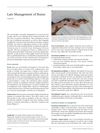
 The document says that treating burns late focuses on improving function, appearance, and helping patients return to normal life, using both non-surgical and surgical methods.
 7 citations
,
July 2014 in “Facial Plastic Surgery Clinics of North America”
7 citations
,
July 2014 in “Facial Plastic Surgery Clinics of North America” Different ethnic hair traits must be considered for successful hair restoration surgery to achieve natural-looking results.
 November 2025 in “International Journal of Zoology and Applied Biosciences”
 New technologies like AI, robotics, and stem cells have made hair transplants more effective and natural-looking.
 July 2007 in “Clinical Risk”
 The claimant sued for negligence after a hair treatment caused harm and distress, and the defendant responded after legal action started.
24 citations
,
October 2010 in “Tissue Engineering Part A” Tissue-engineered skin can support hair growth after grafting, especially with mouse-derived dermis.
133 citations
,
July 2020 in “Cells” Creating fully functional artificial skin for chronic wounds is still very challenging.
 27 citations
,
October 1999 in “Experimental and Molecular Pathology”
27 citations
,
October 1999 in “Experimental and Molecular Pathology” Stump-tailed macaque best for researching hair loss causes and treatments.