 3 citations
,
December 2020
3 citations
,
December 2020 The interdigital gland in crossbred sheep is similar to skin and has specialized structures for secretion.
16 citations
,
January 2010 in “Journal of Korean medical science/Journal of Korean Medical Science” A Korean boy's skin and digestive symptoms were caused by a rare genetic disorder that affects zinc absorption, and he got better with zinc supplements.
 13 citations
,
February 2007 in “British Journal of Dermatology”
13 citations
,
February 2007 in “British Journal of Dermatology” EF and PXE not closely related.
2 citations
,
October 2001 in “Mycoses” A cat had a rare fungal infection caused by Microsporum gypseum.
33 citations
,
September 2017 in “Journal of Investigative Dermatology” A mutation in the KRT25 gene causes woolly hair and hair loss.
 April 2018 in “The journal of investigative dermatology/Journal of investigative dermatology”
 GATA6 is important for maintaining and differentiating cells in a key area of human skin.
40 citations
,
September 2004 in “Biomacromolecules” The Glu413Lys mutation in keratin affects hair stability, while Glu413Asp does not.
2 citations
,
July 2019 in “Indian dermatology online journal” A 17-year-old girl and her brothers have a rare hair condition with long eyelashes, thick eyebrows, and easily pluckable hair.
 4 citations
,
January 2011 in “Annals of Dermatology”
4 citations
,
January 2011 in “Annals of Dermatology” Researchers found a new mutation in the HR gene linked to a rare hair loss condition.
 19 citations
,
July 2006 in “Acta crystallographica”
19 citations
,
July 2006 in “Acta crystallographica” Errors found in identifying furosemide and finasteride polymorphs due to incomplete data.
32 citations
,
August 2020 in “American Journal Of Pathology” S100A4 promotes aggressive ovarian cancer and is a potential treatment target.
78 citations
,
August 1996 in “The Journal of Clinical Endocrinology & Metabolism” The same gene mutation can cause different symptoms in family members.
August 2023 in “Zenodo (CERN European Organization for Nuclear Research)”  February 2009 in “Journal of The American Academy of Dermatology”
 The document concludes that detailed clinical descriptions of seven family cases help understand dominant dystrophic epidermolysis bullosa's symptoms and inheritance.
May 2026 in “Animal Bioscience” m6A-circHECA helps stem cells become hair follicles in cashmere goats.
 63 citations
,
December 2002 in “Archives of Dermatology”
63 citations
,
December 2002 in “Archives of Dermatology” The 308-nm excimer laser is a promising treatment for vitiligo with varying success and mild side effects.
 2 citations
,
September 2021 in “Cutis”
2 citations
,
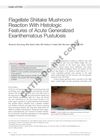
September 2021 in “Cutis” Eating shiitake mushrooms caused a man to develop a rash similar to a skin condition known as AGEP.
Mechanical stress causes ligament thickening through WISP-1 and Hedgehog signaling.
5 citations
,
September 2009 in “Acta Ophthalmologica” Hyper-keratinisation in Meibomian glands contributes to gland dysfunction.
69 citations
,
December 2015 in “BMC plant biology” Three genes in Arabidopsis are important for plant growth and development by affecting sugar attachment to proteins.
July 2024 in “Journal of Investigative Dermatology” A KLK5 inhibitor effectively improved skin symptoms in a mouse model of Netherton Syndrome.
 5 citations
,
January 2015 in “Genetics and Molecular Research”
5 citations
,
January 2015 in “Genetics and Molecular Research” Maize hybrids show better early growth due to complex gene interactions from their parent strains.
 3 citations
,
March 2014 in “Journal of Industrial Microbiology & Biotechnology”
3 citations
,
March 2014 in “Journal of Industrial Microbiology & Biotechnology” Scientists found a new gene in a bacterium that can modify an immunosuppressant drug, potentially helping to treat hair loss.
4 citations
,
January 2013 in “Genetics and Molecular Research” VEGF and microvessel density are closely linked and peak during specific hair growth phases in cashmere goats.
18 citations
,
February 2006 in “Genomics” A new genetic mutation in mice causes permanent hair loss and skin wrinkling.
1 citations
,
July 2024 in “Journal of Investigative Dermatology” VYN201 shows promise as a safe and effective treatment for non-segmental vitiligo.
 1 citations
,
January 1971 in “Acta dermato-venereologica”
1 citations
,
January 1971 in “Acta dermato-venereologica” Mice hair follicles take in the amino acid cystine.
41 citations
,
December 1988 in “Journal of Investigative Dermatology” 39 citations
,
July 1997 in “American Journal of Medical Genetics” The gene for Clouston syndrome in a large Indian family is located in the 13q11-q12.1 region.
19 citations
,
August 1972 in “PubMed” The patient had a severe allergic reaction to gold treatment.