 1 citations
,
January 2017 in “Evolutionary studies”
1 citations
,
January 2017 in “Evolutionary studies” Different human traits like skin color and hair type vary between populations due to genetic adaptations to the environment.
 April 2023 in “Journal of Cutaneous and Aesthetic Surgery”
 The conclusion is that a safe donor area for hair transplants varies and should be chosen based on individual factors like race, future hair loss, family history, and specific thinning patterns.
 28 citations
,
November 2018 in “Journal of structural biology”
28 citations
,
November 2018 in “Journal of structural biology” Different populations have distinct hair structures related to their ancestry.
May 2024 in “International journal of medicine and psychology.” Ganser syndrome may result from both organic and psychogenic factors.
32 citations
,
March 2016 in “American Journal of Physical Anthropology” African hair is curled, Asian hair is thick, European hair is lighter, and chemical methods help identify hair color differences.
 6 citations
,
December 2014 in “Clinical and Experimental Dermatology”
6 citations
,
December 2014 in “Clinical and Experimental Dermatology” Hair density and thickness decrease in all scalp areas for East Asians with AGA.
 March 2026 in “Egyptian Journal of Forensic Sciences”
 Unified regulations and ethical guidelines are needed for fair use of forensic DNA phenotyping.
 14 citations
,
March 2016 in “Journal of Dermatology”
14 citations
,
March 2016 in “Journal of Dermatology” Hair loss links to high blood pressure, high fat levels, and metabolic issues, suggesting early heart disease screening.
January 2015 in “프로그램북(구 초록집)” Many Korean women with female-pattern hair loss have reduced hair density at the temples.
 March 2024 in “Skin research and technology”
 New dermoscopic criteria accurately diagnose and grade the severity of hair loss in androgenetic alopecia.
 4 citations
,
December 2012 in “Human Biology”
4 citations
,
December 2012 in “Human Biology” The most different genetic segment between Africans and East Asians is the EDA2R/AR region, with two main types influenced by population changes and natural selection, and linked to baldness.
 1 citations
,
September 2016 in “Journal of Dermatology”
1 citations
,
September 2016 in “Journal of Dermatology” Baldness is common in Korean men (60.5%), and those with a family history are 3.1 times more likely to have hairline recession.
26 citations
,
April 2010 in “The American journal of dermatopathology/American journal of dermatopathology” Researchers created a standard system to grade hair damage using microscopic images.
September 1998 in “Journal of the European Academy of Dermatology and Venereology” Different racial groups have varying keratin proteins, affecting hair texture and strength.
 18 citations
,
July 2003 in “Dermatologic Surgery”
18 citations
,
July 2003 in “Dermatologic Surgery” The conclusion is that creating natural-looking hair restoration requires replicating natural scalp whorl patterns and inserting grafts at specific angles.
 196 citations
,
March 2016 in “Nature Communications”
196 citations
,
March 2016 in “Nature Communications” Genetic factors influence hair traits like shape, color, and greying in Latin Americans.
 24 citations
,
November 2023 in “Nature”
24 citations
,
November 2023 in “Nature” The extracellular matrix affects where tumors can start in the body.
 5 citations
,
September 1997 in “Dermatologic Surgery”
5 citations
,
September 1997 in “Dermatologic Surgery” Dr. Russell Knudsen's system classifies hair grafts by class, shape, and size for clearer communication in hair restoration surgery.
5 citations
,
January 2007 in “Lincoln (University of Nebraska)” Geochemical methods help manage wildlife by revealing toxic elements and diet details in Yellowstone.
 3 citations
,
September 2016 in “Hair transplant forum international”
3 citations
,
September 2016 in “Hair transplant forum international” Southeast and East Asian men typically have straighter hairlines with less recession and lower hair density, which is important to consider in hair restoration surgery.
Ethnic differences in skin and hair affect penetration minimally, but cultural habits matter in product development.
 2 citations
,
January 2014 in “The Korean journal of medicine”
2 citations
,
January 2014 in “The Korean journal of medicine” The 2012 SLICC criteria provide an updated method for classifying Systemic Lupus Erythematosus.
1 citations
,
April 2018 in “Dermatologic Surgery”  126 citations
,
January 2010 in “British Journal of Dermatology”
126 citations
,
January 2010 in “British Journal of Dermatology” Baldness is more common in Chinese men than women, increasing with age, and is influenced by genetics.
 8 citations
,
March 2023 in “Journal of Clinical Epidemiology”
8 citations
,
March 2023 in “Journal of Clinical Epidemiology” The updated GRADE guidance advises considering context when interpreting variability in research results and introduces tools for assessing subgroup effects.
November 2025 in “Archaeometry” Animal hair from 18th-century Mazamet burial sites shows locals used goat, badger, cow, or horse fur for clothing, indicating modest economic status.
260 citations
,
January 2020 in “Nature” Stress can cause hair to turn gray by depleting stem cells.
31 citations
,
August 2023 in “Cell Genomics” The Tyrolean Iceman had mostly Anatolian farmer ancestry and traits like darker skin and a risk for certain health issues.
 10 citations
,
November 2012 in “The journal of investigative dermatology/Journal of investigative dermatology”
10 citations
,
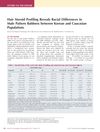
November 2012 in “The journal of investigative dermatology/Journal of investigative dermatology” Korean and Caucasian men with male pattern baldness have different hair steroid levels.
 March 2022 in “Journal of The American Academy of Dermatology”
 The study found different balding patterns in men of color.