Patients with graft-versus-host disease often have nail changes related to the nail matrix, with severity not linked to skin condition.
 7 citations
,
October 2019 in “Clinical, Cosmetic and Investigational Dermatology”
7 citations
,
October 2019 in “Clinical, Cosmetic and Investigational Dermatology” Certain gene variations in the Vitamin D receptor may increase the risk of chronic hair loss.
 3 citations
,
May 2024 in “Cureus”
3 citations
,
May 2024 in “Cureus” Early detection and removal of hair can prevent damage in hair-thread tourniquet syndrome.
 2 citations
,
January 2008 in “Journal of The American Academy of Dermatology”
2 citations
,
January 2008 in “Journal of The American Academy of Dermatology” Trichoscopy is a helpful and quick method to diagnose hair loss without shaving.
 July 2014 in “Journal of Dermatology”
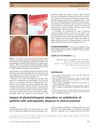
 Educating patients on phototrichogram increased satisfaction in androgenetic alopecia treatment.
1 citations
,
February 2026 in “ACS Nano” The TLMG hydrogel improves wound healing and monitoring with strong adhesion and conductivity.
 37 citations
,
January 2017 in “International Journal of Dermatology”
37 citations
,
January 2017 in “International Journal of Dermatology” Trichoscopy helps tell apart alopecia areata and trichotillomania in Asians by looking at specific hair and scalp features.
11 citations
,
March 2002 in “Pediatric Dermatology” Temporal triangular alopecia is a non-scarring hair loss seen in some Asian children.
July 1997 in “JEADV. Journal of the European Academy of Dermatology and Venereology/Journal of the European Academy of Dermatology and Venereology” January 2025 in “Biochimica et Biophysica Acta (BBA) - Molecular Cell Research” Green tea compound EGCG may help hair growth by boosting cell activity.
 8 citations
,
April 2001 in “Dermatologic Surgery”
8 citations
,
April 2001 in “Dermatologic Surgery” Michael L. Beehner proposed a standardized way to describe balding areas on the scalp to help hair restoration experts communicate better.
 June 2019 in “Journal of evolution of medical and dental sciences”
 Dermoscopy is useful for tracking alopecia areata treatment, with yellow dots and new vellus hairs being good indicators of hair regrowth.
 January 2014 in “Journal of Physiology & Pathology in Korean Medicine”
 Microneedle roller therapy can help hair grow.
May 2022 in “Dermatology practical & conceptual” Trichoscopy is crucial for diagnosing and managing androgenetic alopecia, showing increased vellus hairs, empty follicles, and fibrosis with severity.
2 citations
,
December 2021 in “Korean Journal of Clinical Pharmacy”  5 citations
,
March 2005 in “Journal of The American Academy of Dermatology”
5 citations
,
March 2005 in “Journal of The American Academy of Dermatology”  17 citations
,
May 2011 in “Movement Disorders”
17 citations
,
May 2011 in “Movement Disorders” Finasteride significantly reduced tics and obsessive-compulsive symptoms in patients with Tourette syndrome.
 1 citations
,
January 2021 in “Nihon rinsho hifukaikai zasshi”
1 citations
,
January 2021 in “Nihon rinsho hifukaikai zasshi” The document provides ways to tell alopecia areata from other similar hair loss conditions, using visual checks and specific tests.
 9 citations
,
March 2019 in “European Journal of Sport Science”
9 citations
,
March 2019 in “European Journal of Sport Science” New signs like changes in blood markers, physical symptoms, and behavioral shifts may help detect hidden steroid use in athletes.
 2 citations
,
July 2017 in “Skin appendage disorders”
2 citations
,
July 2017 in “Skin appendage disorders” Alfredo Rebora suggests a simpler classification for hair loss and a new test for easier diagnosis.
December 2025 in “Journal of Paediatrics and Child Health” Tick-bite alopecia can be identified by a bite-centered mark and treated with topical steroids, while SENLAT needs doxycycline.
12 citations
,
January 2019 in “International Journal of Trichology” Trichoscopy is useful for detecting and monitoring androgenetic alopecia.
22 citations
,
August 2020 in “Cells” TGM3 is important for skin and hair structure and may help diagnose cancer.
 1 citations
,
March 2014 in “Turkderm”
1 citations
,
March 2014 in “Turkderm” Trichoscopy helps tell different hair loss types apart using specific scalp and hair patterns.
February 2024 in “Indian Dermatology Online Journal” Androgenic alopecia is linked to more severe COVID-19 and higher mortality.
 3 citations
,
November 2018 in “PubMed”
3 citations
,
November 2018 in “PubMed” SMT effectively treats advanced baldness with high satisfaction.
 1 citations
,
October 2022 in “Molecular therapy”
1 citations
,
October 2022 in “Molecular therapy” The FDA approved the first gene therapy for a blood disorder after overcoming early challenges and demonstrating patient benefits.
8 citations
,
January 2023 in “International journal of molecular sciences” Transglutaminase activity is important for skin and is found in both mammals and birds.
 February 2026 in “Archives of Dermatological Research”
 Microneedle-delivered polyglutamate effectively and safely improves hair growth in androgenetic alopecia.
 4 citations
,
April 2016 in “Plastic and reconstructive surgery. Global open”
4 citations
,
April 2016 in “Plastic and reconstructive surgery. Global open” Scalp medical tattooing effectively camouflages bifid parietal whorls.