 20 citations
,
January 2017 in “Scientific reports”
20 citations
,
January 2017 in “Scientific reports” Whale genes show changes that help them live in water, like less hair and better flippers.
 April 2018 in “Journal of Investigative Dermatology”
 A new peptide, FOL-005, may help treat excessive hair growth by reducing a hair growth promoter, FGF7.
14 citations
,
October 2017 in “Gene Expression Patterns” A new mouse model helps study melanocyte cells using GFP expression.
March 2026 in “Journal of Biomedical Materials Research Part B Applied Biomaterials” The scaffold improves wound healing and tissue regeneration.
 3 citations
,
January 2019 in “Journal of Dermatology”
3 citations
,
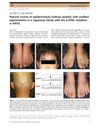
January 2019 in “Journal of Dermatology” The p.P25L mutation in the KRT5 gene causes a rare skin condition that worsens over time and may lead to hair loss starting in young adulthood.
March 1998 in “Journal of Dermatological Science” Keratin-associated proteins may have roles in various mouse tissues, not just hair.
 August 2019 in “Journal of Investigative Dermatology”
 The study found that tight junctions reach the top layer of the skin's stratum granulosum, not just the second top layer as previously thought.
112 citations
,
August 2012 in “The American Journal of Human Genetics” Mutations in the RBPJ gene cause Adams-Oliver Syndrome.
 June 2024 in “Synthetic and systems biotechnology”
 A fragment of human type XVII collagen shows great potential for skin health and wound healing.
1 citations
,
January 1989 Four antibodies were developed to help study hair follicle cell differentiation.
 9 citations
,
February 2018 in “The Journal of Dermatology”
9 citations
,
February 2018 in “The Journal of Dermatology” A new mutation in the LIPH gene was found to cause a rare hair disorder in a Japanese boy.
5 citations
,
October 2021 in “American Journal of Medical Genetics Part A” A new genetic variant causes BRESHECK syndrome by disrupting cell growth and stress response.
73 citations
,
November 2001 in “Journal of Investigative Dermatology Symposium Proceedings” Markers help differentiate between apocrine and eccrine sweat glands to identify sweat gland tumors.
30 citations
,
August 2008 in “The journal of investigative dermatology/Journal of investigative dermatology” TGase 3 helps build hair structure by forming strong bonds between proteins.
January 2005 in “Life sciences” Targeting LPA could help treat skin disorders.
43 citations
,
September 2009 in “Stem Cells” A nonviral method was developed to label and culture human hair follicle stem cells.
January 2019 in “DSpace@MIT (Massachusetts Institute of Technology)” Higher PHGDH levels cause unusual melanin buildup in hair follicles.
7 citations
,
August 2020 in “Plastic and reconstructive surgery. Global open” QR 678 and QR 678 Neo are safe and promote hair growth, potentially helping chemotherapy-induced hair loss.
7 citations
,
August 2008 in “Immunogenetics” A gene mutation in mice causes increased mast cells and disorganized hair follicles in their skin.
1 citations
,
April 2017 in “Journal of Investigative Dermatology” ZNF750 and MPZL3 are important in causing seborrheic dermatitis.
The agouti gene may help understand and treat obesity.
July 2024 in “Journal of Investigative Dermatology” PP405 may help hair growth by activating hair follicle stem cells.
36 citations
,
October 2015 in “Cell reports” Gab1 protein is crucial for hair growth and stem cell renewal, and Mapk signaling helps maintain these processes.
70 citations
,
December 2004 in “Proceedings of the National Academy of Sciences” BMP signaling affects hair color by interacting with the MC-1R pathway.
4 citations
,
October 2021 in “Journal of Clinical Medicine” Carriers of a specific gene mutation have subtle skin changes without visible symptoms.
158 citations
,
June 2014 in “Journal of Lipid Research” Lysophospholipids can act as anti-inflammatory agents through specific receptors, but more research is needed.
3 citations
,
May 2018 in “The Indian Journal of Animal Sciences” The KAP 7 gene affects wool traits in Rambouillet sheep, with the BB genotype showing the best wool characteristics.
11 citations
,
April 2012 in “Journal of Investigative Dermatology” A specific mutation in PA-PLA1α causes abnormal hair growth.
 3 citations
,
December 2022 in “npj Regenerative Medicine”
3 citations
,
December 2022 in “npj Regenerative Medicine” HSPGs help control stem cell behavior, affecting hair growth and offering a target for hair loss treatments.
32 citations
,
August 2020 in “American Journal Of Pathology” S100A4 promotes aggressive ovarian cancer and is a potential treatment target.