 May 2020 in “Hair transplant forum international”
 The updated NPRT system now covers different types of hair loss in men and women.
 4 citations
,
October 2022 in “Journal of Imaging”
4 citations
,
October 2022 in “Journal of Imaging” An intelligent system can classify hair follicles and measure hair loss severity with reasonable accuracy.
 125 citations
,
May 2007 in “Journal of The American Academy of Dermatology”
125 citations
,
May 2007 in “Journal of The American Academy of Dermatology” The BASP classification is a detailed and accurate way to categorize hair loss in both men and women.
 1 citations
,
January 2023 in “Annals of Dermatology”
1 citations
,
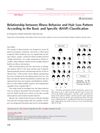
January 2023 in “Annals of Dermatology” The BASP classification helps predict patient behavior and improve treatment for hair loss.
 July 2007 in “Faculty Opinions – Post-Publication Peer Review of the Biomedical Literature”
 The BASP classification is a detailed system for categorizing hair loss in both men and women, but it may be complex for beginners and not fully suitable for grading female hair loss.
 May 2021 in “Pakistan Journal of Medical and Health Sciences”
 M type hair loss is the most common in Pakistani men.

EfficientNet improves accuracy in diagnosing hair loss stages.
 101 citations
,
January 2016 in “Journal of Cutaneous and Aesthetic Surgery”
101 citations
,
January 2016 in “Journal of Cutaneous and Aesthetic Surgery” Different types of hair loss need specific treatments, and while many classification systems exist, each has its flaws; more research is needed to refine these systems and treatments.
 16 citations
,
October 2012 in “The Journal of Dermatology”
16 citations
,
October 2012 in “The Journal of Dermatology” The BASP classification is more reliable than the Norwood-Hamilton for classifying hair loss in men and women.
 8 citations
,
January 2013 in “International Journal of Trichology”
8 citations
,
January 2013 in “International Journal of Trichology” The BASP classification is effective for diagnosing pattern hair loss in Indian men and women.
 November 2009 in “Hair transplant forum international”
 Dr. Bernard Cohen created a new system to classify hair loss using numbers and a detailed scalp map.
3 citations
,
January 2018 in “International Journal of Trichology” The new system helps detect and track early female hair loss better.
January 2022 in “Journal of Pharmaceutical Negative Results” The VGG-SVM method accurately identifies and classifies stages of Alopecia Areata and other hair loss conditions.
October 2022 in “Hair Transplantation” Male pattern hair loss is mainly caused by genetics and hormones, especially DHT.
 2 citations
,
June 2019 in “International Journal of Dermatology”
2 citations
,
June 2019 in “International Journal of Dermatology” The modified hair loss classification is more detailed but less user-friendly.
October 2022 in “Hair Transplantation” Female pattern hair loss affects many women and requires specialized care.
January 2016 in “프로그램북(구 초록집)” The revised BASP classification for hair loss is less accurate and harder to use but could still be a viable option.
 9 citations
,
January 2017 in “International Journal of Trichology”
9 citations
,
January 2017 in “International Journal of Trichology” No current system perfectly classifies male-pattern hair loss, indicating a need for a new system for better diagnosis and treatment.

Combining biomarker analysis and advanced algorithms improves hair loss detection accuracy.
March 2026 in “Frontiers in Medicine” A hybrid model using traditional methods, trichoscopy, and AI improves hair loss assessment.
 5 citations
,
January 2012 in “Dermatology”
5 citations
,
January 2012 in “Dermatology” Adapted classification better assesses male pattern hair loss and its link to heart disease.
Hair restoration surgery is becoming more common as male pattern baldness increases with age.
 2 citations
,
December 2021 in “Journal of Cosmetic Dermatology”
2 citations
,
December 2021 in “Journal of Cosmetic Dermatology” Platelet-rich plasma may help with hair loss by promoting hair growth.
1 citations
,
November 2024 VGG19 is more accurate, but MobileNetV2 is faster and uses fewer resources.

An automated system can accurately classify hair disorders using image analysis.
The optimized VGG19 model accurately classifies hair diseases with 98.64% accuracy.
 September 2023 in “International journal of Unani and integrative medicine”
 Hair loss patterns are linked to temperament and can help diagnose it.
The model accurately predicts hair loss severity in alopecia areata.
 5 citations
,
January 2020 in “Journal of Dermatology”
5 citations
,
January 2020 in “Journal of Dermatology” Temporal hair loss relates to overall scalp hair loss in women.
 50 citations
,
December 1998 in “Dermatologic Surgery”
50 citations
,
December 1998 in “Dermatologic Surgery” Hair loss is more common in men aged 18-49 and increases with age.