January 2025 in “Open University of Cape Town (University of Cape Town)” Lipids play a key role in determining hair curvature.
July 2019 in “Dermatologic Surgery” January 2022 in “Institutional Repositories DataBase (IRDB)” Pen-type microwells are best for forming hair follicle germ structures.
4 citations
,
November 2016 in “The Journal of Dermatology” Pili torti hair is fragile due to loose keratin filaments and weak disulfide bonds.
5 citations
,
January 1997 in “Birkhäuser Basel eBooks” Recognizing bamboo hair helps diagnose Netherton’s syndrome.
52 citations
,
May 2006 in “Journal of Structural Biology” Keratin-associated proteins help link filaments and affect keratin's strength.
 1 citations
,
June 2023 in “Journal of applied crystallography”
1 citations
,
June 2023 in “Journal of applied crystallography” The technique showed that human hair has two main parts, with 68% being rigid and the rest flexible, and water swelling affects its structure.
 January 2024 in “Indian Journal of Pharmaceutical Sciences”
 Relaxing certain muscles might straighten curly hair.
January 2016 in “Belarusian State Pedagogical University repository (Belarusian State Pedagogical University)” A 6-group geometric classification of human scalp hair is more reliable and objective for testing than an 8-group system.
January 2016 in “Dermatology online journal” A 15-year-old girl has a benign skin tumor on her neck.
24 citations
,
June 2003 in “Journal of Structural Biology” Sheet formation is key to macrofibril structure differences in wool.
14 citations
,
June 2005 in “PubMed” A rare ear cyst contained hair fragments.
 November 2021 in “International journal of research - granthaalayah”
 The document suggests that human hair has electrical charges because of a gap in nerve cell coverage that affects electromagnetic radiation.
12 citations
,
December 2011 in “Journal of Dermatological Science” The C-terminal tail of AHF/trichohyalin is essential for organizing keratin filaments in keratinocytes.
 1 citations
,
January 2018 in “Acta dermato-venereologica”
1 citations
,
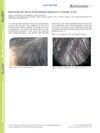
January 2018 in “Acta dermato-venereologica” A teenager's hair with alternating white and dark bands, known as Pili annulati, is a genetic condition that is usually harmless and often considered attractive.
2 citations
,
January 1993 Trichohyalin is a versatile protein involved in hair and skin structure.
28 citations
,
July 2000 in “PubMed” Hair structure forms the same way inside and outside the body.
35 citations
,
September 2003 in “Archives of dermatology” Tiger tail bands in hair are caused by wavy hair fibers with melanin, unlike straight fibers in normal hair.
 13 citations
,
May 2016 in “International journal of biological macromolecules”
13 citations
,
May 2016 in “International journal of biological macromolecules” Keratin's mechanical properties are influenced by hydrogen bonds and secondary structure, and can be improved with the SPD-2 peptide.
3 citations
,
March 2013 in “American Journal of Dermatopathology” Ossification in trichilemmal cysts is more common than previously believed.
7 citations
,
January 1990 in “Archives of Dermatological Research” Syringomas likely start in the upper dermis and form distinct luminal structures.
 29 citations
,
September 1989 in “Journal of The American Academy of Dermatology”
29 citations
,
September 1989 in “Journal of The American Academy of Dermatology” Abnormal scalp whorls can indicate brain development issues but may also be seen in neurologically normal people.
95 citations
,
January 2007 in “Human biology” Human hair can be classified into eight types based on physical features, not ethnicity.
7 citations
,
May 1988 in “International Journal of Dermatology” The patient's hair has unique structural differences with alternating bright and dark bands.
The model explains how mammal ear hair cells respond to sound and adapt.
 3 citations
,
May 2006 in “Dermatologic Surgery”
3 citations
,
May 2006 in “Dermatologic Surgery” Most men's multi-hair follicles naturally stand perpendicular to a line from the top of their head, which is important for natural-looking hair transplants.
The curly mutation in SELH/Bc mice affects hair and may help study human genetic disorders.
2 citations
,
March 2018 in “ACS Sustainable Chemistry & Engineering” Heating human hair creates hollow microtubes with smooth surfaces.