Children with Parry Romberg Syndrome had successful facial fat-grafting surgeries after disease stabilization with no complications.
 February 2019 in “Neoreviews”
 The infant with a urea cycle disorder improved with treatment and a liver transplant.
 December 2018 in “Journal of Patan Academy of Health Sciences”
 Many Chinese patients lose hair after weight loss surgery, especially women, and taking iron and zinc on their own doesn't help.
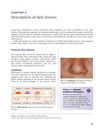
The document explains different types of skin lesions and their characteristics, causes, and related conditions.
 June 2016 in “American Journal of Cardiology”
 Endovascular repair and open surgery for abdominal aortic aneurysms both result in a temporary decline in physical health, with no significant mental health difference, and a return to near normal health in 90 days.
 September 2015 in “Philippine Journal of Internal Medicine”
 Recognizing and treating overlap syndrome in connective tissue diseases is crucial.
 August 2013 in “Gastroenterology”
 A 60-year-old man with Cronkhite-Canada syndrome improved with treatment, but the condition has a high mortality rate and a risk of colorectal cancer.
 April 2013 in “Journal of the American Academy of Dermatology”
 Diabetic patients often have ingrown nails due to obesity, high blood pressure, past injuries, bad nail trimming, nail fungus, weak foot pulse, and weak knee reflex.
Low-level laser therapy combined with Neoptide improved hair regrowth better than either treatment alone in rats.
 May 2012 in “Research and reports in neonatology”
 The newborn with Klippel-Trénaunay syndrome was healthy but needed regular check-ups for possible complications.
 June 2011 in “CRC Press eBooks”
 Low-Level Laser Therapy can stimulate healing and cell function, potentially leading to wider medical use.
 December 2010 in “Actas Urológicas Españolas”
 Taking dutasteride for one month before prostate surgery can reduce bleeding.

Oral iron therapy may help reduce hair loss in iron-deficient women.
 February 2009 in “Journal of the American Academy of Dermatology”
 Transverse sections are better for non-scarring hair loss, vertical sections are better for lichen planopilaris, and either method works for other scarring hair loss types.
 January 2009 in “International Journal of Trichology”
 Dr. Shyam B Verma encourages more scientific research on hair disorders and criticizes the unscientific hair care market in India.
 October 2003 in “Journal of Investigative Dermatology Symposium Proceedings”
 Mice treatments didn't grow hair, a patient treatment may affect immune response, and people with hair loss often feel anxious or depressed.
 January 2003 in “Annals of Dermatology”
 Iron deficiency can cause hair abnormalities, but taking iron can fix them and stop hair loss.
 April 1978 in “Pediatric research”
 Patients with anorexia nervosa did not show a correlation between zinc levels and taste perception or the severity of their condition.
 April 1963 in “Archives of Dermatology”
 Dermatological conditions are complex and treatments often have mixed results.
Iron and zinc deficiencies may be treated to help female hair loss.
 February 2013 in “Journal of The American Academy of Dermatology”
 Finasteride solution helps treat hair loss.
 January 2012 in “Yearbook of Dermatology and Dermatologic Surgery”
 No significant difference in iron deficiency between women with or without hair loss.
July 2025 in “International Journal of Dermatology”  13 citations
,
August 2016 in “Medical Hypotheses”
13 citations
,
August 2016 in “Medical Hypotheses” Hair characteristics might be early signs of Type 2 Diabetes and could help with early prevention.
 October 2004 in “Australian Prescriber”
 Agalsidase alfa helps treat Fabry's disease but needs more research for long-term benefits.
 11 citations
,
January 2013 in “Indian Journal of Endocrinology and Metabolism”
11 citations
,
January 2013 in “Indian Journal of Endocrinology and Metabolism” Skin problems are common in people with diabetes and controlling blood sugar can reduce these issues.
8 citations
,
June 2001 in “Journal of Biological Chemistry” A truncated protein linked to breast cancer may change cell adhesion.
18 citations
,
October 2014 in “Indian Journal of Dermatology” Patients with alopecia areata have lower RBC folate levels, especially in severe cases.
48 citations
,
September 2011 in “British Journal of Dermatology” Epigenetic changes in blood cells may contribute to alopecia areata.
Screening for iron levels in patients with hair loss may help find a genetic iron overload condition early.