6 citations
,
June 1983 in “Cancer” A six-drug treatment for metastatic breast cancer showed promising results with low side effects, especially in premenopausal women.
 32 citations
,
September 2018 in “Clinical Obstetrics and Gynecology”
32 citations
,
September 2018 in “Clinical Obstetrics and Gynecology” Hormone therapy for transgender females increases the risk of blood clots and requires careful dosing, monitoring, and lifelong management.
 7 citations
,
December 2021 in “Curēus”
7 citations
,
December 2021 in “Curēus” Breast cancer skin metastases are rare, look different, and can be confused with other skin issues, so a biopsy is needed for accurate diagnosis.
 5 citations
,
October 2014 in “Gynecological Endocrinology”
5 citations
,
October 2014 in “Gynecological Endocrinology” Triptorelin helps evaluate hormone production in Sertoli-Leydig cell tumors.
8 citations
,
June 2001 in “Journal of Biological Chemistry” A truncated protein linked to breast cancer may change cell adhesion.

Benign ovarian tumors can cause excess male hormones and related conditions in postmenopausal women.
35 citations
,
April 1998 in “PubMed” Activated erbB-2 in mice skin causes severe skin and hair abnormalities.
December 2020 in “Research Square (Research Square)” Rare ovarian tumors can cause increased male hormones in postmenopausal women; surgery is an effective treatment.
15 citations
,
September 2014 in “PloS one” The study found that analyzing certain cell signaling pathways is not a reliable method to tell apart two types of skin tumors.
 59 citations
,
December 2016 in “Supportive Care in Cancer”
59 citations
,
December 2016 in “Supportive Care in Cancer” Core symptoms in breast cancer chemotherapy remain stable, aiding targeted interventions.
 5 citations
,
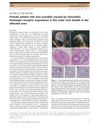
August 2012 in “Journal of Dermatology”
5 citations
,
August 2012 in “Journal of Dermatology” Tamoxifen may cause female hair loss by increasing androgen receptor expression.
 January 2013 in “Revista Clínica Española”
 A postmenopausal woman's increased male hormone levels were successfully treated with surgery.

A woman's excess male hormone symptoms were caused by a rare benign tumor in her ovary.
December 2024 in “AACE Clinical Case Reports” Ovarian hyperthecosis can cause polycythemia, and surgery can normalize symptoms.
June 2020 in “AACE clinical case reports” A woman's severe male hormone excess was caused by a small, hard-to-find ovarian tumor.
 28 citations
,
August 2003 in “Steroids”
28 citations
,
August 2003 in “Steroids” Hirsute women have lower type 2 17β-HSD enzyme levels, which improve with treatment.
42 citations
,
January 2003 in “International Journal of Gynecological Pathology” PEH in vulvar LS is common and needs careful diagnosis to avoid confusion with cancer.
1 citations
,
March 2005 in “Zentralblatt für Gynäkologie” A postmenopausal woman had high testosterone from her right adrenal gland, leading to recommended surgery.
Hirsutism is excessive male-pattern hair growth in women, often treated cosmetically or with hormone therapy if contraception is also desired.
6 citations
,
March 2018 in “The American journal of dermatopathology/American journal of dermatopathology” BerEP4 and CD34 staining can help tell apart tricholemmoma from basal cell carcinoma.
January 2015 in “Journal of pediatric endocrinology & metabolism/Journal of pediatric endocrinology and metabolism” A 5-year-old girl with McCune-Albright syndrome grew abnormal hair due to the drug tamoxifen.
February 2025 in “Clinical Chemistry” The woman's symptoms were due to an androgen-secreting tumor, not PCOS.
 56 citations
,
February 2006 in “American journal of physiology. Cell physiology”
56 citations
,
February 2006 in “American journal of physiology. Cell physiology” Steroid sex hormones activate matriptase in prostate cancer cells but not in breast cancer cells.
 April 2019 in “Journal of the Endocrine Society”
 The study found that imaging might miss small ovarian tumors causing high testosterone, and suggested using certain testosterone levels and treatment responses to identify these tumors.
 June 2026 in “Romanian Journal of Medical Practice”
 Surgery resolved hormone imbalance and symptoms in a rare ovarian tumor case in an elderly woman.
October 2025 in “Frontiers in Toxicology” A new method effectively predicts estrogen-related health effects for early screening.
6 citations
,
April 2010 in “The American Journal of Surgical Pathology” Trichoblastoma in the breast can be mistaken for cancer, so expert review is crucial to avoid misdiagnosis.
 1 citations
,
January 2018 in “Journal of Gynecologic Surgery”
1 citations
,
January 2018 in “Journal of Gynecologic Surgery” Removing both ovaries can treat increased testosterone and related symptoms in postmenopausal women with ovarian hyperthecosis.
 May 2025 in “Cellular Oncology”
 Blocking both P-cadherin and c-Met can effectively stop head and neck cancer growth.
 4 citations
,
May 2021 in “The American Journal of Surgical Pathology”
4 citations
,
May 2021 in “The American Journal of Surgical Pathology” Cutaneous Lymphadenoma is a unique skin tumor with specific protein markers and common gene mutations that may cause continuous cell growth.