 1 citations
,
February 2018 in “Australasian journal of dermatology”
1 citations
,
February 2018 in “Australasian journal of dermatology” Advanced imaging techniques are crucial for accurately diagnosing Monilethrix, a rare hair disorder.
10 citations
,
September 1994 in “International Journal of Dermatology” Three Iranian men had reddish-brown facial pigmentation with no effective treatment.
5 citations
,
June 2008 in “British Journal of Dermatology” 20 citations
,
August 2003 in “Clinical and Experimental Dermatology” A new genetic mutation in the hairless gene causes a rare hair loss disorder.
12 citations
,
March 2004 in “Journal of Investigative Dermatology”  21 citations
,
November 1981 in “Archives of Dermatology”
21 citations
,
November 1981 in “Archives of Dermatology” Ashy dermatosis may be linked to atopy and thyroid disease and can be treated with topical steroids.
17 citations
,
April 1997 in “American Journal of Dermatopathology” PC-associated alopecia has unique microscopic features.
October 2024 in “Developmental Dynamics” Recent advances show zebrafish can model anemia, Alx4 affects craniofacial and hair development, and mTORC1 is crucial for retinal development.
 3 citations
,
August 2010 in “Anais brasileiros de dermatologia/Anais Brasileiros de Dermatologia”
3 citations
,
August 2010 in “Anais brasileiros de dermatologia/Anais Brasileiros de Dermatologia” A rare genetic disease caused severe, worsening hair loss from early childhood with poor treatment results.
175 citations
,
September 1998 in “British Journal of Dermatology” Keratin 17 gene mutations cause both steatocystoma multiplex and pachyonychia congenita type 2.
49 citations
,
April 2007 in “Pediatric Dermatology” Biotin improved hair appearance in uncombable hair syndrome but didn't change hair structure.
5 citations
,
October 2012 in “Australian veterinary journal” Two Australian Poll Hereford calves had severe anaemia, abnormal red blood cells, and skin issues.
4 citations
,
November 2020 in “Case reports in dermatology” A rare skin condition causes red, dark, bumpy facial lesions.
87 citations
,
August 1974 in “Journal of Investigative Dermatology” 2 citations
,
May 2022 in “International journal of trichology” Plica neuropathica is a tangled hair condition that may be caused by hair damage or psychiatric issues and is treated by cutting the hair and addressing mental health.
April 2025 in “Indian Journal of Paediatric Dermatology” Trichorrhexis invaginata can occur with tinea capitis, though it's rare.
 39 citations
,
January 2011 in “Archives of Dermatology”
39 citations
,
January 2011 in “Archives of Dermatology” Reflectance confocal microscopy confirms that yellow dots are signs of damaged hair follicles in alopecia areata.
 14 citations
,
July 2012 in “Journal of the American Academy of Dermatology”
14 citations
,
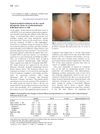
July 2012 in “Journal of the American Academy of Dermatology” Topical tacalcitol ointment can help improve symptoms of EFFC.
Spiny keratoderma is a rare skin condition with small spines on palms and soles, possibly linked to abnormal hair formation.
 11 citations
,
May 2011 in “World Journal of Pediatrics”
11 citations
,
May 2011 in “World Journal of Pediatrics” The document emphasizes the importance of correctly identifying and classifying genetic hair disorders to help diagnose related health conditions.
9 citations
,
December 2012 in “Indian Journal of Dermatology Venereology and Leprology” Two sisters had rare, widespread cysts and complete hair loss, suggesting a genetic link.
20 citations
,
October 2005 in “Archives of Dermatological Research”  January 2023 in “Pesquisa Veterinária Brasileira”
 A KRT71 mutation in Hereford cattle in Uruguay causes thin, curly hair and scaly skin.
18 citations
,
May 2023 in “Science Advances” Activating the sonic hedgehog pathway in chicken embryos can permanently change scales to feathers.
 April 2017 in “The journal of investigative dermatology/Journal of investigative dermatology”
 Astrotactin2 affects hair follicle orientation and skin cell polarity.
November 2017 in “Arthritis Care & Research” November 2025 in “Indian Journal of Dermatology” Early diagnosis and multidisciplinary care are crucial for improving the quality of life in patients with ectodermal dysplasia.
 April 2016 in “The journal of investigative dermatology/Journal of investigative dermatology”
 MPZL3 is crucial for seborrheic dermatitis development.
Recognizing mild or atypical cases of ectodermal dysplasia is crucial for better treatment and future planning.
2 citations
,
October 2018 in “Skin appendage disorders” A boy's hair that was frizzy and hard to comb returned to normal after 9 months, possibly due to genetic factors.