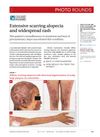
 March 2022 in “The Journal of Family Practice”
 Following treatment plans is crucial to prevent worsening skin and hair conditions.
 October 2021 in “Research Square (Research Square)”
 Melatonin affects certain genes and pathways involved in cashmere goat hair growth.
 June 2021 in “Research Square (Research Square)”
 Melatonin can increase cashmere yield by altering gene expression and restarting the growth cycle early.

A man with four autoimmune diseases suggests a new category for multiple autoimmune syndrome.
 November 2020 in “International journal of contemporary pediatrics”
 Two siblings had a rare immune disorder caused by a FOXN1 gene mutation.
 May 2020 in “bioRxiv (Cold Spring Harbor Laboratory)”
 The study found that certain genes are important for hedgehog skin appendage development and immunity, with spines possibly evolving for protection and infection resistance.
 June 2018 in “Surgical Case Reports”
 S-1 treatment led to a complete response in pancreatic cancer with manageable side effects.
 December 2017 in “Revista Brasileira de Saúde Materno Infantil”
 Pregnant women with Systemic Lupus Erythematosus have a higher risk of blood clotting problems.
A thorough skin history and examination are essential for diagnosing and treating skin conditions effectively.
 May 2017 in “InTech eBooks”
 Some hair loss disorders cause permanent loss due to scarring, and treatments like steroids don't always work well.
 January 2017 in “Springer eBooks”
 The document explains various skin conditions and their treatments.
 January 2017 in “Springer eBooks”
 The document concludes that Cutaneous Lupus Erythematosus has different forms, is influenced by genetic and environmental factors, and can be treated with various medications, but more targeted therapies are needed.
 November 2016 in “Therapeutic Delivery”
 New drugs for Alzheimer's and rheumatoid arthritis advanced, a Zika vaccine is in development, and there were business deals in anesthesia and oncology.
 July 2016 in “American Journal of Dermatopathology”
 The meeting showcased rare skin disease cases, highlighting the need for accurate diagnosis and treatment.

Lichen planopilaris and frontal fibrosing alopecia are likely the same disease with different clinical appearances.

The document provides 70 multiple choice questions to improve haematology skills.

The document tests knowledge and decision-making in hematology through multiple-choice questions.
 January 2016 in “Springer eBooks”
 Understanding drug interactions, side effects, and patient-specific factors is crucial for effective dermatological care.
 June 2015 in “Journal of the turkish academy of dermatology”
 Eating the right foods is important for skin health and can help treat some skin conditions.
Lupus is a complex disease that requires personalized treatment because it varies greatly between individuals.
Any medication can cause skin reactions, some due to allergies and others due to dosage or genetic factors.
Different connective tissue disorders have unique symptoms and treatments, with varying outcomes and often require ongoing care from a specialist.
 April 2014 in “Jurnal Biomedik : JBM”
 An 8-year-old girl had nail and hair issues that improved without specific treatment, but fungal nail infection was hard to cure.
 March 2014 in “Journal of The American Academy of Dermatology”
 The document lists various dermatology topics, treatments, and diagnostic methods.
 July 2011 in “British Journal of Dermatology”
 Dermatologists give better information on pathology forms, hypersensitivity vasculitis is a common skin issue, misdiagnoses can occur, and various skin conditions are linked to loss of elastin or genetic factors.

Accurate diagnosis of cicatricial alopecias requires thorough scalp examination and multiple biopsy techniques.
 January 2010 in “Nihon Hou Kagaku Gijutsu Gakkaishi”
 The modified staining method can determine the ABO blood group of hair samples accurately.
 January 2010 in “Elsevier eBooks”
 The document concludes that different types of hair loss have specific treatments, and early diagnosis is crucial for preventing permanent hair loss.
 November 2009 in “Medical & surgical dermatology”
 The document concludes that Borrelia afzelii causes a skin condition in France, a gene is linked to hair loss in Caucasian women, and various genetic mutations affect skin diseases.
 January 2009 in “Springer eBooks”
 The document concludes that managing skin conditions during pregnancy is important and requires specialized care.