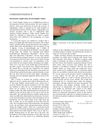
 May 2002 in “British Journal of Dermatology”
 A pregnant woman's skin condition improved after giving birth, possibly due to high estrogen levels during pregnancy.
 June 2001 in “Proceedings of SPIE”
 Low energy laser therapy effectively treats certain skin conditions and improves recovery time without side effects.
 May 1991 in “Current problems in dermatology”
 Skin issues can indicate immune system problems.
 January 1985 in “Japanese Journal of Clinical Immunology”
 Dental procedures and immunosuppressants can lead to heart infections in lupus patients.
January 1984 in “Japanese Journal of Clinical Immunology” A woman with lupus developed a rare skin condition, which improved with increased medication.
 January 1982 in “Japanese Journal of Clinical Immunology”
 Soft-tissue calcification is rare in systemic lupus erythematosus.
 July 2008 in “British Journal of Dermatology”
 Cyclosporin doesn't stop hair loss.
 May 2002 in “British Journal of Dermatology”
 Hair loss caused by longer latent hair cycle and sudden miniaturization, not gradual follicle size reduction.
3 citations
,
February 2023 in “Frontiers in Immunology” The IGRA test effectively detects past SARS-CoV-2 exposure, especially using nucleocapsid peptides.
 103 citations
,
January 2009 in “Carbon”
103 citations
,
January 2009 in “Carbon” Pure carbon nanotubes are safe for mice, but impure ones cause immune issues and hair loss.
 December 2025 in “Open Repository of the University of Porto (University of Porto)”
 Pharmacists play a crucial role in improving patient outcomes through personalized care and staying updated with scientific advancements.
 6 citations
,
August 2014 in “Sri Lanka Journal of Diabetes Endocrinology and Metabolism”
6 citations
,
August 2014 in “Sri Lanka Journal of Diabetes Endocrinology and Metabolism” The FG score is better at detecting hyperandrogenism in PCOS patients than testosterone levels or FAI, but testosterone is the recommended test for diagnosis.
7 citations
,
February 2023 in “Journal of Dermatological Treatment” The Scalp Photographic Index (SPI) is a reliable tool for assessing scalp conditions.
March 2026 in “Journal of Investigative Dermatology” Generative AI tools like GPT-4o can effectively automate SALT scoring for alopecia areata, matching clinician accuracy.
March 2026 in “Pediatric Dermatology” Generative AI tools can accurately score alopecia areata, reducing subjectivity in evaluations.
 2 citations
,
January 2013 in “Türkiye klinikleri tıp bilimleri dergisi”
2 citations
,
January 2013 in “Türkiye klinikleri tıp bilimleri dergisi” The study suggests using a score of 11 on the mFG scale to diagnose hirsutism in Turkish women, with adjustments for age, skin type, and family history.
5 citations
,
April 2024 in “JAAD International” AI can accurately measure hair loss severity in alopecia areata.
 6 citations
,
March 2018 in “Hair transplant forum international”
6 citations
,
March 2018 in “Hair transplant forum international” The Graft Quality Index grades hair transplant grafts to predict placement difficulty and surgery results.
 5 citations
,
June 2016 in “TURKDERM”
5 citations
,
June 2016 in “TURKDERM” Scoring systems help doctors assess and treat skin diseases effectively.
14 citations
,
January 2003 in “Skin Research and Technology” The new scalp coverage scoring method accurately measures hair loss and growth in men.
 13 citations
,
July 1996 in “Annals of Internal Medicine”
13 citations
,
July 1996 in “Annals of Internal Medicine” International medical graduates outperformed U.S. graduates on an internal medicine exam.
 1 citations
,
September 2023 in “Baghdad Journal of Biochemistry and Applied Biological Sciences”
1 citations
,
September 2023 in “Baghdad Journal of Biochemistry and Applied Biological Sciences” The mFG score is effective for diagnosing hirsutism.
 1 citations
,
January 2024 in “Archives of Endocrinology and Metabolism”
1 citations
,
January 2024 in “Archives of Endocrinology and Metabolism” Self-assessed hirsutism scores are not reliable for clinical diagnosis but may help in screening.
 July 1996 in “Annals of Internal Medicine”
 In 1995, international medical graduates did better than U.S. graduates on a medical exam.
 10 citations
,
June 2010 in “Fertility and Sterility”
10 citations
,
June 2010 in “Fertility and Sterility” Patients with PCOS tend to score their hirsutism higher than clinicians, making self-scoring less useful for diagnosis.
 May 2025 in “Journal of Investigative Medicine”
 FAI is a better marker for predicting female hair loss than testosterone or SHBG alone.
 1 citations
,
December 2022 in “JAMA Dermatology”
1 citations
,
December 2022 in “JAMA Dermatology” The AI system HairComb accurately scores hair loss severity, matching dermatologist assessments.
January 2025 in “Mansoura Medical Journal” Serum IMA levels don't help diagnose AGA but may indicate its severity.
 4 citations
,
May 2019 in “Zeitschrift für Naturforschung C”
4 citations
,
May 2019 in “Zeitschrift für Naturforschung C” Ishige sinicola extract helps bone-building cells grow and mature, which could aid in treating osteoporosis.
 2 citations
,
December 2018 in “International Journal of Dermatology”
2 citations
,
December 2018 in “International Journal of Dermatology” New grading scale accurately measures hair loss severity and treatment effectiveness.