 January 2024 in “International journal of Indian medicine”
 Ayurvedic practices can help prevent and manage hair problems.
 June 2023 in “LA Referencia (Red Federada de Repositorios Institucionales de Publicaciones Científicas)”
 Home photobiomodulation therapy can improve life quality and mobility for disabled individuals.
 April 2023 in “Research Society and Development”
 Corticosteroids are safe and effective for treating Alopecia Areata.
 January 2023 in “Open veterinary journal”
 A cat developed skin problems from a certain brand of injected water pills, which went away after switching brands.
 December 2022 in “Exploratory animal and medical research”
 The study concluded that Acral lick dermatitis is most common in young male Labrador retrievers, often caused by psychological factors, and leads to skin inflammation and stress-related blood changes.
Clinical signs don't match inflammation levels in lichen planopilaris and frontal fibrosing alopecia.
 March 2022 in “Brazilian Journal of Health Review”
 COVID-19 can cause a type of hair loss that usually starts 3-6 months after the illness, and treatment includes stress reduction and hair care products like Minoxidil.
Ruxolitinib cream shows promise for vitiligo, and early melanoma diagnosis is crucial.
Topical Minoxidil is effective for hair loss after COVID-19.
Biotin boosts wool growth and follicle health in sheep.
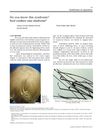
The document concludes that Loose Anagen Hair Syndrome is a benign condition where hair is thin and easily pulled out, often improving with age.
 July 1980 in “Journal of The American Academy of Dermatology”
 The conference concluded that understanding hair and nail disorders is important, iron deficiency may be linked to hair loss, and while some treatments for skin conditions are effective, they may have risks and high costs.
Hair loss can cause significant social and emotional issues, especially for women and young men.
 January 2026 in “Forum Dermatologicum”
 LED therapy is safe and can help with acne, aging skin, and hair loss, but consumer devices may be less effective.
 65 citations
,
March 2016 in “Lasers in Medical Science”
65 citations
,
March 2016 in “Lasers in Medical Science” Most low-level light therapy studies did not accurately report how light was measured, affecting treatment reliability.
 August 2025 in “Photodermatology Photoimmunology & Photomedicine”
 LED therapy is a promising, non-invasive skin treatment, but needs standardization and personalization.
 8 citations
,
November 2020 in “Optics and Laser Technology”
8 citations
,
November 2020 in “Optics and Laser Technology” LED light therapy is effective for skin and hair treatments but requires careful use to minimize risks.
 2 citations
,
July 2004 in “Proceedings of SPIE, the International Society for Optical Engineering/Proceedings of SPIE”
2 citations
,
July 2004 in “Proceedings of SPIE, the International Society for Optical Engineering/Proceedings of SPIE” Near-infrared laser therapy with Indocyanine Green dye improves acne by reducing inflammation without side effects.
January 2005 in “Cosmetic Surgery Times” Infrared light therapy helps regrow hair.
April 2020 in “The Aesthetics” LED-LLLT helps heal wounds, reduce pain, and regrow hair using specific light wavelengths.
 62 citations
,
July 2018 in “Lasers in Medical Science”
62 citations
,
July 2018 in “Lasers in Medical Science” LED therapy is safe and shows potential for treating skin conditions and promoting hair growth, but more research is needed.
1 citations
,
April 2008 in “Experimental Dermatology” Hidradenitis suppurativa may mainly affect vellus hair follicles, not terminal ones.
33 citations
,
October 2016 in “Photomedicine and laser surgery” Future clinical uses of Intense Pulsed Light (IPL) are likely to grow and become more effective with new advancements and combined treatments.
October 2013 in “CRC Press eBooks” Low-level light therapy is used in cosmetics and dermatology to repair skin, reduce inflammation, and treat various skin conditions.
1 citations
,
February 2025 in “Photodermatology Photoimmunology & Photomedicine” 830 nm LED light effectively treats and prevents skin redness and dark spots, while 590 nm LED light only helps prevent them.
15 citations
,
June 2021 in “Medicina” Combined light therapy improves eye health and quality of life for those with meibomian gland dysfunction.
 January 2026 in “American Journal of Medical and Clinical Research & Reviews”
 Different wavelengths of LED light are needed to treat different types of hair loss effectively.
 108 citations
,
December 2003 in “Lasers in surgery and medicine”
108 citations
,
December 2003 in “Lasers in surgery and medicine” ICG-enhanced NIR laser therapy may be a promising acne treatment with improvement and no side effects.
 March 2024 in “GSC Advanced Research and Reviews”
 Different light affects cell functions and can help treat skin conditions.
 9 citations
,
January 2018 in “Medical research archives”
9 citations
,
January 2018 in “Medical research archives” Low-intensity light therapy is effective for skin healing, reducing inflammation, and treating various skin conditions.