 2 citations
,
January 2023 in “Curēus”
2 citations
,
January 2023 in “Curēus” Low-dose naltrexone may help reduce redness in certain scalp conditions.
 2 citations
,
January 2019 in “Skin appendage disorders”
2 citations
,
January 2019 in “Skin appendage disorders” Higher social status is linked to earlier diagnosis and better treatment results for Frontal Fibrosing Alopecia in women.
 2 citations
,
January 2017 in “Przegla̧d dermatologiczny”
2 citations
,
January 2017 in “Przegla̧d dermatologiczny” Two trichoscopic patterns found in hair loss: diffuse fibrotic and androgenetic alopecia, affecting treatment choice and regrowth chances.
 1 citations
,
September 2023 in “Acta dermato-venereologica”
1 citations
,
September 2023 in “Acta dermato-venereologica” Certain genetic variants are linked to frontal fibrosing alopecia in Spanish patients.
 1 citations
,
October 2008 in “Expert Review of Dermatology”
1 citations
,
October 2008 in “Expert Review of Dermatology” Frontal Fibrosing Alopecia is a slowly progressing hair loss condition, likely underdiagnosed, with ineffective treatments, needing more research to understand it fully.
 July 2025 in “Revista Eletrônica Acervo Científico”
 Hydroxychloroquine is most effective for scarring alopecias, especially when combined with other treatments.

Frontal fibrosing alopecia can be managed with personalized combination therapies, but no cure exists yet.
 December 2023 in “Portuguese journal of dermatology and venereology”
 Trichoscopy can reliably distinguish between alopecia areata and trichotillomania.
 August 2023 in “International journal of research and review”
 Homeopathy can effectively treat pattern hair loss by using remedies like Lycopodium Clavatum and Natrum Muriaticum, tailored to the patient's overall condition.
 July 2022 in “Research Square (Research Square)”
 Lower PPARγ levels and specific gene variations are linked to more severe Frontal Fibrosing Alopecia.
 January 2021 in “Türkiye klinikleri dermatoloji dergisi”
 Eyebrow loss in frontal fibrosing alopecia is common and may be linked to other health issues.
 December 2020 in “Skin appendage disorders”
 A young man with an unusual type of scarring hair loss suggests a possible new variant of a known scalp condition.
 October 2018 in “InTech eBooks”
 The most effective treatments for hair loss are minoxidil, finasteride, PRP, and hair transplants, with steroids and immunosuppressants for autoimmune types.

Antimalarial agents are effective for LPP, and intralesional steroids are effective for FFA.
 July 2018 in “Nasza Dermatologia Online”
 Frontal fibrosing alopecia and ulerythema ophryogenes may be related and can evolve from one to the other.
 March 2018 in “Dermatología Argentina”
 The study found that the average age of women diagnosed with Frontal Fibrosing Alopecia in Argentina is higher than in other countries, but their symptoms are similar.
 May 2007 in “Dermatologic Therapy”
 Hair care practices like using relaxers and tight braiding can lead to permanent hair loss in black women.
 June 2022 in “Revista del Hospital Italiano de Buenos Aires”
 A rare case of a man having both frontal fibrosing alopecia and vitiligo was reported.
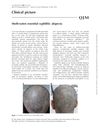 3 citations
,
July 2014 in “QJM”
3 citations
,
July 2014 in “QJM” A 35-year-old man had patchy hair loss that was actually due to syphilis, not alopecia areata.

Herbal therapies for alopecia show promise but need more research for safety and effectiveness.
 January 2021 in “Skin appendage disorders”
 The report concludes that atypical Brauer nevus is more common in males, present at birth, and often misdiagnosed due to its unusual scalp locations.
 44 citations
,
November 1998 in “Australasian Journal of Dermatology”
44 citations
,
November 1998 in “Australasian Journal of Dermatology” Accurate diagnosis is key for treating different kinds of hair loss, and immune response variations may affect the condition and treatment results.
 102 citations
,
April 2014 in “International Journal of Dermatology”
102 citations
,
April 2014 in “International Journal of Dermatology” The treatment helped reduce symptoms and stabilize the hairline in most patients with Frontal Fibrosing Alopecia, but hair regrowth was limited.
 98 citations
,
January 2013 in “Journal of The American Academy of Dermatology”
98 citations
,
January 2013 in “Journal of The American Academy of Dermatology” Dutasteride may help stabilize Frontal Fibrosing Alopecia, but more research is needed.
 62 citations
,
June 2015 in “The Journal of Dermatology”
62 citations
,
June 2015 in “The Journal of Dermatology” People with alopecia areata have more Th17 cells and fewer Treg cells, which may be key to the condition's development.
 58 citations
,
January 2018 in “International Journal of Women's Dermatology”
58 citations
,
January 2018 in “International Journal of Women's Dermatology” Alopecia significantly lowers women's quality of life, with psychological and social challenges, highlighting the importance of early treatment and support.
 44 citations
,
July 2005 in “Aesthetic Plastic Surgery”
44 citations
,
July 2005 in “Aesthetic Plastic Surgery” Hair transplantation successfully treated a woman's hair loss caused by a tight ponytail.
 39 citations
,
March 2018 in “Archives of Dermatological Research”
39 citations
,
March 2018 in “Archives of Dermatological Research” Androgens may block hair growth signals, targeting this could treat hair loss.
 37 citations
,
June 2011 in “Journal of The American Academy of Dermatology”
37 citations
,
June 2011 in “Journal of The American Academy of Dermatology” Loss of sebaceous glands and inflammation may contribute to the development of scarring alopecia.
 29 citations
,
June 2013 in “Journal of the Saudi Society of Dermatology & Dermatologic Surgery”
29 citations
,
June 2013 in “Journal of the Saudi Society of Dermatology & Dermatologic Surgery” Alopecia areata is an autoimmune hair loss condition treated with corticosteroids, and histologic confirmation is the best diagnosis method.