 10 citations
,
November 2016 in “International Journal of Cosmetic Science”
10 citations
,
November 2016 in “International Journal of Cosmetic Science” A tough membrane between the outer and inner layers of human hair protects it from damage.
 2 citations
,
January 2015 in “Sen'i Gakkaishi”
2 citations
,
January 2015 in “Sen'i Gakkaishi” Washing permed hair after using thioglycolic acid helps reform strong bonds, making hair stronger.
NaOH treatment improves hair strength and suitability for textiles.
65 citations
,
March 2017 in “Experimental Dermatology” Curly hair is influenced by specific genetic variations.
42 citations
,
July 2015 in “PLoS ONE” The study revealed the detailed structure of a keratin dimer, aiding understanding of how intermediate filament proteins function.
 10 citations
,
September 2020 in “Biopolymers”
10 citations
,
September 2020 in “Biopolymers” Hair's structure and properties change with pH; acidic pH maintains strength and less swelling, while alkaline pH increases water content and swelling.
 42 citations
,
January 2009 in “Colloids and Surfaces B: Biointerfaces”
42 citations
,
January 2009 in “Colloids and Surfaces B: Biointerfaces” A certain surfactant sticks to human hair, making it change from water-repelling to water-attracting, which could help in hair conditioning.
 14 citations
,
September 1954 in “Textile Research Journal”
14 citations
,
September 1954 in “Textile Research Journal” Hair absorbs different substances from solutions based on pH levels.
 4 citations
,
March 2021 in “Journal of Surfactants and Detergents”
4 citations
,
March 2021 in “Journal of Surfactants and Detergents” Shampoo B, which uses water-soluble silicone, is better at detangling hair in wet conditions due to its two-layer conditioning film.
 1 citations
,
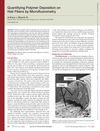
July 2019 in “Microscopy Today”
1 citations
,
July 2019 in “Microscopy Today” Microfluorometry effectively measures how much polymer coats and penetrates hair, useful for evaluating hair products.
 47 citations
,
June 1996 in “International Journal of Legal Medicine”
47 citations
,
June 1996 in “International Journal of Legal Medicine” Hair analysis for drugs needs a better understanding of how drugs enter hair, considering factors like hair structure and pigmentation.
 8 citations
,
November 2022 in “International Journal of Cosmetic Science”
8 citations
,
November 2022 in “International Journal of Cosmetic Science” Human hair varies widely and should be classified by curl type rather than race.
 2 citations
,
February 2024 in “Nature cell biology”
2 citations
,
February 2024 in “Nature cell biology” Mechanical forces are crucial for shaping cells and forming tissues during development.
 4 citations
,
October 2017 in “Advances in tissue engineering & regenerative medicine”
4 citations
,
October 2017 in “Advances in tissue engineering & regenerative medicine” Researchers created a potential skin substitute using a biodegradable mat that supports skin cell growth and layer formation.
 161 citations
,
July 2003 in “ACM Transactions on Graphics”
161 citations
,
July 2003 in “ACM Transactions on Graphics” Researchers developed a new model for more realistic computer graphics rendering of hair by considering how light scatters on hair fibers.
Researchers developed a new model for more realistic computer graphics of hair by considering how light scatters on hair fibers.
 21 citations
,
January 1995 in “Journal of the American Institute for Conservation”
21 citations
,
January 1995 in “Journal of the American Institute for Conservation” A new method extracts red dyes from wool without damaging it, although it slightly weakens the wool.
 15 citations
,
December 2015 in “Textile Research Journal”
15 citations
,
December 2015 in “Textile Research Journal” Adding amber particles to polyamide fibers makes them suitable for medical textiles like compression socks.
 11 citations
,
February 2019 in “Frontiers in Physiology”
11 citations
,
February 2019 in “Frontiers in Physiology” Hair properties are interconnected; a comprehensive, cross-disciplinary approach is essential for understanding hair behavior.
 8 citations
,
March 2018 in “Expert Review of Respiratory Medicine”
8 citations
,
March 2018 in “Expert Review of Respiratory Medicine” Inhalation therapy may repair and protect elastin in the lungs of COPD patients.
 5 citations
,
October 2011 in “Small ruminant research”
5 citations
,
October 2011 in “Small ruminant research” Goat hair growth and follicle activity change with the seasons and differ between males and females.
 4 citations
,
June 2021 in “Scientific Reports”
4 citations
,
June 2021 in “Scientific Reports” Hair fiber shape and curvature are not significantly linked when ancestry is considered.
 3 citations
,
July 2012 in “Sokoto Journal of Veterinary Sciences”
3 citations
,
July 2012 in “Sokoto Journal of Veterinary Sciences” As sheep age, their hair fibers and follicles grow larger and more organized, with no significant differences between males and females.
 3 citations
,
August 1980 in “Acs Symposium Series”
3 citations
,
August 1980 in “Acs Symposium Series” Hair increases in size when it absorbs water, and treatments like bleaching affect how much water it can take in.
 April 2025 in “Journal of the Association for Research in Otolaryngology”
 NM2 and RLC phosphorylation are essential for normal inner ear hair cell function.
Water and fatty acids affect hair's surface differently based on hair damage, and models can help understand hair-cosmetic interactions.
 August 2020 in “Textile research journal”
 The model helps understand how wool fiber structure affects its strength and flexibility.
 28 citations
,
January 2011 in “Hearing Research”
28 citations
,
January 2011 in “Hearing Research” Gene therapy, especially using atoh1, shows promise for creating functional sensory hair cells in the inner ear, but dosing and side effects need to be managed for clinical application.
 9 citations
,
January 1989 in “Sen'i Gakkaishi”
9 citations
,
January 1989 in “Sen'i Gakkaishi” Wool and hair fibers absorb moisture similarly due to their keratin structure, with the amount of non-crystalline areas affecting the moisture uptake.
 3 citations
,
September 2020 in “Journal of cosmetic dermatology”
3 citations
,
September 2020 in “Journal of cosmetic dermatology” Coconut oil makes hair stronger and more flexible than mineral oil.