5 citations
,
January 1976 Leucaena was unpalatable, caused health issues, and reduced fertility in heifers.
 2 citations
,
February 2016 in “African Journal of Traditional Complementary and Alternative Medicines”
2 citations
,
February 2016 in “African Journal of Traditional Complementary and Alternative Medicines” Prolonged linseed ingestion is safe for rabbits.
 January 2023 in “Revista Brasileira de Parasitologia Veterinária/Brazilian Journal of Veterinary Parasitology”
 A single dose of fluralaner effectively treats mite infestations in cats without side effects.
November 2025 in “animal” Certain genes in European Merino sheep help them adapt to different climates.
1 citations
,
May 2016 in “Journal of Veterinary Diagnostic Investigation” Exotic lice infest 45% of California mule deer, with younger and selenium-deficient deer more vulnerable.
January 2026 in “Frontiers in Animal Science” Gentile di Puglia sheep have finer wool and more lanolin than Sarda sheep.
 23 citations
,
February 2020 in “PLOS genetics”
23 citations
,
February 2020 in “PLOS genetics” Mice with LSS deficiency showed hair loss and cataracts, similar to humans, and can help in understanding and treating this condition.
 9 citations
,
September 2006 in “Veterinary pathology”
9 citations
,
September 2006 in “Veterinary pathology” A dog with unusual skin lesions near its tail was successfully treated for a rare form of lupus.
1 citations
,
October 2023 in “BMC Genomics” miRNAs in the Dlk1-Gtl2 region may improve lamb fur quality.
 6 citations
,
September 2016 in “American journal of medical and biological research”
6 citations
,
September 2016 in “American journal of medical and biological research” Male cattle skin is better for quality leather production.
 June 2025 in “Deleted Journal”
 Selamectin effectively cured the cats' infestation.
18 citations
,
November 2007 in “Acta Veterinaria Hungarica” The ovine interdigital sinus has a complex structure with three layers and various skin-like features.
11 citations
,
July 2021 in “Genetics selection evolution” Researchers found genes and genetic variants linked to sheep wool and skin wrinkles.
12 citations
,
October 2014 in “Journal of Applied Animal Research” Bakerwali goat skin thickens with age, especially on the neck, and shows strong lipid reactions in the keratin layer.
3 citations
,
November 2022 in “Molecules/Molecules online/Molecules annual” The substances improved hair regrowth and protected hair cells in humans and mice.
 January 2023 in “Trakia Journal of Sciences”
 Goats infested with lice showed anemia and skin issues, which improved after treatment.
1 citations
,
January 2024 in “Clinical Cosmetic and Investigational Dermatology” Recognizing and treating oral lichen sclerosus is important, but treatment guidelines are lacking.
 March 2024 in “Journal of animal science/Journal of animal science ... and ASAS reference compendium”
 Soy hull supplement does not affect sheep and lamb growth or reproductive performance compared to corn-based supplements.
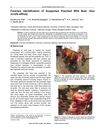 1 citations
,
August 2016 in “Journal of Buffalo Science”
1 citations
,
August 2016 in “Journal of Buffalo Science” The animal was likely a wild boar.
1 citations
,
November 2022 in “International Journal of Cosmetic Science” Lotus corniculatus seed extract reduces oily skin by decreasing sebum production.
 1 citations
,
November 2020 in “Research Square (Research Square)”
1 citations
,
November 2020 in “Research Square (Research Square)” The study found specific skin cells and genes that may affect the quality of cashmere in Liaoning Cashmere Goats.
 September 2024 in “Seven Editora eBooks”
 Dermatophylosis sporadically affects adult sheep in Sertão da Paraíba, causing alopecic and crusty skin lesions.
July 2021 in “Veterinary record/The veterinary record” A calf in Scotland likely had Schmallenberg virus from its mother.
 December 2013 in “Iranian Journal of Applied Animal Science”
 Adding bentonite clays to goat diets increased milk yield, periwinkle shell improved chicken egg production, and vaccination increased muscle area and carcass yield in calves.
Lichen spinulosus, usually seen in young people, can rarely occur in adults, as shown by a 52-year-old woman with a rough, bumpy rash.
11 citations
,
January 2015 in “JOURNAL OF HEALTH SCIENCE” A 12-year-old boy's rare skin condition improved with topical treatments and may resolve by puberty.
May 2021 in “Veterinarìâ, tehnologìï tvarinnictva ta prirodokoristuvannâ” Treating sheep and wild goats with specific medications and bathing sheep was 100% effective against a contagious skin disease caused by mites.
 November 2022 in “Gigascience”
 A specific genetic deletion in goats affects cashmere yield and thickness.
7 citations
,
April 2019 in “Animal biotechnology” The POMP gene is active in various goat tissues and affects hair growth, with certain treatments influencing its expression.
 October 2023 in “Cell & bioscience”
 A special gene region controls the re-emergence of a primitive wool type in Merino sheep, improving their wool yield and adaptability.