1 citations
,
January 2020 in “International Journal of Agriculture and Biology” Certain miRNAs are linked to Cashmere goat hair quality.
 1 citations
,
August 2016 in “Journal of Buffalo Science”
1 citations
,
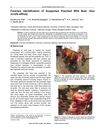
August 2016 in “Journal of Buffalo Science” The animal was likely a wild boar.
4 citations
,
January 2011 in “European journal of dermatology/EJD. European journal of dermatology” A boy had a rare scalp condition with thickened skin and different-colored hair.
October 2023 in “Lithuanian University of Health Sciences” The TG5 gene affects beef cattle weight, and the CC genotype leads to higher weights.
4 citations
,
March 2018 in “Animal biotechnology” The LAMTOR3 gene is involved in cashmere goat hair growth and is affected by certain treatments and other genes.
1 citations
,
February 2025 in “Journal of Dairy Science” The SLICK1 allele in Holstein heifers affects hair and immune traits without altering prolactin signaling.
March 2011 in “Pigment Cell & Melanoma Research” The Agouti gene influences pigmentation and may have a developmental role in deer mice.
January 2011 in “Leather Science and Engineering” Processing changes Sichuan rabbit skin structure by altering collagen fiber arrangement and porosity.
 March 2024 in “Journal of animal science/Journal of animal science ... and ASAS reference compendium”
 Soy hull supplement does not affect sheep and lamb growth or reproductive performance compared to corn-based supplements.
January 1991 in “Linchuang pifuke zazhi”  27 citations
,
July 1946 in “The journal of nutrition/The Journal of nutrition”
27 citations
,
July 1946 in “The journal of nutrition/The Journal of nutrition” Biotin and inositol are crucial for pig health and growth.
 218 citations
,
October 2013 in “Proceedings of the National Academy of Sciences of the United States of America”
218 citations
,
October 2013 in “Proceedings of the National Academy of Sciences of the United States of America” Mice lacking the PPARγ gene in their fat cells had almost no fat tissue, severe metabolic problems, and abnormal development of other fat-related tissues.
8 citations
,
August 1971 in “Canadian Journal of Zoology” Chinchillas have specific blood and protein levels, with variations possibly linked to pregnancy or hair growth.
1 citations
,
October 2010 in “2010 3rd International Conference on Biomedical Engineering and Informatics” The LEF-1 gene in cashmere goats was successfully cloned and analyzed, showing potential for improving cashmere production.
 November 2023 in “Food science of animal resources”
 Lactilactobacillus curvatus LB-P9 taken orally helps hair regrow faster and thicker in mice.
20 citations
,
February 2021 in “Frontiers in Pharmacology” Angelica sinensis and Tetrapanax papyrifer are common in Taiwanese TCM for lactation, with potential anticancer benefits.
39 citations
,
January 2020 in “Frontiers in Genetics” PDGFC gene may help select goats with desirable curly wool traits.
December 2018 in “Bioscience Journal” Leporacarus gibbus mite was found in a domestic rabbit in Espírito Santo, Brazil, for the first time.
3 citations
,
December 2024 in “Journal of Animal Science” LncRNA MSTRG.14227.1 hinders hair follicle development in cashmere goats, affecting cashmere quality.
 2 citations
,
May 2012 in “Acta pharmaceutica sinica B”
2 citations
,
May 2012 in “Acta pharmaceutica sinica B” The study found unique microscopic features for hair or feather in five animal ingredients in Shenrongbian pill.
1 citations
,
August 2025 in “Genes” Genetic markers linked to sheep body traits were identified, aiding future breeding.
 November 2023 in “Journal of animal science/Journal of animal science ... and ASAS reference compendium”
 Pig hair cortisol levels are inheritable and linked to stress responses, which could help select for more resilient pigs.
 9 citations
,
July 2019 in “Folia Morphologica”
9 citations
,
July 2019 in “Folia Morphologica” Brandt's hedgehog has thick skin on its back and many glands near its nostrils.
3 citations
,
November 2022 in “Molecules/Molecules online/Molecules annual” The substances improved hair regrowth and protected hair cells in humans and mice.
35 citations
,
January 2001 in “Journal of Animal Science” High dietary selenium, especially inorganic, causes weight loss and selenosis in pigs, with effects varying by hair color.
1 citations
,
January 2013 in “Lung India” Radiological findings help distinguish LAM, PLCH, and BHD to avoid invasive tests.
13 citations
,
March 1997 in “Research in Veterinary Science/Research in veterinary science” Epithelial proliferation and hyperkeratosis are linked to gastric ulcers in pigs.
November 2005 in “PubMed” The hairless gene in Kunming mice is important for hair and skin, and shows genetic variations.
4 citations
,
August 2022 in “Cells” lncRNA2919 slows down rabbit hair growth by stopping cell growth and causing cell death.
1.5% lactic acid improved mink growth and health best.