March 2026 in “Acta Pharmaceutica Sinica B” Microneedles show promise for improving hair regrowth in alopecia.
 March 2026 in “Zenodo (CERN European Organization for Nuclear Research)”
 Minoxidil works best for female hair loss, while laser therapy and plasma treatments might help but need more research.
 March 2026 in “Zenodo (CERN European Organization for Nuclear Research)”
 Minoxidil works well for female hair loss, while laser therapy and plasma treatments might help but need more research.
 February 2026 in “Zenodo (CERN European Organization for Nuclear Research)”
 Current treatments can slow hair loss and promote regrowth, with hair transplantation being most effective for advanced cases.
 February 2026 in “Zenodo (CERN European Organization for Nuclear Research)”
 Current treatments can slow hair loss and promote regrowth, with hair transplantation being most effective for advanced cases.
January 2026 in “Journal of Biosciences and Medicines” Androgenetic alopecia treatments focus on reducing hair loss by targeting hormones, with new therapies showing promise but needing more research.
 January 2026 in “Archives of Internal Medicine Research”
 PRP, exosomes, and physical therapies show promise for hair and tissue repair, but need more research for optimization.
 September 2025 in “International Journal of Innovative Technologies in Social Science”
 Red light therapy may help rejuvenate skin and regrow hair.
 August 2025 in “Arabixiv (OSF Preprints)”
 Low-level laser therapy effectively improves hair growth in androgenetic alopecia with minimal side effects.
 August 2025 in “Dermatological Reviews”
 Stem cells, natural oils, and laser therapy may help hair regrowth, but more research is needed.
July 2025 in “Carolina Digital Repository (University of North Carolina at Chapel Hill)” Low-level laser therapy is the most supported non-drug treatment for hair loss, but combining it with other methods may be promising.
 June 2025 in “Journal of Education Health and Sport”
 Combination therapies for androgenetic alopecia are more effective, but more research is needed for safe, standardized treatments.
 June 2025 in “Clinical Cosmetic and Investigational Dermatology”
 Gray hair can potentially be managed or reversed with treatments that boost melanin production and address nutritional deficiencies.
 May 2025 in “Journal of Dermatological Treatment”
 Initial hair loss severity can affect treatment results for minoxidil and laser therapy.
CAM offers natural hair care solutions that may improve hair health and growth with fewer side effects.
 April 2025 in “Journal of Applied Cosmetology”
 The combined therapy of microneedling and light therapy effectively and safely promotes hair regrowth in trichotillomania.
 February 2025 in “Journal of Biophotonics”
 Dual-wavelength laser therapy promotes better hair regrowth than single-wavelength treatments.
 December 2024 in “Journal of Biophotonics”
 Dual wavelength LEDs may help reduce hair loss by lowering DHT levels.

Certain combination therapies, like microneedling with minoxidil, are more effective for female-pattern hair loss than other treatments.
 October 2024 in “Dermatologic Surgery”
 Low-level laser therapy helps increase hair density in androgenetic alopecia.
 September 2024 in “Ain Shams Medical Journal”
 Androgenic alopecia causes hair thinning, and treatments include minoxidil, finasteride, and light therapy.
August 2024 in “Journal of Photochemistry and Photobiology B Biology” Combining light therapy with certain substances improves hair growth in people with hair loss.
 August 2024 in “Dermatological Reviews”
 New technologies are improving the diagnosis and treatment of hair and nail disorders.
 July 2024 in “Scholars Journal of Medical Case Reports”
 Combining low-level laser therapy and exosome therapy promotes hair growth.
 May 2024 in “Medical Journal Armed Forces India/MJAFI”
 Both low-level light therapy and 5% minoxidil are effective and safe for treating male hair loss, with no significant difference in results.
 May 2024 in “Journal of cosmetic and laser therapy”
 Minoxidil and finasteride are the most effective treatments for hair loss.
 May 2024 in “International Society of Hair Restoration Surgery”
 New treatments like PRP, PRF, SVF, exosomes, and LLLT show promise for hair growth.
February 2024 in “Institutional Repository of the Federal Technological University of Paraná (RIUT) (Federal University of Technology – Paraná)” Photobiomodulation can influence gene and protein expression related to healing and inflammation.
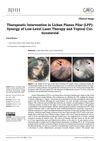 January 2024 in “Brazilian Journal of Hair Health”
 Combining low-level laser therapy with topical corticosteroids effectively improved Lichen Planopilaris symptoms.
January 2024 in “International Journal of Physics and Applications” Low-level laser therapy can boost cell activity and energy production.