 December 2023 in “Journal of General Procedural Dermatology and Venereology Indonesia”
 A 61-year-old Filipino man had a skin condition that looked like another disease, making diagnosis difficult.
September 2019 in “Journal of Investigative Dermatology” IL-17 and certain immune cells are linked to more severe alopecia areata.
 October 2022 in “Boletín médico del Hospital infantil de México/Boletín médico del Hospital Infantil de México”
 The patient has a rare skin condition that shows features of two known disorders.
 8 citations
,
January 2011 in “Experimental and Therapeutic Medicine”
8 citations
,
January 2011 in “Experimental and Therapeutic Medicine” Stromal cells in melanoma promote tumor growth and spread.
August 2024 in “Journal of the Egyptian Womenʼs Dermatologic Society” SOX10 in hair follicles is linked to inflammation in alopecia areata.
 September 2023 in “Research Square (Research Square)”
 TNC+ fibroblasts play a key role in skin inflammation by interacting with T cells.
22 citations
,
September 2008 in “International Journal of Dermatology” The case suggests a possible autoimmune link between lichen sclerosus and vitiligo.
 December 2021 in “Research Square (Research Square)”
 M-CSF-stimulated myeloid cells can cause alopecia areata in mice.
2 citations
,
June 2017 in “Journal of Evidence Based Medicine and Healthcare” Skin and mucous symptoms are key for diagnosing autoimmune connective tissue diseases.
12 citations
,
November 2018 in “Archives of Dermatological Research”  6 citations
,
January 2014 in “American Journal of Medical Case Reports”
6 citations
,
January 2014 in “American Journal of Medical Case Reports” Early diagnosis, intensive therapy, and careful follow-up are crucial for managing overlapping TTP and SLE.
 6 citations
,
April 2020 in “Cureus”
6 citations
,
April 2020 in “Cureus” A woman with both TLE and SLE improved with hydroxychloroquine treatment.
7 citations
,
December 2016 in “Journal of the American Academy of Dermatology” NKG2D+CD4+ T cells are higher in alopecia areata patients and may be involved in the disease.
October 1967 in “Archives of Dermatology” A 42-year-old woman had a scalp lesion that didn't cause hair loss and showed specific changes under a microscope.
 July 2014 in “Plastic and Reconstructive Surgery”
 Sentinel lymph node biopsy is recommended for all types of desmoplastic melanoma due to higher rates of nodal metastasis.
 July 2014 in “Plastic and Reconstructive Surgery”
 Sentinel lymph node biopsy is recommended for all types of desmoplastic melanoma due to higher rates of nodal metastasis.
34 citations
,
December 2011 in “The Journal of Dermatology” A unique type of lupus panniculitis causes reversible hair loss on the scalp in East Asians.
 26 citations
,
March 2003 in “Pediatrics”
26 citations
,
March 2003 in “Pediatrics” Oral steroids may effectively treat recurrent intussusception in children with ILH, possibly avoiding surgery.
11 citations
,
January 1999 in “Dermatology” Accurate diagnosis is crucial for effective treatment of similar hair loss conditions.
 1 citations
,
March 2020 in “Poster presentations”
1 citations
,
March 2020 in “Poster presentations” SLE patients need careful diagnosis to distinguish infections from disease flares for proper treatment.
16 citations
,
April 2016 in “Medicine” Early treatment and regular check-ups are crucial for lupus patients to prevent progression and improve outcomes.
 3 citations
,
September 2023 in “Frontiers in immunology”
3 citations
,
September 2023 in “Frontiers in immunology” Chronic inflammatory skin diseases are caused by disrupted interactions between skin cells and immune cells.
July 2022 in “British Journal of Dermatology” 87 citations
,
September 2016 in “Journal of the American Academy of Dermatology” Intralesional triamcinolone effectively reduces pain and inflammation in hidradenitis suppurativa flares.

Accurate diagnosis of cicatricial alopecias requires thorough scalp examination and multiple biopsy techniques.
1 citations
,
December 2023 in “JAAD International” Mast cells may significantly contribute to central centrifugal cicatricial alopecia.
 September 2016 in “Journal of Dermatological Science”
 Plasmacytoid dendritic cells, which overproduce IFN-α, may play a crucial role in starting alopecia areata, an autoimmune disease causing hair loss.
7 citations
,
June 2017 in “Journal of Cutaneous Pathology” Cystic panfolliculoma resembles hair follicle tumors due to specific cell interactions.
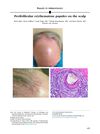 January 2016 in “Journal of The American Academy of Dermatology”
 The woman has a type of scarring hair loss with red bumps around hair follicles.