 4 citations
,
January 2018 in “JEADV. Journal of the European Academy of Dermatology and Venereology/Journal of the European Academy of Dermatology and Venereology”
4 citations
,
January 2018 in “JEADV. Journal of the European Academy of Dermatology and Venereology/Journal of the European Academy of Dermatology and Venereology” Panitumumab can cause excessive ear hair growth.
1 citations
,
October 2021 in “The journal of investigative dermatology/Journal of investigative dermatology” Removing HIF-P4H-2 from certain skin cells in mice causes hair loss on the body but not the head.
2 citations
,
April 2008 in “Advances in therapy” Proper diagnosis and treatment of childhood hair loss require distinguishing between alopecia and trichotillomania.
4 citations
,
September 1992 in “Journal of Small Animal Practice” A French bulldog had sparse hair due to a condition similar to that seen in Chinese crested dogs.
2 citations
,
March 2010 in “European journal of dermatology/EJD. European journal of dermatology” A young Caucasian girl had both woolly hair and alopecia areata, which is rare.
53 citations
,
October 2003 in “Genetics” The mK6irs1/Krt2-6g gene likely causes wavy hair in mice.
14 citations
,
May 1979 in “International Journal of Dermatology” Trichostasis spinulosa mainly affects the nose, with many tiny hairs in one follicle, possibly influenced by hormones and sunlight.
 January 2025 in “Clinical Dermatology Review”
 Trichoscopy helps accurately diagnose Netherton syndrome, often mistaken for atopic dermatitis.
Goats can have various genetic skin diseases affecting hair, skin, and thyroid function.
February 2022 in “Authorea (Authorea)” PAON shows skin patterns due to genetic mosaicism.
 September 2023 in “Journal of the American Academy of Dermatology”
 Children with alopecia areata, especially with Down syndrome or thyroid issues, should be screened for thyroid disease.
February 2013 in “Journal of the American Academy of Dermatology” Uncombable hair syndrome causes dry, frizzy hair that can't be combed flat, seen in a young child.
29 citations
,
July 2015 in “Journal of Medical Genetics” A genetic variant in the KRT25 gene causes tightly curled hair.
37 citations
,
October 2006 in “Archives of Biochemistry and Biophysics” A unique gene mutation causes vitamin D-resistant rickets without causing hair loss.
 March 2012 in “Journal of The American Academy of Dermatology”
 Hand-foot-mouth disease may cause nail loss in children.
33 citations
,
October 1996 in “Journal of Investigative Dermatology”  14 citations
,
August 2006 in “Clinical and Experimental Dermatology”
14 citations
,
August 2006 in “Clinical and Experimental Dermatology” A girl with no hair neglect developed plica neuropathica in the hospital, lost all her hair, but it grew back.
September 2016 in “Journal of Dermatological Science” Polarizing light microscopy can easily and reliably diagnose congenital keratinizing disorders like Netherton syndrome.
3 citations
,
October 2009 in “Dermatology” 203 citations
,
November 1984 in “Journal of the American Academy of Dermatology” Common baldness is likely inherited through multiple genes, not just one.
84 citations
,
April 2002 in “Archives of Dermatology” Loose anagen hair syndrome may be caused by keratin gene mutations.
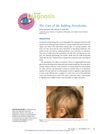 November 2017 in “Pediatrics in Review”
 A 4-year-old girl with hair loss was diagnosed with early-onset trichotillomania and improved with behavioral interventions.
 2 citations
,
June 2016 in “PubMed”
2 citations
,
June 2016 in “PubMed” An 11-year-old girl with compulsive hair pulling was successfully treated with therapy and medication.
 June 2023 in “British Journal of Dermatology”
 A person with Werner syndrome was initially thought to just have female pattern hair loss.
July 2024 in “LA CIENCIA AL SERVICIO DE LA SALUD Y NUTRICIÓN” The condition is harmless, doesn't worsen, and needs no invasive treatment.
Female hair loss is often hereditary and can be treated with medication, hair transplants, and lasers.
5 citations
,
April 2014 in “International Journal of Pediatric Endocrinology” Prepubertal girls with hypertrichosis have more sensitive androgen receptors, leading to increased body hair growth.
1 citations
,
January 2013 in “Pediatric Annals” The girl's thin hair was due to loose anagen syndrome, not other hair loss types.
January 2026 in “American Journal of Medical Genetics Part A” A new genetic variant causes trichothiodystrophy in two brothers, but their mother may carry it without showing symptoms.
The naked mutation in mice causes hair loss and helps identify keratin genes.