 9 citations
,
January 1989 in “Sen'i Gakkaishi”
9 citations
,
January 1989 in “Sen'i Gakkaishi” Wool and hair fibers absorb moisture similarly due to their keratin structure, with the amount of non-crystalline areas affecting the moisture uptake.
 31 citations
,
February 2020 in “BioMed Research International”
31 citations
,
February 2020 in “BioMed Research International” Thai people's hair density decreases with age and varies by scalp area, but hair thickness stays the same regardless of age or scalp area.
 16 citations
,
October 2003 in “Journal of applied polymer science”
16 citations
,
October 2003 in “Journal of applied polymer science” 2-iminothiorane hydrochloride improves hair waving permanence without damage.
 12 citations
,
October 1954 in “Textile Research Journal”
12 citations
,
October 1954 in “Textile Research Journal” Hair absorbs alkali bromide salts and water, affecting its structure, with absorption decreasing at higher temperatures.
 8 citations
,
November 2022 in “International Journal of Cosmetic Science”
8 citations
,
November 2022 in “International Journal of Cosmetic Science” Human hair varies widely and should be classified by curl type rather than race.
 8 citations
,
November 2019 in “Journal of Natural Fibers”
8 citations
,
November 2019 in “Journal of Natural Fibers” Adding human hair to clayey soil makes it stronger, even after freeze-thaw cycles, and is eco-friendly and cheap.
 4 citations
,
June 2021 in “Scientific Reports”
4 citations
,
June 2021 in “Scientific Reports” Hair fiber shape and curvature are not significantly linked when ancestry is considered.
 4 citations
,
April 1955 in “Textile Research Journal”
4 citations
,
April 1955 in “Textile Research Journal” The effectiveness of reducing agents on hair fibers depends on their electrode potentials.
 1 citations
,
July 2019 in “Microscopy Today”
1 citations
,
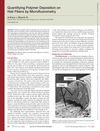
July 2019 in “Microscopy Today” Microfluorometry effectively measures how much polymer coats and penetrates hair, useful for evaluating hair products.
 98 citations
,
June 2008 in “Human mutation”
98 citations
,
June 2008 in “Human mutation” A genetic change in the EDAR gene causes the unique hair traits found in East Asians.
 10 citations
,
January 2007 in “Dermatologic Surgery”
10 citations
,
January 2007 in “Dermatologic Surgery” Artificial hair fibers help treat scalp scars with few complications and a 20% yearly fiber fall rate.
 January 2007 in “Dermatologic Surgery”
 Artificial hair fibers help treat scalp scars with few complications and a 20% yearly fiber fall rate.
 3 citations
,
April 2021 in “Journal of Cosmetic Dermatology”
3 citations
,
April 2021 in “Journal of Cosmetic Dermatology” The micrometer caliper is a reliable tool for measuring hair diameter for FUE surgery.
 5 citations
,
April 2016 in “Proceedings of the Latvian Academy of Sciences. Section B, Natural, Exact and Applied Sciences”
5 citations
,
April 2016 in “Proceedings of the Latvian Academy of Sciences. Section B, Natural, Exact and Applied Sciences” Researchers created small amber particles for use in bioactive and biocompatible fibers that could help with skin and hair restoration and are safe for infant clothing.
 34 citations
,
May 2021 in “Journal of Nanobiotechnology”
34 citations
,
May 2021 in “Journal of Nanobiotechnology” The 3D electrospun fibrous sponge is promising for tissue repair and healing diabetic wounds.
 7 citations
,
January 2018 in “Materials Today: Proceedings”
7 citations
,
January 2018 in “Materials Today: Proceedings” Adding human hair fibers and glass micro-spheres to epoxy improves its wear resistance and strength.
 40 citations
,
May 2016 in “Proceedings of the National Academy of Sciences of the United States of America”
40 citations
,
May 2016 in “Proceedings of the National Academy of Sciences of the United States of America” Changes in keratin make hair follicles stiffer.
 5 citations
,
February 2015 in “Journal of Bio- and Tribo-Corrosion”
5 citations
,
February 2015 in “Journal of Bio- and Tribo-Corrosion” Plasma jet treatments can clean hair and might replace peroxide for hair care.
 2 citations
,
December 2019 in “Textile Research Journal”
2 citations
,
December 2019 in “Textile Research Journal” L-cysteine and ultrasound successfully improved rabbit hair fibers for industrial use.
 January 2026 in “Animal Advances”
 Genes linked to coat color and fiber length in Chinese goats were identified.
 November 2022 in “Gigascience”
 A specific genetic deletion in goats affects cashmere yield and thickness.
 23 citations
,
June 2017 in “Rejuvenation Research”
23 citations
,
June 2017 in “Rejuvenation Research” Minoxidil treatment increases aorta elasticity and reduces stiffness in aged mice, potentially helping with age-related heart issues.
 17 citations
,
June 2019 in “Cellular signalling”
17 citations
,
June 2019 in “Cellular signalling” Minoxidil helps protect and rebuild elastic fibers in arteries, improving artery function, especially in older females.
 January 2003 in “Research Portal (King's College London)”
 Hair color affects light reflection, with black hair having higher cuticle angles and lighter hair showing less specular reflection.
 104 citations
,
October 2016 in “PLoS ONE”
104 citations
,
October 2016 in “PLoS ONE” CRISPR/Cas9 gene editing in cashmere goats increases hair follicles and fiber length, boosting cashmere yield.
 23 citations
,
August 2019 in “Proceedings of the National Academy of Sciences of the United States of America”
23 citations
,
August 2019 in “Proceedings of the National Academy of Sciences of the United States of America” Pollution exposure speeds up hair damage.
 January 2024 in “Wiadomości Lekarskie”
 Countries should improve sex education, access to contraception, and legal abortion options.
 40 citations
,
June 2013 in “Biomaterials”
40 citations
,
June 2013 in “Biomaterials” Scientists created 3D hair-like structures that could help study hair growth and test treatments.
 11 citations
,
July 2021 in “Sustainability”
11 citations
,
July 2021 in “Sustainability” Concrete made from animal bones and human hair is stronger and more environmentally friendly than traditional concrete.
Hair properties change under electromagnetic fields and are influenced by individual characteristics and the environment.