 152 citations
,
April 2012 in “Recent Patents on Inflammation & Allergy Drug Discovery”
152 citations
,
April 2012 in “Recent Patents on Inflammation & Allergy Drug Discovery” Minoxidil treats hair loss, promotes growth, has side effects, and has recent patents.
The 1298CC genotype in RA patients leads to higher methotrexate toxicity, while the 1298AA genotype results in better treatment response.
 8 citations
,
October 2015 in “Asian Journal of Chemistry”
8 citations
,
October 2015 in “Asian Journal of Chemistry” A new method was created to accurately measure minoxidil and aminexil in hair loss treatments.
January 2025 in “Case Reports in Gastrointestinal Medicine” Topical minoxidil can cause severe liver failure.
 November 2019 in “Actas Dermo-Sifiliográficas”
 Oral minoxidil helps treat hair loss and has reversible side effects.
 August 2024 in “Asian Journal of Research in Chemistry”
 Repurposing existing drugs can improve cancer treatment but faces challenges.
 December 2023 in “Forensic science international. Genetics”
 The RapidHIT ID system can effectively get DNA profiles from hair roots with enough cells.
 29 citations
,
September 1990 in “Biochemical Journal”
29 citations
,
September 1990 in “Biochemical Journal” Enzyme purified and characterized for minoxidil sulphation in rat liver.
 June 2024 in “Research Square (Research Square)”
 Aminoacridine and Minoxidil together show promise for better hair and nail growth.
 2 citations
,
December 2023 in “Journal of clinical immunology”
2 citations
,
December 2023 in “Journal of clinical immunology” Ruxolitinib significantly improves multiple autoimmune conditions in APS-1 patients.
May 2026 in “Carbohydrate Polymer Technologies and Applications” This study investigates the formation of a stable inclusion complex between the active ingredient MPPC, found in Minoxicapil®, and β-cyclodextrin (β-CD) for alopecia treatment. Using 1H NMR titration and ROESY experiments, a 1:1 host-guest stoichiometry was identified, with the pyrrolidinyl moiety of MPPC preferentially inserted into the β-CD cavity. Molecular simulations confirmed the stable complex formation, driven by hydrophobic interactions and hydrogen bonding. Strat-M® Franz diffusion studies showed low systemic exposure after 24 hours, and in vitro assays indicated enhanced proliferation of dermal papilla cells (DPCs), supporting the formulation's effectiveness for topical hair-loss treatment.
 9 citations
,
February 2018 in “The Journal of Dermatology”
9 citations
,
February 2018 in “The Journal of Dermatology” A new mutation in the LIPH gene was found to cause a rare hair disorder in a Japanese boy.
4 citations
,
March 2021 in “Experimental dermatology” Minoxidil increases nail growth more than biotin.
July 2023 in “SKIN The Journal of Cutaneous Medicine” Continued ritlecitinib treatment can improve hair regrowth in some alopecia areata patients who initially don't respond.
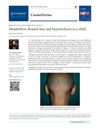 January 2026 in “Cosmoderma”
 A 9-year-old girl has a rare hair disorder causing beaded, sparse hair.
 January 2025 in “Journal of the American Academy of Dermatology”
 Combining oral minoxidil and bicalutamide may help improve hair growth in adolescent girls.
Retinoids can help treat skin pigmentation disorders by affecting melanin production.
January 2025 in “The Journal of Dermatology” Patients prefer the higher 50 mg dose of ritlecitinib for better hair regrowth despite higher risks.
 December 2025 in “Lasers in Medical Science”
 Combining red laser therapy with minoxidil improves hair growth more effectively than minoxidil alone in women with hair loss.
 6 citations
,
February 2020 in “Journal of Natural Products”
6 citations
,
February 2020 in “Journal of Natural Products” A new compound from a sponge strongly inhibits an enzyme linked to male-pattern hair loss without being toxic at low levels.
November 2025 in “Journal of Investigative Dermatology” Combining MMP-9 and JAK inhibitors can effectively prevent skin depigmentation in vitiligo.
 28 citations
,
September 2019 in “International Journal of Nanomedicine”
28 citations
,
September 2019 in “International Journal of Nanomedicine” Minoxidil nanoparticles can potentially be a more effective treatment for hair growth than current treatments.
 1 citations
,
April 1987 in “American Journal of Nursing”
1 citations
,
April 1987 in “American Journal of Nursing” Some drugs can cause serious side effects, like hypoglycemia from mix-ups, skin reactions, or depression, and while penicillamine may help rheumatoid arthritis more than auranofin, it has more severe side effects.
January 1987 in “Chronica Dermatologica” March 2025 in “Molecular Neurobiology” 15 citations
,
September 2018 in “Hearing research” Rapamycin reduces age-related hearing cell loss in mice, but acarbose does not.
52 citations
,
June 1998 in “British journal of dermatology/British journal of dermatology, Supplement” Ruby laser treatment is effective and well-tolerated for reducing hair growth.
21 citations
,
August 2002 in “British Journal of Ophthalmology” Drug misuse can cause serious eye infections and other severe side effects.
 April 2023 in “The journal of investigative dermatology/Journal of investigative dermatology”
 Blocking a key energy pathway in human hair follicles can trigger stress responses that stop cell growth.
August 1996 in “NEJM Journal Watch” The conclusion is unclear about minoxidil's effectiveness for preventing hair loss from chemotherapy.