Search
for
Sort by
Research
510-540 / 1000+ results
research Evaluation of oxidative stress, 3-Nitrotyrosine, and HMGB-1 levels in patients with wet type Age-Related Macular Degeneration
wAMD patients have higher oxidative stress, suggesting antioxidant treatment may help.

research In Vivo Reflectance Confocal Microscopy in General Dermatology: How to Choose the Right Indication
Reflectance confocal microscopy is useful for diagnosing and monitoring skin diseases, but it has limitations and requires expertise for correct use.
research Comparison of Components of Metabolic Syndrome in Androgenic Alopecia versus Healthy Population
People with androgenic alopecia are more likely to have metabolic syndrome than healthy individuals.
research Generalized maculopapular rash and fever
The man was diagnosed with lupus and improved with treatment.
research Differentiating pulmonary lymphangioleiomyomatosis from pulmonary langerhans cell histiocytosis and Birt-Hogg-Dube syndrome
Radiological findings help distinguish LAM, PLCH, and BHD to avoid invasive tests.
research Comorbidities in primary cicatricial alopecia: a systematic review and meta-analysis
Primary cicatricial alopecia is linked to various health issues, indicating broader systemic problems.
research A Systematic Review of 207 Studies Describing Validation Aspects of the Dermatology Life Quality Index
The Dermatology Life Quality Index is reliable and consistent but needs more diverse participant studies.
research A case of antilaminin 332 mucous membrane pemphigoid showing a blister on the bulbar conjunctiva and a unique epitope on the α3 subunit
A woman with a rare autoimmune disorder had a blister on her eye and unique immune reaction, which was effectively treated with medication.

research DP10 Scalp disease in dermatomyositis
Scalp disease in dermatomyositis causes significant symptoms and has unique features.
research Mogamulizumab‐induced alopecia. Multicentric case series: Clinical, trichoscopic and histological characterization
Mogamulizumab can cause hair loss, often linked to a better treatment response.
research Age-specific cut-off levels of anti-Müllerian hormone can be used as diagnostic markers for polycystic ovary syndrome
Different levels of anti-Müllerian hormone can help diagnose polycystic ovary syndrome in women of different ages.
research The features of onychomatrimas on in vivo reflectance confocal microscopy
Reflectance confocal microscopy can noninvasively diagnose onychomatricoma by showing unique features different from healthy nails or nail fungus.
research A Case of Cronkhite-Canada Syndrome Presenting with Hematochezia
Cronkhite-Canada syndrome can cause multiple gastrointestinal polyps and various physical symptoms.
research D ERMATOLOGICAL MANIFESTATIONS - ARE THEY SPECIFIC MARKERS FOR SYSTEMIC INVOLVEMENT IN SLE ?
Certain skin symptoms can help detect and manage systemic lupus.

research MIXED CONNECTIVE TISSUE DISEASE EVOLVING FROM THE SEQUENTIAL OVERLAP OF SYSTEMIC LUPUS ERYTHEMATOSUS, SJÖGREN’S SYNDROME, RHEUMATOID ARTHRITIS AND DERMATOMYOSITIS: A FOLLOW-UP
Mixed Connective Tissue Disease can develop from overlapping symptoms of several autoimmune diseases, making diagnosis complex.
research 574 Comparative analysis of quality of life impact in patients with autoimmune blistering disease
Patients with autoimmune blistering diseases experience a reduced quality of life, with the need for better measurement tools, especially for those with mucous membrane pemphigoid.
research LP-161 Tjalma syndrome (Pseudo-Pseudo Meigs Syndrome): polyserositis with increased CA-125 in patients with systemic lupus erythematosus
Tjalma Syndrome is a rare condition in people with lupus, causing fluid buildup and high CA-125 levels, but not due to tumors.
research Development and validation of the Brigham Eyelash Tool for Alopecia (BELA): A measure of eyelash alopecia areata
The Brigham Eyelash Tool for Alopecia (BELA) is a reliable way to measure eyelash loss in alopecia areata patients.
research Screening guidelines for thyroid function in children with alopecia areata
Children with alopecia areata should only get thyroid screening if they have Down syndrome, a family history of thyroid disease, atopy, or signs of thyroid problems.
research Evaluation of efficacy, safety, and reversibility of combination regimen of cyproterone acetate and testosterone buciclate in bonnet monkey
The right dosage of CPA and TB can work as a safe and reversible male contraceptive in monkeys.

research Application of validated UV spectrophotometric and colorimetric method to quantify minoxidil in the development of trilayer dissolving microneedle: Proof of concept in ex vivo and in vivo studies in rats
The UV–Vis Spectrophotometry method effectively measures minoxidil in rat skin for alopecia treatment.
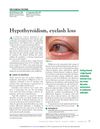
research Hypothyroidism, eyelash loss
Eyelash loss can be a sign of thyroid problems.
research Is obesity surpassing the conventional risk factors in the development of CAD, irrespective of age?
Obesity is an independent risk factor for early coronary artery disease (CAD) and its severity is not affected by age.
research 76626 Adjunctive Combined Regenerative Technique (CRT) vs Oral Minoxidil Alone for Androgenetic Alopecia: A Six-Month Retrospective Study
CRT is more effective than oral minoxidil alone for treating hair loss.
research P095 The Very Interesting Small Bowel Lesions of Cronkhite-Canada Syndrome
Small bowel lesions in Cronkhite-Canada syndrome persist despite steroid treatment.
research Assessing Quality of Life in Pediatric Alopecia Areata
The new tool helps measure the impact of alopecia areata on children's quality of life.
research Autoimmune polyendocrine syndrome type 1: an Italian survey on 158 patients
APS-1 in Italy shows diverse AIRE mutations and various autoimmune issues.

research Quality of life and patient-reported side effects of low-dose oral minoxidil in treating female pattern hair loss.
Low-dose oral minoxidil improves hair loss and quality of life for women, despite mild side effects.
research Genomewide analysis of copy number variants in alopecia areata in a Central European cohort reveals association with MCHR2
MCHR2 gene duplications may be linked to alopecia areata.