 20 citations
,
January 2005 in “Australasian Journal of Dermatology”
20 citations
,
January 2005 in “Australasian Journal of Dermatology” A woman had a skin condition with increased normal elastic fibers, not related to other known disorders, likely due to aging.
14 citations
,
May 2017 in “Journal of Investigative Dermatology” A rare gene mutation causes skin fragility and itching without affecting hair or nails.
 14 citations
,
April 2011 in “Journal of the American Academy of Dermatology”
14 citations
,
April 2011 in “Journal of the American Academy of Dermatology” Researchers found a gene mutation responsible for a rare hair loss condition.
3 citations
,
September 2016 in “Pediatric Dermatology” Hypertrichosis (excessive hair growth) can help diagnose superficial epidermolytic ichthyosis.
113 citations
,
June 2010 in “Biological Chemistry” Cathepsin L deficiency causes large, abnormal cell structures and health issues in mice.
 January 2022 in “International journal of zoology and animal biology”
 Dogs with dermatomyositis, especially Collies and Shetland Sheepdogs, need better treatments for their skin and muscle inflammation.
101 citations
,
October 2007 in “Journal of Biological Chemistry” Reduced matriptase activity causes skin and hair issues in both humans and mice.
42 citations
,
September 1985 in “British Journal of Dermatology” Trichothiodystrophy causes abnormal protein deposits and distortion in hair follicles.
1 citations
,
January 2018 in “Jornal Brasileiro de Patologia e Medicina Laboratorial” Monilethrix causes brittle hair and hair loss, and it runs in families.
5 citations
,
December 2014 in “Molecular cytogenetics” A specific genetic change is linked to mental disorders, intellectual disability, and possibly autoimmune disease in a family.
 24 citations
,
May 2019 in “PLOS ONE”
24 citations
,
May 2019 in “PLOS ONE” The African spiny mouse can fully regenerate its muscle without scarring, unlike the common house mouse.
37 citations
,
June 2000 in “Experimental dermatology” The Lanceolate hair-J mutation in mice mimics human hair disorders like Netherton's syndrome.
 October 2023 in “Pediatric dermatology”
 Middle Eastern patients with epidermolysis bullosa show specific genetic mutations linked to different types of the disease.
 October 2024 in “Journal of the Endocrine Society”
 Type B Insulin Resistance Syndrome is rare, linked to lupus, and hard to treat due to severe insulin resistance.
November 2025 in “The Journal of Immunology” BTNL2 helps protect hair follicles from immune attacks, which could aid in treating alopecia areata.
January 2000 in “Linchuang pifuke zazhi” The man had pretibial myxedema and hyperthyroidism, causing skin changes and thyroid issues.
 4 citations
,
January 2014 in “International Journal of Trichology”
4 citations
,
January 2014 in “International Journal of Trichology” A 12-year-old boy with a rare genetic condition has progressive hair loss with no effective treatment.
May 2022 in “Journal of Neurology Neurosurgery & Psychiatry” The woman's facial symptoms are best explained by primary Sjögren’s Syndrome.
22 citations
,
June 2010 in “Experimental Dermatology” Lower MC2R expression may contribute to alopecia areata.
31 citations
,
October 1992 in “PubMed” A mycobacterial protein shares a similar region with a human skin protein, possibly affecting skin diseases.
 28 citations
,
February 2010 in “British journal of dermatology/British journal of dermatology, Supplement”
28 citations
,
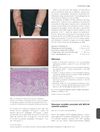
February 2010 in “British journal of dermatology/British journal of dermatology, Supplement” WNT10A mutations cause varied symptoms in patients with odonto-onycho-dermal dysplasia.
1 citations
,
September 2017 in “BMJ” The man has a disease causing skin patches, thickened nerves, and mild muscle weakness.
 31 citations
,
January 2014 in “Journal of endocrinological investigation”
31 citations
,
January 2014 in “Journal of endocrinological investigation” Woodhouse-Sakati syndrome often causes sexual development issues, hair loss, learning disabilities, deafness, muscle contractions, limb pain, and diabetes.
 January 2017 in “Open Journal of Endocrine and Metabolic Diseases”
 The document concludes that managing Dunnigan-Type Familial Partial Lipodystrophy involves treating associated health issues and using medications like metformin and leptin replacement.
60 citations
,
March 2006 in “Journal of Medical Genetics” A mutation in the KRTHB5 gene causes hair and nail issues.
37 citations
,
August 2011 in “Journal of Bone and Mineral Research” A girl had rickets due to a gene mutation affecting vitamin D response.
5 citations
,
June 2008 in “British Journal of Dermatology” RNA-based treatments show promise for managing Hutchinson-Gilford Progeria Syndrome.
 May 2024 in “British journal of dermatology/British journal of dermatology, Supplement”
 CYLD deficiency in skin tumors disrupts hair follicle cell processes and protein secretion.
January 1998 in “The Nishinihon Journal of Dermatology” A 7-year-old girl was diagnosed with Netherton's Syndrome, shown by skin and hair symptoms.