 65 citations
,
August 2007 in “Experimental Dermatology”
65 citations
,
August 2007 in “Experimental Dermatology” Human hair follicles can make and process prostaglandins, which may affect hair growth.
25 citations
,
July 1994 in “Journal of Cell Science” Immortalized rat dermal papilla cells can still induce hair growth.
Some fibroblast growth factors may promote hair growth similarly to minoxidil and could potentially treat hair loss.
21 citations
,
December 2015 in “European journal of cell biology” Tight junctions create a barrier in pig hair follicles that controls what can enter the skin.
February 2010 in “Journal of the American Academy of Dermatology” Activating cAMP and ATP improves hair growth and strength.
13 citations
,
August 2007 in “Journal of Investigative Dermatology” Mouse hair can regrow in a special lab setup without serum.
 43 citations
,
December 2013 in “Seminars in Cell & Developmental Biology”
43 citations
,
December 2013 in “Seminars in Cell & Developmental Biology” Genetic mutations can cause hair growth disorders by affecting key genes and signaling pathways.
KY19382 helps to regrow hair and create new hair follicles.
23 citations
,
July 1993 in “The journal of investigative dermatology/Journal of investigative dermatology” Certain chemicals and peptides can promote hair growth or prevent baldness.
December 1963 in “Medical Entomology and Zoology” Wnt1a from stem cells boosts hair growth and regeneration in mice.
 February 2022 in “Research Square (Research Square)”
 Key genes influencing sheep hair follicle development were identified, aiding wool breeding and understanding human hair conditions.
July 2024 in “Chemical Engineering Journal” A new microneedle system with minoxidil nanoparticles effectively promotes hair regrowth with fewer side effects.
 12 citations
,
May 2003 in “Journal of dermatological science”
12 citations
,
May 2003 in “Journal of dermatological science” Hsc70 protein may influence hair growth by responding to androgens.
 January 2025 in “Journal of Contemporary Medical Practice”
 Nano-cerium oxide may help treat hair loss by improving hair growth and reducing certain skin proteins.
 June 2018 in “Advances in Cosmetic Surgery”
 Hair loss caused by genetics and hormones; more research needed for treatments.
1 citations
,
July 2025 in “Scientific Reports” CD133+ cells are crucial for hair growth.
 57 citations
,
May 2007 in “Nature”
57 citations
,
May 2007 in “Nature” Adult mice can grow new hair from skin wounds.
10 citations
,
April 2007 in “PubMed” Coordinated gene activities are crucial for normal hair growth.
 August 2013 in “Nature Reviews Drug Discovery”
 A protein called FGF9 helps regenerate hair follicles in mice after skin damage, and increasing FGF9 could potentially help human hair growth.
 May 2007 in “Science's STKE”
 Healing skin wounds in mice can create new hair follicles, and adjusting Wnt signaling could potentially reduce scarring and treat hair loss.
 61 citations
,
June 2018 in “Proceedings of the National Academy of Sciences of the United States of America”
61 citations
,
June 2018 in “Proceedings of the National Academy of Sciences of the United States of America” Light can turn on hair growth cells through a nerve path starting in the eyes.
November 2025 in “Biomacromolecules” Nanochitins, especially DNCh and PNCh, effectively promote hair growth.
106 citations
,
February 2014 in “eLife” Lanceolate complexes in mouse hair follicles are essential for touch and depend on specific cells for maintenance and regeneration.
Balding hair follicles have reduced growth factors and increased inhibitory factors, suggesting new treatment paths for hair loss.
18 citations
,
November 2005 in “Archives of Dermatological Research” 
Understanding hair follicle signaling can improve hair disorder treatments.
 829 citations
,
May 2007 in “Nature”
829 citations
,
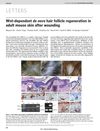
May 2007 in “Nature” Hair follicles can regrow in wounded adult mouse skin using a process like embryo development.
July 2026 in “arXiv (Cornell University)” Hair has varying structures and properties along its length.
May 2022 in “British Journal of Dermatology” The girl's hair condition improved on its own in 24 months.
 12 citations
,
December 2021 in “Aging”
12 citations
,
December 2021 in “Aging” A new painless method to collect hair follicles helps study DNA damage and aging.