 51 citations
,
December 2003 in “The FASEB Journal”
51 citations
,
December 2003 in “The FASEB Journal” The substance AS101 can help hair grow by slowing down hair cell aging and boosting a hair growth protein.
December 1991 in “Annals of the New York Academy of Sciences”  August 2012 in “Nature Cell Biology”
 Hair grows when stem cell offspring in the follicle base proliferate, influenced by the dermal papilla.
55 citations
,
February 1975 in “Journal of Cutaneous Pathology” Dermal cell activity increases during hair growth in rats.
64 citations
,
January 1995 in “Cells Tissues Organs” Merkel cells develop independently of nerves and are linked to specific hair follicles in mice.
6 citations
,
April 2021 in “NAR Genomics and Bioinformatics” PolyQ repeats in neural proteins evolve together, affecting brain function and disease.
 5 citations
,
February 2008 in “Experimental Dermatology”
5 citations
,
February 2008 in “Experimental Dermatology” Cyclosporin A promotes hair growth in mice and increases a protein linked to hair growth, but it may not work the same way in humans.
2 citations
,
January 1998 in “Neurourology and Urodynamics” AMN can cause bladder problems due to nerve damage.
September 2008 in “Kitasato medical journal” 3 citations
,
June 2024 in “iScience” Axolotl spinal cord regeneration may be controlled by a specific signal affecting cell sensitivity and diffusion.
 5 citations
,
December 2022 in “Toxins”
5 citations
,
December 2022 in “Toxins” Neurotoxins can affect neurotransmitter release and have potential in treating muscle, pain, and cancer conditions, but more research is needed on how they work.
January 2022 in “Stem cell biology and regenerative medicine” New hair can grow at wound sites, which could help improve treatments for hair loss and wound healing.
 April 2023 in “Journal of Investigative Dermatology”
 Hair growth is driven by cells that move and change like a conveyor belt.
17 citations
,
January 1998 in “Neurourology and Urodynamics” Adrenomyeloneuropathy (AMN) can cause bladder problems due to nerve damage.
January 2021 in “Global Dermatology” Cellcurex™ treatment increased hair growth and thickness but caused pain and bleeding.
 8 citations
,
July 2007 in “International Journal of Dermatology”
8 citations
,
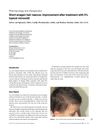
July 2007 in “International Journal of Dermatology” Using 5% topical minoxidil improved and normalized the hair growth in a girl with short anagen hair naevus.
Understanding wound healing and signaling pathways could lead to new alopecia treatments.
 61 citations
,
June 2018 in “Proceedings of the National Academy of Sciences of the United States of America”
61 citations
,
June 2018 in “Proceedings of the National Academy of Sciences of the United States of America” Light can turn on hair growth cells through a nerve path starting in the eyes.
94 citations
,
March 1996 in “Journal of Investigative Dermatology”  April 2016 in “The journal of investigative dermatology/Journal of investigative dermatology”
 The back of the scalp has more nerve fibers than the front, which may explain why some people feel more sensitivity there.
 15 citations
,
April 2017 in “Cell Stem Cell”
15 citations
,
April 2017 in “Cell Stem Cell” Some brain cancer cells avoid immune system detection, and certain treatments could target this to slow their growth; also, certain fat cell precursors help regenerate hair and skin after injury.
 1 citations
,
October 2022 in “Scientific reports”
1 citations
,
October 2022 in “Scientific reports” Nestin identifies specific progenitor cells in hair follicles that can become outer root sheath cells.
13 citations
,
June 2020 in “International Journal of Molecular Sciences” HNG helps hair grow by keeping hair in the growth phase longer.
 20 citations
,
October 2008 in “Archives of dermatological research”
20 citations
,
October 2008 in “Archives of dermatological research” Angiogenin helps hair grow by stimulating cell growth and blood vessel formation.
February 2026 in “Chemical Engineering Journal” PCA hydrogel promotes hair growth by enhancing blood vessel formation and hair follicle stem cell activity.
January 2014 in “International Journal of Dermatology and Venereology” A man with hair loss and a scalp lump was diagnosed with a diffuse neurofibroma but chose not to have surgery.
10 citations
,
January 1987 in “PubMed” Thyroid hormone and epidermal growth factor affect hair angle, tooth eruption, and ear development in rats.
 76 citations
,
March 2005 in “Journal of Molecular Medicine”
76 citations
,
March 2005 in “Journal of Molecular Medicine” Certain mice without specific receptors or mast cells don't lose hair from stress.
 17 citations
,
April 2017 in “PLoS ONE”
17 citations
,
April 2017 in “PLoS ONE” Hair follicle cells can become bone-like cells, useful for bone repair.
August 2021 in “The Journal of Physiology” NKCC1 transporters help control neuron excitability and inhibition.