The study found genetic variations in sheep that affect traits like milk production, growth, and health.
 25 citations
,
September 2018 in “Scientific Reports”
25 citations
,
September 2018 in “Scientific Reports” Morroniside may help hair grow and stay in its growth phase by affecting certain cell signals.
1 citations
,
September 2020 in “Sahel Journal of Veterinary Sciences” Switching to coarser feed and providing hay improved the sheep's health.
 35 citations
,
May 2019 in “Frontiers in genetics”
35 citations
,
May 2019 in “Frontiers in genetics” Non-coding RNAs play key roles in the hair growth cycle of Angora rabbits.
9 citations
,
May 2021 in “JEADV. Journal of the European Academy of Dermatology and Venereology/Journal of the European Academy of Dermatology and Venereology” Topical minoxidil may help treat a rare genetic hair condition with no fully effective treatments yet.
18 citations
,
January 2015 in “Journal of medical genetics” New genes linked to woolly hair have been found, which could help treat it and change hair texture.
1 citations
,
December 2022 in “Bioactive Materials” The microneedle patch with quercetin, zinc, and copper effectively promotes hair regrowth for androgenic alopecia.
 1 citations
,
January 2022 in “Transgender health”
1 citations
,
January 2022 in “Transgender health” Hormone therapy in transgender individuals can increase acne and affect hair growth and loss.
 May 2024 in “Frontiers in medicine”
 A genetic mutation in the LIPH gene causes tightly curled hair that stops growing in some Japanese individuals.
 July 2025 in “bioRxiv (Cold Spring Harbor Laboratory)”
 A new Wnt surrogate specifically targets the Frizzled7 receptor, promoting organoid formation and hair growth.
 40 citations
,
February 1990 in “Journal of The American Academy of Dermatology”
40 citations
,
February 1990 in “Journal of The American Academy of Dermatology” A 17-year-old developed woolly hair nevus in adolescence, which is unusual, and over time the hair darkened and straightened slightly, but microscopic changes persisted.
March 2021 in “Annals of palliative medicine” Plum-blossom needling with conventional treatments improves hair regrowth in alopecia areata.
July 2025 in “Frontiers in Medicine” Mutations in the LIPH gene cause woolly hair in a child.
 7 citations
,
January 2015 in “Evidence-based Complementary and Alternative Medicine”
7 citations
,
January 2015 in “Evidence-based Complementary and Alternative Medicine” The review suggests renaming two herbs to avoid confusion and recommends more research for safe use.
 7 citations
,
November 2014 in “Histochemistry and Cell Biology”
7 citations
,
November 2014 in “Histochemistry and Cell Biology” The we/we wal/wal mice have defects in hair growth and skin layer formation, causing hair loss, useful for understanding alopecia.
 August 2016 in “Journal of Investigative Dermatology”
 Researchers found a new genetic mutation linked to a hair condition in a Japanese boy.
 April 2019 in “Journal of Investigative Dermatology”
 Non-coding RNA boosts retinoic acid production and signaling, aiding regeneration.
 August 2010 in “Journal of The American Academy of Dermatology”
 The document explains the diagnosis and characteristics of woolly hair nevus and alopecia neoplastica.
 6 citations
,
July 2007 in “Developmental Dynamics”
6 citations
,
July 2007 in “Developmental Dynamics” The molecule Wise is involved in the development of various structures in chick embryos.
4 citations
,
January 2011 in “Chinese Herbal Medicines” Improving wogonin's solubility greatly increases its absorption in the body.
 17 citations
,
September 2022 in “Genes & Genomics”
17 citations
,
September 2022 in “Genes & Genomics” Long non-coding RNAs affect feather growth in chickens in ways that don't follow traditional genetic rules.

Proper planning and careful extraction are crucial for successful and sustainable hair transplants.
 9 citations
,
November 2021 in “Current Opinion in Genetics & Development”
9 citations
,
November 2021 in “Current Opinion in Genetics & Development” Wounds can cause new hair growth in adult mice, influenced by Wnt signaling.
43 citations
,
April 2010 in “Clinical genetics” Truncating mutations in the C2orf37 gene cause Woodhouse–Sakati syndrome.
 19 citations
,
June 2020 in “Animals”
19 citations
,
June 2020 in “Animals” Poor maternal nutrition can lead to fewer wool follicles in Chinese Merino sheep.
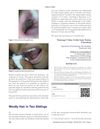
Recognizing bamboo hair helps diagnose Netherton’s syndrome.
 January 2012 in “International Journal of Trichology”
 Two siblings have a rare genetic condition causing curly, coarse hair.
37 citations
,
January 2010 in “Journal of Clinical Investigation” N-WASP is essential for normal hair growth in mice.
 80 citations
,
April 2017 in “Frontiers in Pharmacology”
80 citations
,
April 2017 in “Frontiers in Pharmacology” PDRN helps repair tissue and improve wound healing with a high safety profile.
 4 citations
,
May 2020 in “Cureus”
4 citations
,
May 2020 in “Cureus” A new genetic mutation causing Werner's syndrome was found in an Indian man.