 10 citations
,
January 2011 in “Journal of Cutaneous and Aesthetic Surgery”
10 citations
,
January 2011 in “Journal of Cutaneous and Aesthetic Surgery” Surgical methods for hair loss are less common than hair transplants but still useful, especially for scarring hair loss.
 9 citations
,
July 2018 in “European journal of dermatology/EJD. European journal of dermatology”
9 citations
,
July 2018 in “European journal of dermatology/EJD. European journal of dermatology” Disrupted sleep patterns can harm skin and hair cell renewal, but melatonin might help.
 7 citations
,
March 2025 in “Archives of Dermatological Research”
7 citations
,
March 2025 in “Archives of Dermatological Research” Trichoscopy helps better understand and manage alopecia areata, improving patient outcomes.
 6 citations
,
January 2010 in “Actas Dermo-Sifiliográficas”
6 citations
,
January 2010 in “Actas Dermo-Sifiliográficas” Follicular Unit Hair Transplantation has become a less invasive procedure with natural results, suitable for certain adults with hair loss.
 5 citations
,
July 2022 in “International Journal of Health Sciences”
5 citations
,
July 2022 in “International Journal of Health Sciences” The herbal hair tonic effectively fights fungi and bacteria and has good texture and balance.
 5 citations
,
May 2020 in “Diagnostics”
5 citations
,
May 2020 in “Diagnostics” Lower zinc levels may predict less effective hair loss treatment.
 4 citations
,
January 2019 in “Skin appendage disorders”
4 citations
,
January 2019 in “Skin appendage disorders” The new Follicular Map method could help assess hair treatment effectiveness but has some limitations.
 4 citations
,
August 2013 in “Case reports in dermatology”
4 citations
,
August 2013 in “Case reports in dermatology” A patient with total hair loss developed vitiligo after using a treatment called DCP.
 1 citations
,
May 2017 in “InTech eBooks”
1 citations
,
May 2017 in “InTech eBooks” Hair loss in Androgenetic alopecia (AGA) is due to altered cell sensitivity to hormones, not increased hormone levels. Hair growth periods shorten over time, causing hair to become thinner and shorter. This is linked to miscommunication between cell pathways in hair follicles. There's also a change in gene expression related to blood vessels and cell growth in balding hair follicles. The exact molecular causes of AGA are still unclear.
 1 citations
,
January 2013 in “International Journal of Trichology”
1 citations
,
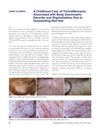
January 2013 in “International Journal of Trichology” A girl with red hair developed hair-pulling and body image disorders after being bullied for her hair color.
 July 2025 in “Journal of Dermatology Research Reviews & Reports”
 A 10-year-old girl with hair and eyelash loss showed significant regrowth after treatment.

Dupilumab may cause hair loss, so patients should be monitored.
 July 2024 in “Plastic and Aesthetic Research”
 Careful planning and accurate diagnosis are crucial for successful hair restoration surgery.
 September 2023 in “Cureus”
 Early recognition and treatment of atypical alopecia areata in infants are crucial.
 July 2021 in “International journal of dermatology, venereology and leprosy sciences”
 Diphenylcyclopropenone is more effective and has fewer side effects than dinitrochlorobenzene for treating alopecia areata.
 October 2018 in “Springer eBooks”
 The document concludes that various hair disorders have different treatments, including medication, surgery, and addressing underlying causes.
 January 2018 in “Springer eBooks”
 Gender affects hair and scalp characteristics, with differences in hormone responses, graying patterns, and trace metals.
 January 2016 in “Elsevier eBooks”
 Trichoscopy is a key method for dermatologists to quickly and effectively diagnose hair and scalp conditions.
 51 citations
,
March 1987 in “Journal of The American Academy of Dermatology”
51 citations
,
March 1987 in “Journal of The American Academy of Dermatology” Minoxidil keeps most hair growth from first year and twice-daily use is better with few side effects.
 47 citations
,
June 2011 in “Movement Disorders”
47 citations
,
June 2011 in “Movement Disorders” The LRRK2-G2019S mutation in Parkinson's disease has a lifetime penetrance of 25-35%, and finasteride may help reduce symptoms in adult male Tourette syndrome patients.
 46 citations
,
May 2011 in “Movement Disorders”
46 citations
,
May 2011 in “Movement Disorders” Finasteride reduces Tourette syndrome symptoms, but results may be limited due to potential biases.
 39 citations
,
May 2011 in “Movement Disorders”
39 citations
,
May 2011 in “Movement Disorders” Finasteride may help reduce symptoms in male Tourette syndrome patients.
 31 citations
,
June 2011 in “Movement Disorders”
31 citations
,
June 2011 in “Movement Disorders” The document describes a woman with familial Parkinson's disease due to a genetic mutation, showing severe symptoms and poor response to treatment, and suggests finasteride may help reduce symptoms in Tourette syndrome.
 17 citations
,
May 2011 in “Movement Disorders”
17 citations
,
May 2011 in “Movement Disorders” Finasteride significantly reduced tics and obsessive-compulsive symptoms in patients with Tourette syndrome.
 11 citations
,
November 2015 in “Skin Research and Technology”
11 citations
,
November 2015 in “Skin Research and Technology” Women's hair grows faster and thicker than men's, but hair growth slows for both genders with pattern hair loss.
 10 citations
,
June 2011 in “Movement Disorders”
10 citations
,
June 2011 in “Movement Disorders” THAP1 gene changes do not affect DYT1 dystonia; finasteride may help reduce tics and OCD in Tourette syndrome.
 7 citations
,
June 2011 in “Movement Disorders”
7 citations
,
June 2011 in “Movement Disorders” A specific gene mutation is linked to a hereditary form of dystonia that responds well to certain medications.
 5 citations
,
May 2011 in “Movement Disorders”
5 citations
,
May 2011 in “Movement Disorders” Finasteride significantly reduced tics and obsessive-compulsive symptoms in Tourette syndrome patients.
 5 citations
,
May 2011 in “Movement Disorders”
5 citations
,
May 2011 in “Movement Disorders” Finasteride may help reduce tic severity in male Tourette syndrome patients.
 4 citations
,
May 2011 in “Movement Disorders”
4 citations
,
May 2011 in “Movement Disorders” A woman's unique dementia was misdiagnosed, a genetic mutation increases Parkinson's risk with age, and finasteride may help with Tourette syndrome.