
Local flaps are effective for covering small to large scalp and forehead defects with good cosmetic results.
 1 citations
,
September 2021 in “CRC Press eBooks”
1 citations
,
September 2021 in “CRC Press eBooks” Frontal Fibrosing Alopecia is a hair loss condition mainly affecting postmenopausal women, with unclear causes and various clinical patterns.
 September 2021 in “CRC Press eBooks”
 Fibrosing alopecia in a pattern distribution is a type of hair loss that may often be overlooked, especially in men.
3 citations
,
November 1992 in “The Journal of Dermatologic Surgery and Oncology” The method effectively reduces and hides scalp defects after surgery.
53 citations
,
July 2002 in “Journal of Investigative Dermatology” The Dfl mutation in mice causes poor sebaceous gland function and complete hair loss.
12 citations
,
February 2017 in “Graefe s Archive for Clinical and Experimental Ophthalmology” Gore-Tex is effective for severe congenital ptosis, with the open approach better for no lid crease and the closed approach better for a preserved crease.
 13 citations
,
November 2014 in “Clinics in Plastic Surgery”
13 citations
,
November 2014 in “Clinics in Plastic Surgery” The transtemporal midface lift improves the lower eyelid and cheek area with high patient satisfaction and low complication rates.
1 citations
,
April 2024 in “Lasers in Surgery and Medicine” The model helps improve medical devices by showing how skin deforms under pressure.
6 citations
,
October 2014 in “International Journal of Molecular Sciences” Tanshinone IIA helps protect tissue from low oxygen damage by activating certain cell pathways.
January 2006 in “Chinese Journal of Aesthetic Medicine” Zinc improves skin flap survival in rats.
July 2026 in “bioRxiv (Cold Spring Harbor Laboratory)” FAKΔe4 helps cells sense and respond to different stiffness levels in their environment.
 August 1998 in “Dermatologic Surgery”
 Follicular unit hair transplantation is better than Miniflap Hair Restoration due to less scarring and more natural results.
 January 2022 in “International Microsurgery Journal”
 This method effectively reconstructs scarred penopubic junctions after surgery.
 4 citations
,
June 2013 in “Aesthetic Plastic Surgery”
4 citations
,
June 2013 in “Aesthetic Plastic Surgery” Minoxidil improved rat skin flap survival but was less effective than surgical methods.
 2 citations
,
September 2003 in “Annals of Plastic Surgery”
2 citations
,
September 2003 in “Annals of Plastic Surgery” The document concludes that hair from the forehead can be used to reconstruct eyebrows.
 1 citations
,
January 2019 in “Advances in Medical Sciences”
1 citations
,
January 2019 in “Advances in Medical Sciences” The combination of azelaic acid, minoxidil, and caffeine significantly increased the survival of skin flaps by affecting certain body channels and nitric oxide levels.
10 citations
,
July 2019 in “Advances in Wound Care” Reducing Flightless I protein improves wound healing by activating skin stem cells.
EFBL offers hidden incisions, faster recovery, and fewer risks, but may raise hairline and cost more.
A wavy two-layer closure in hair transplants makes scars nearly invisible for most patients.
 3 citations
,
August 2018 in “Journal der Deutschen Dermatologischen Gesellschaft”
3 citations
,
August 2018 in “Journal der Deutschen Dermatologischen Gesellschaft” The technique effectively repairs skin after tumor removal, maintaining appearance and function without complications.
 May 2026 in “The EMBO Journal”
 Feather follicles form through specific cellular flows and mechanical changes in the skin.
 1 citations
,
April 2017 in “Journal of Investigative Dermatology”
1 citations
,
April 2017 in “Journal of Investigative Dermatology” D-OCT shows increased blood vessel growth in response to tissue damage in Frontal Fibrosing Alopecia and is useful for diagnosis and monitoring.
 November 2021 in “CRC Press eBooks”
 Fibrosing alopecia in a pattern distribution is a new type of scarring hair loss that resembles common baldness and an autoimmune skin disease.
39 citations
,
January 2006 in “Journal of Cosmetic and Laser Therapy” Pneumatic Skin Flattening (PSF) significantly reduces pain during laser and IPL hair removal.
3 citations
,
February 2018 in “Aesthetic plastic surgery” The Locked Cheek Lift is a simple, effective method for cheek and lower eyelid rejuvenation with a high success rate and minimal complications.
 3 citations
,
December 2020 in “International Journal of Women's Dermatology”
3 citations
,
December 2020 in “International Journal of Women's Dermatology” Scalp micro-wounding helps promote hair growth in female pattern hair loss.
 19 citations
,
February 2008 in “Facial Plastic Surgery”
19 citations
,
February 2008 in “Facial Plastic Surgery” The article concludes that microvascular free flaps, especially the latissimus dorsi flap, are recommended for large scalp reconstructions, and hair transplantation offers high survival rates and excellent aesthetic results.
 February 2004 in “Dermatologic Surgery”
 Deep Plane Fixation in scalp surgeries allows for more tissue removal with less tension and minimal scarring.
 5 citations
,
February 2011 in “Aesthetic Plastic Surgery”
5 citations
,
February 2011 in “Aesthetic Plastic Surgery” The new technique for repositioning lower eyelid fat with a midface lift is easier, faster, and has better results with fewer complications.
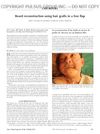 5 citations
,
December 2011 in “Canadian Journal of Plastic Surgery”
5 citations
,
December 2011 in “Canadian Journal of Plastic Surgery” Hair grafts can successfully reconstruct a beard on reconstructed jaw skin, improving appearance and patient satisfaction.