January 2026 in “Dermatologica Sinica” Both oral and topical minoxidil effectively regrow hair in men with similar results.
4 citations
,
April 2020 in “Dermatology practical & conceptual” Topical finasteride works faster and better than 17α-estradiol for postmenopausal hair loss.
 September 2025 in “Journal of the American Academy of Dermatology”
 Combining topical finasteride with minoxidil significantly improves hair density in treating hair loss.
May 2018 in “Hair transplant forum international” Topical finasteride promotes hair growth with minimal side effects but needs more research for women and optimal use.
 3 citations
,
October 2015 in “PubMed”
3 citations
,
October 2015 in “PubMed” Most men stopped using the hair loss treatment not because of sexual side effects, but because they didn't see positive results.
 September 2025 in “JAAD reviews.”
 Finasteride and dutasteride can improve hair loss in women, but more research is needed.

Combined oral minoxidil and finasteride significantly improve hair density in men with male pattern baldness.
 April 2025 in “Journal of Pioneering Medical Science”
 Topical minoxidil is safer and improves hair density better than oral minoxidil.
 41 citations
,
December 2008 in “Journal of the American Academy of Dermatology”
41 citations
,
December 2008 in “Journal of the American Academy of Dermatology” Oral valganciclovir improved a patient's skin condition caused by immunosuppression.
 30 citations
,
December 1999 in “International Journal of Dermatology”
30 citations
,
December 1999 in “International Journal of Dermatology” Oral ivermectin effectively cured scabies with minimal side effects, and finasteride promoted hair growth in men with hair loss.
January 2026 in “Open Science Framework” Oral and topical 5-alpha reductase inhibitors affect DHT levels and hair density differently in treating hair loss.
 August 2025 in “Archives of Dermatological Research”
 Oral minoxidil is more effective than topical minoxidil for hair growth in men.
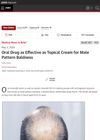
Oral minoxidil works as well as topical minoxidil for male pattern baldness.
 18 citations
,
April 2010 in “Journal of Chromatography B”
18 citations
,
April 2010 in “Journal of Chromatography B” New method measures finasteride in blood quickly and accurately.
Oral bicalutamide may cause hair regrowth in male pattern baldness but has significant side effects.
 March 2023 in “International Journal of Trichology”
 Using both minoxidil and finasteride together is more effective for male hair loss than using either one alone.
 December 2025 in “PubMed”
 The minoxidil and finasteride foam remains stable and effective for 180 days at room temperature.
September 2025 in “Toxicology” Long-term use of finasteride and minoxidil may harm male reproductive health in mice.
April 2025 in “Skin Health and Disease” Oral minoxidil is an effective alternative for hair loss but may cause more unwanted hair growth.
 108 citations
,
March 2006 in “Archives of Dermatology”
108 citations
,
March 2006 in “Archives of Dermatology” Finasteride with oral contraceptive helps improve hair loss in premenopausal women.
 2 citations
,
March 2021 in “Journal of Cosmetic Dermatology”
2 citations
,
March 2021 in “Journal of Cosmetic Dermatology” Combining platelet-rich plasma therapy with low dose oral minoxidil improved hair growth in men with hair loss, with slightly higher satisfaction at the higher minoxidil dose.
 127 citations
,
June 2006 in “International Journal of Pharmaceutics”
127 citations
,
June 2006 in “International Journal of Pharmaceutics” Liposomes and niosomes improve finasteride delivery for hair loss treatment.
23 citations
,
April 2018 in “PubMed” Topical finasteride reduces hair loss and promotes hair growth in men and women.
 5 citations
,
May 2020 in “Pharmaceutical Research”
5 citations
,
May 2020 in “Pharmaceutical Research” Heat and chemicals improve finasteride delivery to scalp and hair follicles, potentially enhancing treatment for hair loss.
 October 2025 in “Frontiers in Medicine”
 The minoxidil-finasteride combination is more effective for hair growth than minoxidil alone.
 February 2025 in “Advances in Therapy”
 The topical finasteride spray was safe and well-tolerated with stable effects.
 October 2023 in “Journal of Cosmetic Dermatology”
 Using both minoxidil and finasteride together is more effective for hair growth than using either one alone in men with hair loss.
 September 2023 in “Cureus”
 Topical finasteride might be a good alternative for hair loss treatment with fewer side effects, but more research is needed.
 October 2020 in “Journal of Pharmaceutical Sciences”
 Topical finasteride with EGCG or TA improves drug release and dermal uptake, potentially treating hair loss effectively.
 64 citations
,
June 2009 in “Journal of The American Academy of Dermatology”
64 citations
,
June 2009 in “Journal of The American Academy of Dermatology” Oral dutasteride can potentially treat frontal fibrosing alopecia in postmenopausal women, with some patients showing disease arrest and hair regrowth.