 2 citations
,
January 2017 in “Przegla̧d dermatologiczny”
2 citations
,
January 2017 in “Przegla̧d dermatologiczny” Two trichoscopic patterns found in hair loss: diffuse fibrotic and androgenetic alopecia, affecting treatment choice and regrowth chances.
46 citations
,
August 1977 in “Journal of Morphology” The big-clawed shrew's sinus hair follicles are highly specialized for sensing vibrations.
September 2025 in “International Journal of Cosmetic Science” Friction causes hair breakage during combing, and fragment count predicts hair strength.
 May 2012 in “Scientific American”
 New app improves storm surge predictions; advances in baldness treatment show potential but require time.
21 citations
,
December 2017 in “bioRxiv (Cold Spring Harbor Laboratory)” Fibroblast behavior is key for skin structure and healing.
 2 citations
,
September 2023 in “PLoS biology”
2 citations
,
September 2023 in “PLoS biology” Newly divided skin cells quickly move to join skin structures due to tissue tension and specific signals.
93 citations
,
May 1990 in “The EMBO Journal” Mice with extra sheep genes had hair that fell out and regrew in cycles.
5 citations
,
January 1979 in “Archives of Dermatological Research” 1 citations
,
April 2019 in “PubMed” The medulla in Asian scalp hair has a tubular structure that allows ions and large molecules to flow through it.
20 citations
,
October 1996 in “Journal of the American Academy of Dermatology”  7 citations
,
September 2017 in “Scientific Reports”
7 citations
,
September 2017 in “Scientific Reports” Mice with too much sPLA₂-IIA have hair loss and poor wound healing due to abnormal hair growth and stem cell depletion.
29 citations
,
January 2016 in “Experimental Dermatology” Mechanical stress may cause lesions in Hidradenitis suppurativa.
84 citations
,
June 1970 in “Journal of Investigative Dermatology” January 2010 in “EPub Bayreuth (University of Bayreuth)” Polyquaternium-87 reduces hair friction the most among tested polymers.
21 citations
,
December 1994 in “British Journal of Dermatology” Sheep dermal papillae can help form hair follicles in skin models.
2 citations
,
January 2017 in “International Journal of Trichology” Trichoscopy can reveal specific hair and scalp changes in linear morphea.
 12 citations
,
October 2016 in “Anais Brasileiros de Dermatologia”
12 citations
,
October 2016 in “Anais Brasileiros de Dermatologia” Frontal Fibrosing Alopecia may be linked to autoimmune diseases like Sjögren's syndrome.
 December 1994 in “The American Journal of Cosmetic Surgery”
 Understanding the scalp's blood flow and using delay techniques can improve the success of hair restoration surgeries.
1 citations
,
June 2018 in “Archives of Disease in Childhood Education & Practice” The girl's hair started regrowing after 6 weeks of treatment.
 September 2025 in “bioRxiv (Cold Spring Harbor Laboratory)”
 Non-invasive methods can effectively monitor hair growth cycles, aiding hair loss treatment development.
 March 2022 in “Más dermatología”
 Chronic lupus and frontal fibrosing alopecia can occur together, but their connection is unclear.
July 2024 in “Journal of Investigative Dermatology” Mechanical tension worsens keloid scars by activating inflammation and fibrosis pathways.
1 citations
,
January 1999 in “Dermatology” 5 citations
,
May 2001 in “Proceedings of SPIE, the International Society for Optical Engineering/Proceedings of SPIE” The DWLSM provides detailed imaging of hair shafts and follicles with high accuracy.
 7 citations
,
January 2012 in “International Journal of Trichology”
7 citations
,
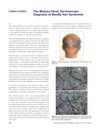
January 2012 in “International Journal of Trichology” A man with Woolly Hair Syndrome had very curly, fragile hair, and doctors used a special scalp examination to diagnose him without invasive tests.
55 citations
,
February 2014 in “Journal of Structural Biology” Human hair has a complex, variable structure with a consistent matrix and double-twist pattern.
 9 citations
,
February 2022 in “Archives animal breeding/Archiv für Tierzucht”
9 citations
,
February 2022 in “Archives animal breeding/Archiv für Tierzucht” A circular RNA helps cashmere goat hair cells become hair follicles by blocking a molecule to boost a gene important for hair growth.
13 citations
,
June 2014 in “Experimental Mechanics”  April 2026 in “Scientific Reports”
 Capillary and dermal papilla interactions are vital for hair growth and aging, with potential for treating hair loss.
 April 2016 in “Proceedings of SPIE”
 UV-induced autofluorescence is effective for identifying different types of alopecia.