 November 2024 in “NeoReviews”
 Pallister-Killian Syndrome is a complex genetic disorder requiring coordinated care and genetic counseling.
12 citations
,
January 2013 in “Indian dermatology online journal” The document reports a unique case of woolly hair with a combination of conditions not previously seen together.
14 citations
,
May 1979 in “International Journal of Dermatology” Trichostasis spinulosa mainly affects the nose, with many tiny hairs in one follicle, possibly influenced by hormones and sunlight.
36 citations
,
July 1988 in “Archives of Dermatological Research” Pili annulati is caused by a protein metabolism disorder affecting hair structure.
 4 citations
,
May 2020 in “Journal of The American Academy of Dermatology”
4 citations
,
May 2020 in “Journal of The American Academy of Dermatology” Cicatricial pattern hair loss is likely advanced common baldness, not a type of lichen planopilaris.
12 citations
,
January 2000 in “Journal of cutaneous medicine and surgery” Microorganism overgrowth and hyperkeratosis may trigger immune reactions causing lichen planopilaris.
8 citations
,
October 2024 in “Developmental Cell” July 2023 in “International journal of physiology” Hypertrichosis lanuginosa causes excessive fine hair growth, often linked to genetics or cancer, with limited treatment options.
26 citations
,
April 2007 in “Journal of clinical oncology” September 2025 in “Indian Journal of Dermatology” A Turkish woman has a hair condition caused by a LIPH gene mutation.
8 citations
,
December 2003 in “Experimental Dermatology” Altering the keratin 17 gene in mice hair follicles caused temporary hair issues, but changes were minimal and short-lived.
 15 citations
,
May 2014 in “Journal of dermatology”
15 citations
,
May 2014 in “Journal of dermatology” Zouboulis syndrome is a rare condition that helps diagnose monosomy 18p early.
 March 2023 in “International journal of integrated medical research”
 Keratosis pilaris is a common skin condition where hair follicles get clogged with keratin, mostly on the arms and thighs.
March 2022 in “JAAD case reports” A man had a non-cancerous, fast-growing skin lump on his arm that was removed with surgery.
 May 2026 in “Scientific Reports”
 Overexpression of LRIG3 in skin causes hair loss.
12 citations
,
January 2013 in “Indian dermatology online journal” Dermatopathia pigmentosa reticularis causes skin discoloration, hair loss, and nail problems.
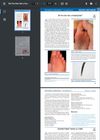 December 2022 in “The journal of pediatrics/The Journal of pediatrics”
 A young girl's foot lesion was actually a rare condition caused by a hair fragment under the skin, not a parasite.
6 citations
,
February 2020 in “Journal of Cutaneous Pathology” Nevus psiloliparus lacks mature hair follicles but keeps other skin structures intact.
4 citations
,
April 2012 in “The journal of investigative dermatology/Journal of investigative dermatology” Krt16-deficient mice help understand skin disorders like PC and FNEPPK.
 September 2025 in “Media Kedokteran Hewan”
 90% of African pygmy hedgehogs in the study had fungal infections.
10 citations
,
July 2001 in “PubMed” A new type of pachyonychia congenita may exist, caused by a different keratin mutation.
 5 citations
,
October 2015 in “The American journal of pathology”
5 citations
,
October 2015 in “The American journal of pathology” Mice with a mutated Dsg3 gene showed severe symptoms but not the typical blistering of pemphigus vulgaris.
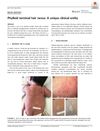
A rare case of a woman having both lichen planus pigmentosus and classic lichen planopilaris at the same time.
 August 2018 in “Pediatric Dermatology”
 A baby had a unique skin condition with a pale patch and surrounding dark hairs, not linked to other health issues.
 1 citations
,
December 2022 in “bioRxiv (Cold Spring Harbor Laboratory)”
1 citations
,
December 2022 in “bioRxiv (Cold Spring Harbor Laboratory)” Pangolins have lost some skin-related genes, but kept others, showing complex skin evolution.
14 citations
,
November 2015 in “Dermatology” The research provided insights into the presentation and management of alopecic and aseptic nodules of the scalp.
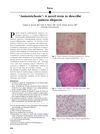
July 2004 in “TSpace (University of Toronto)” A rare case showed alopecia areata and lichen planus occurring together in one person.
 25 citations
,
April 2007 in “Journal of The American Academy of Dermatology”
25 citations
,
April 2007 in “Journal of The American Academy of Dermatology” The document suggests "anisotrichosis" as a new term for hair thickness variation in common baldness.
13 citations
,
January 1985 in “International Journal of Dermatology” The document found differences in lesion distribution and microscopic features among trichostasis spinulosa and similar skin conditions.
36 citations
,
July 1996 in “The journal of investigative dermatology/Journal of investigative dermatology” Mice with the 'lanceolate hair' mutation have abnormal hair and skin similar to human Netherton's syndrome.