 February 2024 in “International Journal of Molecular Sciences”
 Hair loss in Androgenetic Alopecia is caused by genetics, aging, and lifestyle, leading to hair follicle shrinkage and related health risks.
 January 2024 in “Indian Journal of Pharmaceutical Sciences”
 Relaxing certain muscles might straighten curly hair.
 January 2024 in “Indian Journal of Pharmaceutical Sciences”
 Relaxing the Arrector Pili Muscle might make curly hair straighter.
December 2023 in “JEADV Clinical Practice” Brownish halos around axillary hair can help diagnose frontal fibrosing alopecia.
October 2023 in “Nutrients” Millet and wheat extracts may improve hair health and promote growth.
 October 2023 in “Biomaterials”
 Nanotechnology could improve hair regrowth but faces challenges like complexity and safety concerns.
 August 2023 in “Journal of the American Academy of Dermatology”
 A scalp biopsy is essential for accurately identifying different types of hair loss.

New treatments for hair loss should target eight main causes and use specific plant compounds and peptides for better results.
 June 2023 in “JAAD case reports”
 The document concludes that "hot comb alopecia" is now called "central cicatricial centrifugal alopecia" and its causes are complex.
 May 2023 in “Journal of Clinical Medicine”
 New understanding and treatments for hair loss are improving, but more research is needed.
April 2023 in “International journal of molecular sciences” People with Collagen VI-related myopathies may often have hair loss and scalp issues.
 August 2022 in “Our Dermatology Online”
 The conclusion is that examining the scalp closely and checking for iron levels and thyroid issues is key to understanding chronic hair loss in women.
 August 2022 in “Case reports”
 Isotretinoin effectively treated a rare scalp condition, but careful drug monitoring and a dairy-free diet were important.
 May 2022 in “Journal of the Egyptian Women's Dermatologic Society (Print)”
 Women's hair loss can be due to hormonal changes and various conditions, with treatments focusing on stopping progression and managing symptoms.
 December 2021 in “Journal of clinical images and medical case reports”
 Moth-eaten alopecia is linked to various skin diseases and requires early treatment to prevent worsening.
 January 2020 in “Egyptian Journal of Dermatology and Venereology”
 People with alopecia have shorter hair follicles and more c-kit, a stem cell factor receptor, which could predict how the condition progresses.
 January 2017 in “Journal of Investigative Dermatology Symposium Proceedings”
 The 2015 Hair Research Congress concluded that stem cells, maraviroc, and simvastatin could potentially treat Alopecia Areata, topical minoxidil, finasteride, and steroids could treat Frontal Fibrosing Alopecia, and PTGDR2 antagonists could also treat alopecia. They also found that low-level light therapy could help with hair loss, a robotic device could assist in hair extraction, and nutrition could aid hair growth. They suggested that Alopecia Areata is an inflammatory disorder, not a single disease, indicating a need for personalized treatments.
May 2023 in “Journal of Cosmetic Dermatology” Androgenetic alopecia is linked to higher cardiovascular and metabolic risks, possibly due to irisin resistance.
Protein profiling of forehead skin can help distinguish between frontal fibrosing alopecia and androgenetic alopecia.
April 2022 in “Journal of Investigative Dermatology” Androgenetic alopecia causes hair thinning due to increased androgen activity, treatable with minoxidil and finasteride.
January 2018 in “Our Dermatology Online” Dutasteride injections can help hair growth in androgenic alopecia but need more research for long-term use.
 1 citations
,
November 2023 in “iScience”
1 citations
,
November 2023 in “iScience” A protein called desmoglein 3 is important for keeping hair follicle stem cells inactive and helps in their regeneration.
 January 2023 in “Karger Kompass. Dermatologie”
 Scientists are still unsure what triggers the immune system to attack hair follicles in Alopecia areata.
 44 citations
,
January 2006 in “Biological & Pharmaceutical Bulletin”
44 citations
,
January 2006 in “Biological & Pharmaceutical Bulletin” Androgen hormones cause hair follicle scarring in hair loss, and finasteride helps reduce it.
 40 citations
,
January 2013 in “International journal of trichology”
40 citations
,
January 2013 in “International journal of trichology” Perifollicular erythema can indicate active frontal fibrosing alopecia.
 38 citations
,
July 2021 in “ACS Nano”
38 citations
,
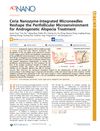
July 2021 in “ACS Nano” Microneedles help treat hair loss by improving hair surroundings and promoting growth.
 33 citations
,
July 1992 in “Journal of Investigative Dermatology”
33 citations
,
July 1992 in “Journal of Investigative Dermatology” Minoxidil doesn't affect perifollicular lymphoid infiltration in alopecia areata patients.
 30 citations
,
May 2016 in “International Journal of Cosmetic Science”
30 citations
,
May 2016 in “International Journal of Cosmetic Science” Hair loss in women links to inflammation around hair follicles.
30 citations
,
October 1994 in “Journal of Cutaneous Pathology” Multiple perifollicular fibromas may actually be unrecognized cases of Birt-Hogg-Dubé syndrome.
26 citations
,
April 2012 in “PubMed” Myofibroblasts in rat wound healing may come from blood vessel pericytes and perifollicular dermal sheath cells.