3 citations
,
May 2008 in “Journal of Clinical Oncology” Panitumumab treatment can cause unusual hair growth in some colorectal cancer patients.
 April 2021 in “Journal of Investigative Dermatology”
 People with atopic dermatitis have more CD4+ T cells that respond to a certain bacterial lipid, which may play a role in the skin condition's inflammation.
 1 citations
,
April 2019 in “JAAD case reports”
1 citations
,
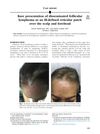
April 2019 in “JAAD case reports” A woman with lymphoma had a rare skin rash on her scalp and forehead, which was hard to diagnose but responded well to treatment.
October 2023 in “Indian Journal of Skin Allergy” Nab-paclitaxel chemotherapy can rarely cause lupus-like skin issues.
 June 2024 in “Journal of Allergy and Clinical Immunology”
 TSLP affects atopic dermatitis by increasing sebum and reducing fat through IL-4/IL-13 signaling.
 January 2026 in “Clinical Cosmetic and Investigational Dermatology”
 Early diagnosis and targeted anti-inflammatory treatments can improve outcomes in androgenetic alopecia with perifollicular inflammation and fibrosis.
 May 2024 in “Journal of colloid and interface science”
 The hydrogel helps skin heal by encouraging new blood vessel growth.
 38 citations
,
July 1998 in “Journal of surgical oncology”
38 citations
,
July 1998 in “Journal of surgical oncology” A woman with breast cancer developed a rare condition causing excessive fine hair growth on her face and body.
1 citations
,
April 2024 in “Cells” Corneal cells can potentially revert to stem cells, aiding in repair and regeneration.
July 2019 in “Cancer Research” Bone marrow and hair follicle cells help form skin tumors, suggesting new treatment targets.
February 2017 in “Developmental Cell” Mammary stem cells drive mammary gland growth by branching and cell mixing.
 77 citations
,
January 1980 in “Carcinogenesis”
77 citations
,
January 1980 in “Carcinogenesis” TPA is about 50 times more effective at promoting tumors than MZ.
21 citations
,
February 2006 in “Clinical Cancer Research” Mitf plays a key role in melanoma progression and is linked to disease stage.
 April 2018 in “Journal of Investigative Dermatology”
 The document concludes that ERBB2 mutations are common in extramammary Paget disease and may respond to systemic treatments like cancer immunotherapy.
 August 2019 in “Journal of Investigative Dermatology”
 The study found that tight junctions reach the top layer of the skin's stratum granulosum, not just the second top layer as previously thought.
October 2017 in “Journal of Investigative Dermatology” Pemphigus vulgaris involves specific immune cells and B cells that produce antibodies causing skin blisters.
5 citations
,
February 2022 in “Stem cell reports” Thymic stromal lymphopoietin (TSLP) promotes hair growth, especially after skin injury.
 July 2026 in “Nature Communications”
 Colorectal cancer uses wound-healing processes to spread, suggesting new treatment targets.
178 citations
,
April 2011 in “Journal of Clinical Investigation” Basal cell carcinomas in mice can start from hair follicle stem cells and other skin cell types, depending on signaling levels.
2 citations
,
May 2024 in “Stem Cell Reviews and Reports”  17 citations
,
November 2017 in “PLoS ONE”
17 citations
,
November 2017 in “PLoS ONE” Transplanted bone marrow cells actively move, form clusters, and grow after transplantation.
July 2025 in “Journal of Investigative Dermatology”  19 citations
,
December 2016 in “PLOS ONE”
19 citations
,
December 2016 in “PLOS ONE” Early-stage skin cells help regenerate hair follicles, with proteins SDF1, MMP3, biglycan, and LTBP1 playing key roles.
3 citations
,
December 2003 in “Archives of Pathology & Laboratory Medicine” The nodule was a benign cutaneous lymphadenoma, not cancer, and was successfully removed.
 26 citations
,
September 2018 in “Colloids and Surfaces B: Biointerfaces”
26 citations
,
September 2018 in “Colloids and Surfaces B: Biointerfaces” A new liposome treatment helps heal deep burns on mice by improving hair regrowth and reducing scarring.
 14 citations
,
January 2020 in “International Journal of Biological Sciences”
14 citations
,
January 2020 in “International Journal of Biological Sciences” Multiphoton microscopy can effectively assess breast cancer treatment responses without labels.
123 citations
,
January 2012 in “The Keio Journal of Medicine” Anti-angiogenic therapy can help treat cancer but may cause resistance and side effects, so alternative methods are being explored.
December 2024 in “Journal of Clinical Medicine” Assessing blood flow can improve skin graft success.
56 citations
,
January 2022 in “Burns & Trauma” WNT5A contributes to keloid scars by promoting cell changes through specific signaling pathways.
May 2005 in “Molecular Carcinogenesis” mrp/plf-mRNA can indicate tumor-promoting effects in skin.