 August 2025 in “Fabad Journal of Pharmaceutical Sciences”
 Cuscuta reflexa has potential medicinal benefits but needs more research for clinical use.
8 citations
,
July 2022 in “Chinese Journal of Integrative Medicine” Related plant species often have similar chemicals and healing properties.
Sweet violet helps with coughs, insomnia, allergies, and skin issues without major side effects at normal doses.
 December 2020 in “International Journal of Biosciences (IJB)”
 Eclipta alba shows promise for medicinal use but needs more research.
3 citations
,
June 2023 in “Molecules/Molecules online/Molecules annual” Cepharanthine has many medicinal uses but needs improvement for better effectiveness.
August 2024 in “Scientia Horticulturae” AMF initially inhibits but later promotes citrus root hair growth by regulating auxin levels.
 February 2022 in “Research Journal of Biotechnology”
 Eclipta alba L. is a medicinal plant with many health benefits, including treating diseases and promoting hair growth.
 June 2025 in “Pharmacon Jurnal Farmasi Indonesia”
 Mangkokan leaves may help hair growth and health.
24 citations
,
May 2017 in “Annals of botany” Pathogenic Pseudomonas syringae bacteria stimulate early root hair growth in Arabidopsis plants.
13 citations
,
July 1978 in “Journal of comparative pathology” Acanthospermum hispidum is toxic to mice, causing death and damage to internal organs.
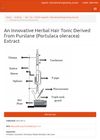
Portulaca-based hair tonics are promising eco-friendly and effective cosmetic alternatives.
 September 2016 in “International Journal of Herbal Medicine”
 Buxus wallichiana has compounds that support its use in traditional medicine.
Medicinal plants are important for local health in La Tranca Arriba.
 March 2026 in “Israel Journal of Plant Sciences”
 Endophytic bacteria in Eclipta prostrata help the plant tolerate stress and boost its medicinal properties.
 January 2023 in “Indian Journal of Unani Medicine”
 Common Myrtle is used in traditional medicine to treat various health issues.
 February 2024 in “Planta”
 TRM21 helps control flavonoid production and root hair growth in Arabidopsis thaliana.
 October 2024 in “Current Issues in Molecular Biology”
 Platycladus orientalis leaf extract helps hair grow by activating certain proteins.
 May 2024 in “Physiologia Plantarum”
 Bacillus subtilis helps plants get more phosphorus and grow better roots.
22 citations
,
December 2020 in “mSphere” A fungal enzyme was used to make compounds more soluble, aiding drug discovery and crop protection.
36 citations
,
August 2016 in “The Plant cell” A specific enzyme is crucial for the bean plant's relationship with certain beneficial soil bacteria and fungi.
 1 citations
,
June 2023 in “International journal of basic science in medicine”
1 citations
,
June 2023 in “International journal of basic science in medicine” Adiantum capillus-veneris may help with respiratory issues, but more research is needed.
 2 citations
,
January 2023 in “International Journal of Dermatology Research”
2 citations
,
January 2023 in “International Journal of Dermatology Research” Calotropis procera leaf extracts have antifungal properties, especially against Microsporum canis.
 December 2021 in “Asia-Pacific journal of pharmacotherapy & toxicology”
 Banana plant leaves extract may have cancer-fighting and antioxidant properties.
 October 2022 in “CRC Press eBooks”
 Cinchona pubescens is a medicinal plant from the Andes with potential health benefits, but more research is needed to fully understand it.
January 2010 in “Journal of Oriental Medicine” Phellodendri Cortex Extract may help treat enlarged prostate.
 1 citations
,
September 2001 in “PubMed”
1 citations
,
September 2001 in “PubMed” Phenytoin, a medication, can cause hair loss and trigger a condition similar to lupus.
January 2017 in “Journal of Drug Research in Ayurvedic Sciences” Arjuna flowers have specific features and compounds useful for their identification and standardization.
 January 2023 in “Open Access Research Journal of Biology and Pharmacy”
 Martynia annua shows promise for future medical research due to its many medicinal properties.
5 citations
,
March 2023 in “Journal of Cosmetic Dermatology” Plantago asiatica L. extract can promote hair growth by enhancing the anagen phase.
 February 2023 in “Asian journal of pharmaceutical research and development”
 Flavonoids in Iraqi marshland plants have potential health benefits like antioxidant and anti-inflammatory effects.