August 2021 in “Journal of Pakistan Association of Dermatologists” Skin issues are common and worsen with longer hemodialysis in kidney patients.
 May 2021 in “IP Indian journal of clinical and experimental dermatology”
 Dermoscopy is useful for diagnosing various skin conditions, and new patterns for diagnosis are emerging.
 August 2020 in “Research Square (Research Square)”
 Oxygen levels affect hair growth and color cells differently when they interact directly.
July 2020 in “RePub (Erasmus University, Rotterdam)” Facial skin aging is influenced by wrinkles, spots, genetics, and environment.
 July 2020 in “International Journal of Dermatology Venereology and Leprosy Sciences”
 Most postmenopausal women experience skin and hair issues, so regular check-ups are important.
October 2019 in “European Journal of Dermatology” The boy's hair and skin color differences are due to a pigmentation disorder.
Gray hair affects hair's movement and appearance, making it less bouncy and more wavy.
April 2019 in “Institutional Repositories DataBase (IRDB)” Patient-derived stem cell melanocytes could be a promising treatment for vitiligo.
 January 2019 in “International journal of dermatology, venereology and leprosy sciences”
 Patients with chronic kidney disease often have various skin problems that affect their quality of life, but early treatment can help.
January 2019 in “Advances in stem cells and their niches” Krox20 is important for cell differentiation in the brain and hair follicles.
September 2018 in “Obsgyne Review Journal of Obstetric and Gynecology of Siddharth Health Research and Social Welfare Society” Pregnant women often experience a variety of skin problems, including pigmentation changes and stretch marks.
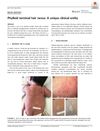 August 2018 in “Pediatric Dermatology”
 A baby had a unique skin condition with a pale patch and surrounding dark hairs, not linked to other health issues.
 March 2018 in “Journal of Pre-Clinical and Clinical Research”
 Skin problems are common in kidney disease, with dry skin and itching in patients not on dialysis or on hemodialysis, and infections most common in transplant recipients.
 January 2018 in “Springer eBooks”
 Cancer treatments targeting specific cells often cause skin, hair, and nail problems, affecting patients' lives and requiring careful management.
September 2017 in “Journal of Evidence Based Medicine and Healthcare” Eczema is the most common skin condition in children.
 August 2017 in “Journal of The American Academy of Dermatology”
 The book is a detailed and well-organized resource on skin conditions, useful for medical students and dermatologists.
 January 2017 in “Springer eBooks”
 The document concludes that Cutaneous Lupus Erythematosus has different forms, is influenced by genetic and environmental factors, and can be treated with various medications, but more targeted therapies are needed.
 January 2017 in “Acta dermato-venereologica”
 The congress showed that psychological therapy can help skin condition patients, social media affects acne stigma, education improves atopic dermatitis, and patient satisfaction in dermatology is high, especially with good doctor engagement.
January 2016 in “Georg Thieme Verlag eBooks” Understanding and careful application of dermabrasion and microdermabrasion can minimize risks and improve patient outcomes.
 September 2015 in “Actas Dermo-Sifiliográficas”
 People with advanced chronic kidney disease often have skin problems, which can be treated with various medications and procedures to improve their quality of life.
 May 2012 in “Nature Genetics”
 Blond hair in Solomon Islanders is due to a unique genetic variant, not European ancestry.
 January 2012 in “The Japanese Journal of Veterinary Dermatology”
 The dog's hair loss healed on its own without treatment.
 October 2009 in “Reactions Weekly”
 A woman developed lupus after taking hydroxyurea for two years.
The PI's development is closely linked to skin and hair pigmentation in macaques.
April 2005 in “Journal of Investigative Dermatology” Vitamin D helps protect skin, PSORS1 gene's risk interval for psoriasis is expanded, hair follicles can be generated from mouse cells, and interferon-γ may cause pigmented skin lesions.
 July 2004 in “Clinics in Dermatology”
 The Third World Congress of the International Academy of Cosmetic Dermatology discussed various topics like hair disorders, skin conditions, wound healing, shampoo technology, acne treatment, and the use of lasers in dermatology.
 January 2004 in “Side effects of drugs annual”
 Certain skin drugs and topical agents, including some natural extracts and fragrances, can cause allergic reactions. Some hair dyes and extensions, as well as minoxidil, a hair growth treatment, can also cause allergies. Botulinum toxin A can effectively reduce sweat but may have temporary side effects.
January 2004 in “Banca y finanzas: Revista profesional de gestión financiera” Androgens increase pigmentation in certain hamster skin areas, but estrogens can reverse this effect.
January 2004 in “Laboratory Animal Science and Administration” The hairless mutant gene causes early hair loss and affects skin and thymus development in mice.

research TOC
September 2003 in “Clinics in Family Practice” The document lists dermatology topics across life stages and notes hair loss can affect self-esteem and early skin cancer treatment is crucial.