 13 citations
,
January 2009 in “The Open Dermatology Journal”
13 citations
,
January 2009 in “The Open Dermatology Journal” Oral pigmentation can be a sign of Addison's disease.
 12 citations
,
May 2023 in “EMBO reports”
12 citations
,
May 2023 in “EMBO reports” High mTORC1 activity slows hair growth and causes it to lose color.
12 citations
,
August 1988 in “Histopathology” The tumor likely shows dual neural crest differentiation.
12 citations
,
January 2013 in “Indian dermatology online journal” Dermatopathia pigmentosa reticularis causes skin discoloration, hair loss, and nail problems.
11 citations
,
May 2012 in “Genesis” Bmpr2 and Acvr2a receptors are crucial for hair retention and color.
11 citations
,
April 2013 in “Homo” Darker skin in 10-year-old girls may be an early sign of puberty.
 10 citations
,
January 2011 in “Case reports in dermatological medicine”
10 citations
,
January 2011 in “Case reports in dermatological medicine” Hair transplant surgery effectively treated a specific type of hair loss and is recommended as a primary treatment option.
 9 citations
,
May 2012 in “PLOS ONE”
9 citations
,
May 2012 in “PLOS ONE” ILK is essential for skin development, pigmentation, and healing.
 6 citations
,
September 2022 in “Frontiers in pharmacology”
6 citations
,
September 2022 in “Frontiers in pharmacology” Epimedium extract helps increase skin pigmentation and could be a new treatment for conditions with reduced pigmentation.
6 citations
,
January 2019 in “Journal of feline medicine and surgery open reports” A cat with severe skin issues improved with dexamethasone and cetirizine.
6 citations
,
January 2018 in “Advances in experimental medicine and biology” Researchers created artificial human skin using special cells, which could help treat skin conditions like albinism and vitiligo.
6 citations
,
January 2016 in “International journal of trichology” Children's hair is more elastic, but tensile strength is similar across different factors.
6 citations
,
March 2010 in “Journal of plastic, reconstructive & aesthetic surgery” Laser treatment can fix skin color issues after syndactyly surgery.
 5 citations
,
March 2023 in “Journal of the American Academy of Dermatology”
5 citations
,
March 2023 in “Journal of the American Academy of Dermatology” Prurigo pigmentosa mainly affects middle-aged White and Asian women, often linked to a ketogenic diet, and is best treated with oral antibiotics.
 5 citations
,
September 2015 in “Nepalese journal of ophthalmology”
5 citations
,
September 2015 in “Nepalese journal of ophthalmology” An 11-year-old girl with a rare skin disorder also had cornea issues and dry eye, needing careful management.
4 citations
,
April 2019 in “JAAD Case Reports” DPR can cause skin, hair, and nail issues, sometimes appearing later in life.
 3 citations
,
January 2019 in “Advances in stem cells and their niches”
3 citations
,
January 2019 in “Advances in stem cells and their niches” Dermal papilla cells are key for hair growth and color, influencing hair type and size, and their interaction with stem cells could help treat hair loss and color disorders.
 3 citations
,
January 2019 in “Journal of Dermatology”
3 citations
,
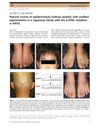
January 2019 in “Journal of Dermatology” The p.P25L mutation in the KRT5 gene causes a rare skin condition that worsens over time and may lead to hair loss starting in young adulthood.
3 citations
,
January 2016 in “Dermatology online journal” Some people with lichen planus pigmentosus might later develop frontal fibrosing alopecia.
 2 citations
,
May 2023 in “Photobiomodulation, photomedicine, and laser surgery”
2 citations
,
May 2023 in “Photobiomodulation, photomedicine, and laser surgery” Light therapy is effective and safe for treating skin color disorders like vitiligo and dark spots.
 2 citations
,
January 2002
2 citations
,
January 2002 Melanin and melanocytes contribute to the brown pigmentation in stasis dermatitis.
1 citations
,
September 2019 in “Hair transplant forum international” The laser-based microjet injector delivers tattoo pigment accurately with less tissue damage.
 1 citations
,
June 2024 in “British Journal of Dermatology”
1 citations
,
June 2024 in “British Journal of Dermatology” Mycophenolate mofetil effectively improved skin pigmentation and itching in a woman with lichen planus pigmentosus and frontal fibrosing alopecia.
 1 citations
,
August 2018 in “Journal of The American Academy of Dermatology”
1 citations
,
August 2018 in “Journal of The American Academy of Dermatology” Patients with melanoma who saw dermatologists and were from higher-income areas were more likely to have follow-up visits, which was linked to lower mortality.
1 citations
,
June 2011 in “InTech eBooks” Darker skin provides more protection against UV damage and cancer.
 August 2026 in “Journal of Genome Biotechnology and Genetics”
 Human pigmentation is influenced by many genetic and environmental factors, affecting traits like skin, hair, and eye color, with implications for health and forensic applications.
 May 2026 in “Southeast Asian Journal of Case Report and Review”
 Individualized homeopathic treatment may help improve vitiligo.
 July 2025 in “Advanced Science”
 Collagen VI and Semaphorin 3C are important for hair pigmentation and could help treat pigmentation disorders.
 October 2023 in “bioRxiv (Cold Spring Harbor Laboratory)”
 Early regulatory T cells are crucial for normal skin pigmentation.
 May 2020 in “Research Square (Research Square)”
 Human stem cells can turn into functional eye cells that might help treat retinal diseases.