 June 2025 in “Rapid Communications in Mass Spectrometry”
 The new method improves protein extraction and analysis in hair, aiding biomedical and forensic work.
 June 2022 in “Scientific Reports”
 Prevelex, a polyampholyte, can create a cell-repellent coating on microdevices, which can be useful in biomedical applications like hair follicle regeneration.
June 2026 in “ACS Applied Polymer Materials” New polymer fibers can produce proteins and have potential uses in masks and swabs.
 December 2023 in “Forensic science international. Genetics”
 The RapidHIT ID system can effectively get DNA profiles from hair roots with enough cells.
September 2022 in “bioRxiv (Cold Spring Harbor Laboratory)” Hair follicles and urine cell pellets are promising for transcriptome studies due to consistent quality and useful expression profiles.
 September 2024 in “IP Indian Journal of Clinical and Experimental Dermatology”
 The best method for high platelet yield is centrifuging at 1300 rpm then 1600 rpm.
November 2023 in “Applied sciences” Pig blood can be used to mass-produce stable, low-cost platelet dry powder for medical use.

Newly designed proteins can effectively degrade specific proteins in cells, offering a promising alternative for targeted protein degradation.
 51 citations
,
January 2024 in “Nanoscale”
51 citations
,
January 2024 in “Nanoscale” Nano-PROTACs could improve drug targeting and delivery by using nanotechnology.
January 2012 in “RepositóriUM (Universidade do Minho)” PLA nanoparticles can effectively deliver treatments to hair follicles, showing potential for hair therapy.
 September 2023 in “International journal of biological macromolecules”
 The chitosan/PDRN polyplex improved wound healing in diabetic rats.
26 citations
,
June 2010 in “Electrophoresis” New techniques helped identify rare wool proteins by reducing dominant ones.
6 citations
,
August 2025 in “Frontiers in Bioengineering and Biotechnology” Platelet-derived exosomes offer better regenerative therapy but face challenges in isolation and regulation.
 6 citations
,
March 2019 in “Dermatologic surgery”
6 citations
,
March 2019 in “Dermatologic surgery” Chilled ATPv-supplemented saline best preserves hair grafts' key genes.
 5 citations
,
January 2006 in “Journal of veterinary medical science”
5 citations
,
January 2006 in “Journal of veterinary medical science” RNA can be extracted from horsehair roots for analysis.
9 citations
,
January 2025 in “Droplet” Precise cell manipulation technologies are advancing but still face challenges in improving accuracy for medical use.
 January 2026 in “Biomaterials Science”
 The formulation helps improve wound healing and skin repair.
130 citations
,
January 2000 in “Nature biotechnology”  226 citations
,
January 2002 in “Biological and Pharmaceutical Bulletin”
226 citations
,
January 2002 in “Biological and Pharmaceutical Bulletin” A new method quickly extracts and identifies proteins from hair and other keratin sources.
 June 2022 in “Authorea (Authorea)”
 Efficient delivery systems are needed for the clinical use of CRISPR-Cas9 gene editing.
March 2023 in “MDPI eBooks” September 2010 in “대한화장품학회지(J. Soc. Cosmet. Scientists Korea)” The study developed a reliable method to measure active ingredients in hair nourisher products using HPLC.
 12 citations
,
December 2020 in “Frontiers in Cell and Developmental Biology”
12 citations
,
December 2020 in “Frontiers in Cell and Developmental Biology” The review found that the way Platelet-Rich Plasma is made varies a lot, which can change the results of medical treatments.
19 citations
,
January 2015 in “International Journal of Cosmetic Science” The improved nanoparticles can effectively target hair follicles for drug delivery.
November 2017 in “Journal of Evolution of Medical and Dental Sciences” The syringe method is better for preparing platelet-rich plasma.
 November 2023 in “ACS Applied Polymer Materials”
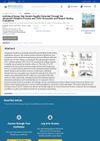
 The new method extracts keratin from hair faster and better, and the resulting product improves blood clotting and wound healing, with potential for personalized treatments.
2 citations
,
October 2018 in “Journal of Mind and Medical Sciences” A new method effectively measures nicotine and cotinine in blood and urine for forensic analysis.
January 2012 in “eScholarship (California Digital Library)” Hair and nails contain stable RNA, useful for personalized medicine and screening.
 August 2015 in “MOJ proteomics & bioinformatics”
 ePUKs could be valuable for regenerative medicine due to their wound healing abilities.

Nanotechnology improves Clomiphene citrate's effectiveness and reduces side effects for treating ovulatory disorders.