 January 2021 in “International journal of dermatology, venereology and leprosy sciences”
 Most adult women experiencing hair loss are aged 21-40, with the most common type being female pattern hair loss. Trichoscopy is a useful tool for diagnosing different types of hair loss.
 2 citations
,
August 2012 in “Journal of the American Academy of Dermatology”
2 citations
,
August 2012 in “Journal of the American Academy of Dermatology” Two patients with the same genetic mutation had both blistering skin and easily pulled out hair.
 9 citations
,
February 2004 in “Clinical and Experimental Ophthalmology”
9 citations
,
February 2004 in “Clinical and Experimental Ophthalmology” The document discusses various eye conditions and their treatments, including a rare eye cancer in a baby, vision loss from a cancer drug, cataracts from a baldness treatment, a rare skin disorder, and a specific type of eye disease diagnosed with a special imaging technique.
November 2012 in “Annales de Dermatologie et de Vénéréologie” Frontal fibrosing alopecia can occur in children, not just postmenopausal women.
1 citations
,
August 2018 in “Journal of the American Academy of Dermatology” A young woman developed facial bumps before hair loss, which is unusual for her condition.
December 2021 in “Journal of pharmaceutical research international” Trichoscopic features can help dermatologists distinguish between female pattern hair loss and chronic telogen effluvium.
 8 citations
,
September 2016 in “The American Journal of Dermatopathology”
8 citations
,
September 2016 in “The American Journal of Dermatopathology” Enlarged sweat gland ducts may indicate scarring hair loss.
 January 2021 in “International journal of dermatology, venereology and leprosy sciences”
 Trichoscopy shows black dots, yellow dots, and empty follicles are common in Alopecia Areata, with broken and exclamation mark hair as typical patterns.
13 citations
,
August 2005 in “Journal of Investigative Dermatology Symposium Proceedings” Mutations in the DSG4 gene cause fragile, sparse hair in humans, mice, and rats.
 November 2021 in “International journal of research - granthaalayah”
 The document suggests that human hair has electrical charges because of a gap in nerve cell coverage that affects electromagnetic radiation.
 March 2024 in “Case Reports in Dermatology”
 A woman's hair loss was misdiagnosed as alopecia areata but was actually lichen planopilaris, needing immediate and ongoing treatment.
 1 citations
,
July 2009 in “Journal of dermatology”
1 citations
,
July 2009 in “Journal of dermatology” A 29-year-old man had a jaw plaque diagnosed as follicular mucinosis, linked to nestin-positive hair follicle stem cells.
2 citations
,
December 2024 in “JAAD reviews.” Modifying grooming techniques and using treatments like chemical depilatories or laser hair removal can help manage Pseudofolliculitis barbae.
 April 2016 in “British Journal of Dermatology”
 Eyelashes are important for looks and eye protection, and more people are treating sparse eyelashes; more research is needed to understand eyelash biology and improve treatments.
 2 citations
,
January 2012 in “Journal of Cutaneous Pathology”
2 citations
,
January 2012 in “Journal of Cutaneous Pathology” The author clarifies that alopecia areata incognito and diffuse alopecia areata are different types of hair loss with unique symptoms and challenges in diagnosis.
13 citations
,
October 2001 in “British Journal of Ophthalmology” 48 citations
,
July 1988 in “PubMed” Rhino mice show significant meibomian gland changes, making them a potential model for studying gland disorders.
Multiphoton microscopy can effectively distinguish between scarring and non-scarring alopecia.
 March 2026 in “Frontiers in Medicine”
 Diffuse unpatterned alopecia can affect donor areas, but treatment with finasteride and minoxidil can improve hair density.
 2 citations
,
December 2019 in “Leprosy Review”
2 citations
,
December 2019 in “Leprosy Review” A woman's hair loss and skin discoloration were found to be caused by a rare case of leprosy on the scalp, not alopecia-vitiligo overlap.
 245 citations
,
March 2012 in “Journal of The American Academy of Dermatology”
245 citations
,
March 2012 in “Journal of The American Academy of Dermatology” Dermatoscopy is useful for identifying different hair and scalp conditions and can reduce the need for biopsies.
3 citations
,
December 1967 in “Australasian Journal of Dermatology” Becker's Melanosis and Hypertrichosis mainly affects young males, causing brown skin patches and extra hair on one side of the upper body.
5 citations
,
October 2019 in “JAAD Case Reports” These hair loss conditions might be part of a spectrum, not separate issues.
5 citations
,
March 2015 in “Indian Journal of Dermatology” Multiple trichofolliculomas can look like multiple trichoepitheliomas on the face.
 March 2021 in “Research Square (Research Square)”
 Patients with RASopathies have a higher risk of autoimmune disorders and should be routinely screened.
103 citations
,
December 1986 in “Journal of Investigative Dermatology” 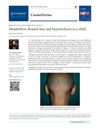 January 2026 in “Cosmoderma”
 A 9-year-old girl has a rare hair disorder causing beaded, sparse hair.
May 2017 in “Journal of the American Academy of Dermatology” 26 citations
,
April 1996 in “Journal of Investigative Dermatology” 
Equine Cushing's disease in horses causes hormonal imbalance, leading to symptoms like abnormal hair growth and requires lifelong treatment with pergolide.