7 citations
,
May 2007 in “Nutrition Journal” Hair pluckability is not a reliable method for assessing nutrition.
 56 citations
,
November 2010 in “Pigment Cell & Melanoma Research”
56 citations
,
November 2010 in “Pigment Cell & Melanoma Research” Brain hormones significantly affect hair color and could potentially be used to prevent or reverse grey hair.
32 citations
,
August 2016 in “Journal of the American Academy of Dermatology” Temporal triangular alopecia is a non-scarring hair loss in children, often linked to other health conditions.
 1 citations
,
September 2021 in “International journal of research - granthaalayah”
1 citations
,
September 2021 in “International journal of research - granthaalayah” Human hair has bipolar electrical charges because of a gap in the hair follicle's electromagnetic field.
 March 2021 in “CRC Press eBooks”
 Hair loss can cause and be caused by psychological issues.
 December 2023 in “International journal of high dilution research”
 Melatonin and Lissotriton improved hair quality and increased activity in mice.
 14 citations
,
January 2013 in “International Journal of Trichology”
14 citations
,
January 2013 in “International Journal of Trichology” Treating hair loss requires a comprehensive approach that addresses both physical and emotional aspects, with a focus on diagnosis, patient education, and good communication.
 3 citations
,
April 1978 in “PubMed”
3 citations
,
April 1978 in “PubMed” The study concludes that traction alopecia, caused by hair styling, can help understand telogen effluvium, a condition of excessive hair loss.
 March 2021 in “CRC Press eBooks”
 The document concludes that different patterns of hair thickness and scalp changes can help diagnose types of non-scarring hair loss.
November 2011 in “Journal of Investigative Dermatology” TRH in hair follicles can influence hair color by increasing melanin.
20 citations
,
August 2017 in “Drug testing and analysis” Drugs localize differently in hair strands based on their properties.
July 2025 in “International Journal of Trichology” Trichoscopy effectively diagnoses temporal triangular alopecia in children.
 12 citations
,
January 2014 in “Menoufia Medical Journal”
12 citations
,
January 2014 in “Menoufia Medical Journal” Dermoscopy improves diagnosis of hair and scalp disorders and can help avoid unnecessary biopsies.

Barbers trained in hair loss can better support and refer clients with alopecia.
18 citations
,
April 2010 in “Langmuir” Human hair surface varies in wettability, showing daily and monthly patterns.
 January 2024 in “International Journal of Trichology”
 Hair root dermoscopy is a simple, noninvasive tool to diagnose telogen effluvium.
 1 citations
,
April 2019 in “PubMed”
1 citations
,
April 2019 in “PubMed” Hair loss can have negative psychological effects and treating it needs teamwork, especially from skin doctors.
1 citations
,
December 2005 in “Journal of Biological Research - Bollettino della Società Italiana di Biologia Sperimentale” Ancient South American mummies' hair shows high sulfur, calcium, and potassium levels.
 August 2024 in “RCMOS - Revista Científica Multidisciplinar O Saber”
 Barbershops should prioritize safe, responsible scalp care and refer clients to dermatologists when needed.
15 citations
,
July 2015 in “Journal of exotic pet medicine” Humans, especially vulnerable groups, can catch skin infections from small mammals.
Trichoscopic examination is crucial for diagnosing congenital triangular alopecia.
February 2026 in “Skin Appendage Disorders” Pseudofolliculitis barbae is linked to higher rates of anxiety and depression.
 11 citations
,
March 2001 in “Clinics in Dermatology”
11 citations
,
March 2001 in “Clinics in Dermatology” Hair microscopy is useful for diagnosing hair disorders, but clear definitions are needed for accurate genetic analysis.
 2 citations
,
January 2010 in “International Journal of Trichology”
2 citations
,
January 2010 in “International Journal of Trichology” The Hair India 2010 conference introduced a new hair loss classification and highlighted advanced diagnostic techniques in trichology.
82 citations
,
January 1997 in “Forensic science international” Drugs can be incorporated into hair based on their chemical properties and hair pigmentation.
July 2023 in “International journal of physiology” Hypertrichosis lanuginosa causes excessive fine hair growth, often linked to genetics or cancer, with limited treatment options.
 60 citations
,
December 2005 in “Biomedical Papers”
60 citations
,
December 2005 in “Biomedical Papers” Hair analysis can detect drug use but requires careful interpretation due to its complexity.
11 citations
,
July 2019 in “Pediatric dermatology” Children with alopecia areata have different trichoscopic features than adults, including more empty follicular openings and pigtail hairs.
 6 citations
,
May 1987 in “Acta dermato-venereologica”
6 citations
,
May 1987 in “Acta dermato-venereologica” Syphilis patients showed abnormal hair root changes, with no difference between primary and secondary stages.
 January 2026 in “Cosmoderma”
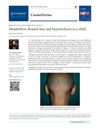
 A 9-year-old girl has a rare hair disorder causing beaded, sparse hair.