 1 citations
,
January 2002
1 citations
,
January 2002 Hair shine can be measured by how it reflects laser light.
24 citations
,
January 2013 in “Lasers in medical science” The fractional ultrapulse CO2 laser is a safe and effective non-surgical treatment for upper eyelid issues and brow lifting.
Light exposure is crucial for health, helping prevent and treat illnesses.
January 2026 in “National Science Review” December 2025 in “Lasers in Surgery and Medicine” February 2022 in “INTERNATIONAL JOURNAL OF SCIENTIFIC RESEARCH” Home-based laser devices are effective for hair removal, skin rejuvenation, and stimulating hair growth, but more research is needed on their safety and long-term effects.
 December 2024 in “Medical alphabet”
 Combining erbium laser, laser blood irradiation, and minoxidil is most effective for treating diffuse alopecia.
 March 2026 in “Research Square”
 Polymer dot nanozymes and exosomes, with laser stimulation, speed up wound healing.
2 citations
,
October 2016 in “European Neuropsychopharmacology”  June 2023 in “LA Referencia (Red Federada de Repositorios Institucionales de Publicaciones Científicas)”
 Home photobiomodulation therapy can improve life quality and mobility for disabled individuals.
 34 citations
,
August 2002 in “British Journal of Dermatology”
34 citations
,
August 2002 in “British Journal of Dermatology” ALA-PDT is effective and safe for chronic X-ray dermatitis, providing complete or partial remission.
2 citations
,
November 2025 in “Pharmaceutics” Moderately lipophilic dyes penetrate skin deeply, while highly hydrophobic or lipophilic dyes stay on the surface.
 November 2025 in “International Journal of Advanced Research”
 Platelet-rich plasma therapy effectively treated laser-induced skin lightening.
64 citations
,
October 2020 in “Journal of lasers in medical sciences” Low-level laser therapy shows promise but needs more research for improvement.
 May 2023 in “Elsevier eBooks”
 Low-level laser/light therapy is effective and safe for mild to moderate hair loss in men and women when combined with other treatments.
 6 citations
,
December 2015 in “International journal of nanomedicine”
6 citations
,
December 2015 in “International journal of nanomedicine” Using sonophoresis can make it harder for certain drug-loaded liposomes to get through the skin.
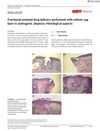 January 2021 in “Dermatologic Therapy”
 Channels stay open for 24 hours, making laser treatment potentially effective for hair loss.
21 citations
,
July 2015 in “International Journal of Nanomedicine” Increased liposome fluidity boosts skin penetration of sodium fluorescein.
5 citations
,
August 2014 in “Dermatologic surgery” Advanced fluorescence technology effectively treats skin discoloration from certain creams.
 140 citations
,
January 2009 in “JEADV. Journal of the European Academy of Dermatology and Venereology/Journal of the European Academy of Dermatology and Venereology”
140 citations
,
January 2009 in “JEADV. Journal of the European Academy of Dermatology and Venereology/Journal of the European Academy of Dermatology and Venereology” Liposomes improve drug delivery and reduce skin irritation in dermatology.
 January 2026 in “SSRN Electronic Journal”
 Riboflavin with blue light speeds up hair dyeing, making it faster, safer, and long-lasting with less hair damage.
 June 2020 in “Journal of Investigative Dermatology”
 The technique effectively shows how human skin and hair cells form into ball-like structures.
Low level laser or LED therapy combined with infiltrations may help hair growth.
24 citations
,
September 2020 in “Pharmaceutics” Lidocaine-loaded microparticles effectively relieve pain and fight bacteria in wounds.
7 citations
,
September 2019 in “DOAJ (DOAJ: Directory of Open Access Journals)” Photobiomodulation can help regrow hair in certain types of hair loss.
 October 2023 in “Skin research and technology”
 The 675 nm laser effectively improved facial acne scars in dark skin with minimal side effects.
 108 citations
,
December 2003 in “Lasers in surgery and medicine”
108 citations
,
December 2003 in “Lasers in surgery and medicine” ICG-enhanced NIR laser therapy may be a promising acne treatment with improvement and no side effects.
68 citations
,
January 2012 in “Lasers in surgery and medicine” Microdermabrasion combined with Q-switched Nd:YAG laser is a safe and effective way to treat stubborn melasma.
25 citations
,
March 2012 in “Photodermatology Photoimmunology & Photomedicine” Photodynamic therapy successfully treated a difficult scalp condition causing hair loss.

The patch speeds up wound healing by using electricity and heat.