3 citations
,
September 2021 in “Journal of Clinical Medicine” Epidermal signaling helps regenerate fingertip tissue.
 April 2025 in “Journal of Skin and Stem Cell”
 PDRN from trout sperm helps skin and hair regeneration but is costly and complex to produce.
8 citations
,
March 2009 in “Differentiation” Adult vibrissa follicle stem cells can regenerate hair follicles, glands, and skin.
January 2022 in “Stem cell biology and regenerative medicine” Lymphatic vessels help hair follicles regenerate by interacting with stem cells.
 April 2024 in “Research Square (Research Square)”
 MSC-protein helps regenerate gum tissue and bone.
 27 citations
,
January 2012 in “Current Topics in Microbiology and Immunology”
27 citations
,
January 2012 in “Current Topics in Microbiology and Immunology” Mice that can regenerate tissue have cells that pause in the cell cycle, which is important for healing, similar to axolotls.
18 citations
,
June 1993 in “Archives of Dermatological Research” Human hair follicles can be used to create skin-like tissue for wound healing and drug testing.
 January 2012 in “조직공학과 재생의학”
 The study found that certain three-dimensional scaffolds can help regenerate hair effectively.
January 2022 in “Stem cell biology and regenerative medicine” Improving dermal papilla cells can help regenerate hair follicles.
 165 citations
,
October 2013 in “Nature Communications”
165 citations
,
October 2013 in “Nature Communications” Scientists made working salivary glands in mice using bioengineered cells, which could help treat dry mouth.
5 citations
,
February 2022 in “Stem cell reports” Thymic stromal lymphopoietin (TSLP) promotes hair growth, especially after skin injury.
30 citations
,
February 2010 in “The journal of investigative dermatology/Journal of investigative dermatology” Plet-1 protein helps hair follicle cells move and stick to tissues.
20 citations
,
March 2014 in “PubMed” Hair follicle stem cell research has advanced in understanding and using these cells for hair growth and skin repair.
 44 citations
,
July 2016 in “Stem Cells Translational Medicine”
44 citations
,
July 2016 in “Stem Cells Translational Medicine” Scientists discovered that certain stem cells from mice and humans can be used to grow new hair follicles and skin glands when treated with a special mixture.
7 citations
,
July 2024 in “Current Issues in Molecular Biology” Understanding skin stem cells and their regulation is key to improving skin healing and treating disorders.
 July 2023 in “AYUSHDHARA”
 Aging is a natural process causing physical and mental decline.
4 citations
,
May 2025 in “Life” 3D bioprinting shows promise for better skin regeneration by creating structures similar to natural skin.
 30 citations
,
March 2017 in “ACS biomaterials science & engineering”
30 citations
,
March 2017 in “ACS biomaterials science & engineering” Hair follicles are valuable for regenerative medicine and wound healing.
23 citations
,
January 2017 in “Journal of Functional Biomaterials” Biomaterials can help reduce skin scarring and improve wound healing.
 8 citations
,
March 2019 in “Open Biology”
8 citations
,
March 2019 in “Open Biology” The document concludes that regenerating functional ectodermal organs like teeth and hair is promising for future therapies.
 January 2008 in “Yearbook of Dermatology and Dermatologic Surgery”
 One type of progenitor cell can maintain normal skin in mice.
 56 citations
,
March 2015 in “Cell death and differentiation”
56 citations
,
March 2015 in “Cell death and differentiation” Older skin has higher cancer risk due to inflammation and stem cell issues.
12 citations
,
November 2024 in “Burns & Trauma” Neuroregulation is crucial for skin wound healing and can be targeted to improve recovery.
 426 citations
,
August 2014 in “Nature Medicine”
426 citations
,
August 2014 in “Nature Medicine” Skin stem cells interacting with their environment is crucial for maintaining and regenerating skin and hair, and understanding this can help develop new treatments for skin and hair disorders.
28 citations
,
April 2024 in “Immunity” CD80 on skin stem cells helps expand Treg cells to aid wound healing.
 July 2025 in “Russian Journal of Skin and Venereal Diseases”
 Exosome therapy significantly increased hair density in androgenetic alopecia patients.
 April 2015 in “Plastic and Reconstructive Surgery”
 Activating TLR3 helps improve skin and hair follicle regeneration after wounds.
6 citations
,
August 2016 in “Journal of Visualized Experiments” The CUBIC protocol allows detailed 3D visualization of proteins in mouse skin biopsies.
 57 citations
,
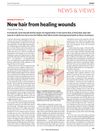
May 2007 in “Nature”
57 citations
,
May 2007 in “Nature” Adult mice can grow new hair from skin wounds.
 November 2023 in “Frontiers in veterinary science”
 The study provides insights into hair growth mechanisms in yaks.