2 citations
,
May 2002 in “PubMed” Micro-graft hair transplantation is an effective, simple, and painless method for permanent hair restoration in men and women.
 January 1998 in “Current Therapeutics”
 Different causes of hair loss require specific treatments, and most men and women will experience some form of hair thinning as they age.
 May 2026 in “Journal of Case Reports and Scientific Images”
 Homeopathic treatment and lifestyle changes helped a teen regrow hair lost to alopecia.
 November 2015 in “European journal of dermatology/EJD. European journal of dermatology”
 A 55-year-old woman with several health conditions did not see hair regrowth after a transplant.
 November 2009 in “Actas dermo-sifiliográficas/Actas dermo-sifiliográficas”
 Hair transplantation effectively treated a bald patch in an 18-year-old woman with Temporal Triangular Alopecia.
 February 2011 in “Journal of the American Academy of Dermatology”
 A 60-year-old man with a long-term balding condition also developed a rare hair loss condition usually seen in postmenopausal women.
 March 2026 in “Zenodo (CERN European Organization for Nuclear Research)”
 Restoring communication in hair follicle networks may treat hair loss and improve sexual dysfunction.
2 citations
,
January 2010 in “PubMed” Current treatments for postmenopausal frontal fibrosing alopecia stop hair loss but don't regrow hair.
 14 citations
,
January 2006 in “Australasian journal of dermatology”
14 citations
,
January 2006 in “Australasian journal of dermatology” Alopecia areata can look like frontal fibrosing alopecia, making diagnosis hard.

The patient with total hair loss did not regrow hair despite treatment, indicating a poor outlook for this type of hair loss.
 May 2015 in “Hair transplant forum international”
 Androgenetic alopecia causes hair loss by shrinking hair follicles due to androgens, with the connection between the muscle and hair follicle determining if the loss is reversible.
 March 2026 in “Frontiers in Medicine”
 Diffuse unpatterned alopecia can affect donor areas, but treatment with finasteride and minoxidil can improve hair density.
 August 2021 in “EMC - AKOS - Trattato di Medicina”
 Acquired alopecia is hair loss that can be reversible or irreversible, depending on whether the hair follicle is destroyed.
 July 2016 in “Journal of Cutaneous Medicine and Surgery”
 Receding hairlines in men are uneven, with the right side larger than the left.
 November 2025 in “Australian Journal of General Practice”
 Oral finasteride and topical minoxidil can regrow hair, but finasteride may affect fertility.
 22 citations
,
July 2012 in “International Journal of Trichology”
22 citations
,
July 2012 in “International Journal of Trichology” Miniaturized hairs stay connected to muscle in alopecia areata, allowing possible regrowth, but not in androgenetic alopecia.
May 2025 in “International Journal of Trichology” Partially bald areas in Indian AGA patients still have hair growth cells, suggesting early treatment is best.
January 2015 in “Faculty of 1000 Research Ltd” Androgenetic alopecia may be irreversible due to the detachment of a muscle from hair follicles.
 53 citations
,
May 2010 in “Dermatologic Surgery”
53 citations
,
May 2010 in “Dermatologic Surgery” Hair transplantation may not work for Frontal Fibrosing Alopecia as transplanted hair was lost when the disease came back.
 12 citations
,
June 2012 in “Dermatologic Surgery”
12 citations
,
June 2012 in “Dermatologic Surgery” Hair transplantation effectively treated a woman's patchy hair loss when other treatments failed.
September 2023 in “International Journal of Trichology” A rare hair regrowth pattern can occur in some people with alopecia areata.
 1 citations
,
August 2002 in “Zeitschrift für Hautkrankheiten”
1 citations
,
August 2002 in “Zeitschrift für Hautkrankheiten” Male androgenetic alopecia involves hair follicle miniaturization due to DHT, with potential treatments using inhibitors and blockers.
 March 2025 in “Cosmetics”
 Combining treatments works best for early hair loss, while transplants are best for severe cases.
5 citations
,
October 1990 in “Archives of Dermatology”  March 2026 in “Zenodo (CERN European Organization for Nuclear Research)”
 Restoring hair follicle communication may treat hair loss and improve sexual dysfunction.
 April 2021 in “Advances in Cosmetic Surgery”
 Hair restoration can be achieved through non-surgical treatments like minoxidil, antiandrogens, phototherapy, and PRP procedures, or through surgical methods like hair transplantation. Continued treatment is needed to maintain results, and full results are visible after 12-18 months.
 December 2023 in “Scientific Reports”
 Scientists created cell lines from balding patients and found that cells from the front of the scalp are more affected by hormones that cause hair loss than those from the back.
 June 1996 in “Archives of Dermatology”
 Using a mix of finasteride and minoxidil can significantly regrow hair in men with pattern baldness.
December 1977 in “Archives of Dermatology” Hair regrowth in alopecia areata is common, but recurrences happen frequently.
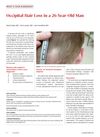 January 2022 in “Consultant”
 The man's occipital hair loss was due to temporal triangular alopecia, not alopecia areata.