Trichoepithelioma and desmoplastic trichoepithelioma have distinct features that can be identified using reflectance confocal microscopy.
97 citations
,
January 1999 in “International Journal of Dermatology” Pityriasis rubra pilaris is a rare skin disorder with reddish-orange patches and thickened skin, needing better treatment understanding.
January 2024 in “Revista del Centro Dermatológico Pascua” Avoiding damage and using specific shampoo and supplements improved the hair condition.
2 citations
,
January 2006 in “PubMed” Carpronium chloride increases blood flow by widening small blood vessels.
48 citations
,
July 1988 in “PubMed” Rhino mice show significant meibomian gland changes, making them a potential model for studying gland disorders.
40 citations
,
February 1946 in “Canadian Journal of Research/Canadian journal of research” Hereditary factors cause hair loss in mice by affecting skin and hair follicle structure.
88 citations
,
August 1998 in “Carcinogenesis” High levels of ODC and a mutant Ha-ras gene cause tumors in mice.
227 citations
,
April 2023 in “The Lancet” Ritlecitinib effectively treats alopecia areata and is well-tolerated.
109 citations
,
February 2018 in “CB/Current biology” ERULUS controls root hair growth by regulating cell wall composition and pectin activity.
1 citations
,
March 2024 in “Life” Dermoscopy can help assess the severity of chronic radiation-induced skin damage in head and neck cancer patients.
July 2024 in “Journal of Investigative Dermatology” A new test helps find drugs to treat head and neck cancer by targeting c-Rel.
 1 citations
,
June 2021 in “bioRxiv (Cold Spring Harbor Laboratory)”
1 citations
,
June 2021 in “bioRxiv (Cold Spring Harbor Laboratory)” GTL1 is needed to control root hair growth and prevent problems when there are too many nutrients.
23 citations
,
July 1994 in “Journal of Dermatological Science” Pili torti hair twists due to uneven outer root sheath cell development.
17 citations
,
November 1967 in “American Journal of Anatomy” Hairless mice have longer hair follicles and abnormal structures during the catagen phase.
A new mutation in the TRPS1 gene caused Trichorhinophalangeal syndrome in a 17-year-old, highlighting the need for genetic testing.
July 2024 in “Journal of Investigative Dermatology” 4 citations
,
November 2023 in “SKIN The Journal of Cutaneous Medicine” Ritlecitinib is safe for treating alopecia areata for up to 48 weeks.
21 citations
,
April 2016 in “International Journal of Oncology” GnRH treatment can reduce breast cancer cell invasion.
8 citations
,
October 2020 in “Clinical Psychopharmacology and Neuroscience” rTMS may help treat trichotillomania in some patients.
 10 citations
,
April 2017 in “PLoS ONE”
10 citations
,
April 2017 in “PLoS ONE” White rhinoceroses have a unique skin structure with thick epidermis and no hair or oil glands.
 1 citations
,
June 2022 in “Experimental dermatology”
1 citations
,
June 2022 in “Experimental dermatology” The SHJH hr mice with a mutated Hr gene show signs of faster skin aging due to poor antioxidative protection.
 6 citations
,
September 2019 in “Skin pharmacology and physiology”
6 citations
,
September 2019 in “Skin pharmacology and physiology” RCS-01 therapy is safe and may improve skin structure by affecting gene expression.
2 citations
,
May 2025 in “Journal of the European Academy of Dermatology and Venereology” Ritlecitinib improves hair regrowth in alopecia areata over 24 months.
11 citations
,
October 2021 in “Orphanet journal of rare diseases” Patients with RASopathies are at risk for autoimmune disorders and should be routinely screened.
Ritlecitinib is a new treatment for severe hair loss in people 12 and older.
 October 2011 in “Journal of dermatology”
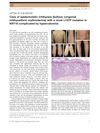
 A man with a rare skin condition and a new gene mutation developed high calcium levels due to his treatment.
55 citations
,
April 2008 in “Clinical Genetics” A new mutation in the ST14 gene was found in a patient with ARIH syndrome, showing milder symptoms and no tooth issues.
2 citations
,
April 2024 in “Biotechnology Progress” 3D-printed microwells can effectively form uniform, viable tumor spheroids.
Ritlecitinib improves hair regrowth in alopecia areata without increasing adverse risks.
 November 2022 in “Journal of Investigative Dermatology”
 Blocking mTORC1 activity could increase hair pigmentation and potentially reverse greying.