 December 2018 in “Lasers in Surgery and Medicine”
 Science improves peace by advancing medical treatments, like laser therapies and non-invasive imaging.
October 2025 in “Journal of Cosmetic Dermatology” AOPT-MTL effectively and safely treats nasal blackheads in Asians.
 April 2016 in “Proceedings of SPIE”
 UV-induced autofluorescence is effective for identifying different types of alopecia.
STS01 1% effectively promotes hair regrowth with minimal side effects.
Optical Coherence Tomography has potential in diagnosing hair loss and monitoring blood clotting, and could be improved for deeper tissue observation and better hair loss understanding.
July 2024 in “Journal of Investigative Dermatology”  2 citations
,
December 2020 in “American Journal of Dermatological Research and Reviews”
2 citations
,
December 2020 in “American Journal of Dermatological Research and Reviews” The combination therapy was effective and well-tolerated, especially in young patients.
 May 2023 in “Journal of drugs in dermatology”
 Most transgender patients getting laser hair removal before gender-affirming surgery are already on hormone therapy, which might affect the hair removal process.
 6 citations
,
October 2018 in “Lasers in Medical Science”
6 citations
,
October 2018 in “Lasers in Medical Science” Low-level laser therapy using near-infrared light may help heart conditions and promote healing by releasing nitric oxide.
 November 2023 in “Deleted Journal”
 Combining laser and corticosteroid is not better than corticosteroid alone for treating frontal fibrosing alopecia.
 32 citations
,
September 2016 in “Dermatologic Surgery”
32 citations
,
September 2016 in “Dermatologic Surgery” The evidence for using Low-Level Laser Therapy for hair loss is limited and more thorough research is needed.
18 citations
,
June 2020 in “Dermatologic Therapy” FCO2 laser is a better treatment for alopecia areata than intralesional steroids.
1 citations
,
March 2024 in “PubMed” Surgery with a carbon-dioxide laser successfully treated a Labrador's tongue condition, but some hair regrew.
 January 2024 in “Brazilian Journal of Hair Health”
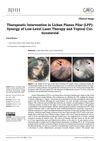
 Combining low-level laser therapy with topical corticosteroids effectively improved Lichen Planopilaris symptoms.
 1 citations
,
February 2010 in “Proceedings of SPIE”
1 citations
,
February 2010 in “Proceedings of SPIE” Low level laser therapy may help regenerate hair cells in the ear after damage from gentamicin.
 1 citations
,
February 2022 in “Lasers in Medical Science”
1 citations
,
February 2022 in “Lasers in Medical Science” Low-level laser therapy is about 80% effective in treating hair loss, with best results in males, those who use it for over a year, and those with scalp conditions like dandruff and rash.
 7 citations
,
March 2020 in “Lasers in Medical Science”
7 citations
,
March 2020 in “Lasers in Medical Science” LLLT is a safe, promising hair loss treatment, but more research needed.
13 citations
,
July 2024 in “Medicina” Lasers can trigger skin reactions, especially in darker skin, and more research is needed to improve treatments.
July 2016 in “Chinese Journal of Dermatology” Low-level laser therapy effectively treats hair loss, especially when combined with finasteride.
May 2025 in “International Journal of Trichology” Laser hair removal might help prevent trichoepithelioma lesions, but more testing is needed.
 July 2002 in “Dermatologic Surgery”
 Some people's hair turned white or gray after using intense pulsed light for hair removal, and for some, it was permanent.
 6 citations
,
April 2012 in “Lasers in surgery and medicine”
6 citations
,
April 2012 in “Lasers in surgery and medicine” Laser hair removal can cause a severe itchy rash in some allergic individuals, treatable with steroids.
 August 2025 in “Lasers in Medical Science”
 Combining laser therapy with minoxidil improves hair growth and satisfaction without extra side effects.
57 citations
,
June 1999 in “Dermatologic surgery” Laser hair removal was a significant new method for getting rid of unwanted hair in 1999.
 December 2020 in “Nippon Laser Igakkaishi”
 Photobiomodulation therapy is beneficial in plastic surgery and dermatology.
 2 citations
,
April 2025 in “Lasers in Medical Science”
2 citations
,
April 2025 in “Lasers in Medical Science” Combining fractional CO2 laser with halometasone cream is more effective for chronic eczema than the cream alone.
 6 citations
,
November 2018 in “Photodiagnosis and Photodynamic Therapy”
6 citations
,
November 2018 in “Photodiagnosis and Photodynamic Therapy” A wearable cap-like device using light therapy reduced scalp skin lesions by 71% and was painless.
 October 2024 in “Small Methods”
 Platinum nanozyme microneedles can effectively and safely promote hair growth for androgenetic alopecia.
January 2015 in “Journal of cosmetics, dermatological sciences and applications” The combined technology safely and effectively removes hair at home on dark skin.