May 2013 in “Faculty Opinions – Post-Publication Peer Review of the Biomedical Literature” A balance between BMP and Wnt signals is crucial for hair follicle stem cell function and hair growth.
 August 2012 in “Nature Cell Biology”
 A pathway helps maintain long telomeres in both stem and cancer cells.
 May 2012 in “The Journal of Nuclear Medicine”
 Hair stem cells were tracked in mice using a special imaging technique, showing that it's possible to monitor hair growth this way.
 April 2012 in “Annals of Neurosciences”
 The document concludes that stem cell therapies lack solid proof of effectiveness, except for blood system treatments, and criticizes the ethical issues and commercial exploitation in the field.
 January 2012 in “Springer eBooks”
 The skin has different types of stem cells that can repair and regenerate tissue.
January 2010 in “Seoul National University Open Repository (Seoul National University)” The medium from stem cells in fat tissue may boost hair growth.
 August 2009 in “Mechanisms of Development”
 Adult hair follicle cells can create new hair follicles from corneal cells with the right support.
June 2009 in “Faculty Opinions – Post-Publication Peer Review of the Biomedical Literature” Lrig1 marks a unique group of stem cells in mouse skin that can become different skin cell types.
January 2009 in “Heilongjiang xumu shouyi” Stem cells are present in goat hair follicles but decrease over time.
January 2009 in “Hubei nongye kexue” Stem cells in cashmere goats are found in hair follicles and have a slow growth rate.
July 2007 in “Cancer biology & therapy” Removing a key gene in mice leads to premature aging and loss of stem cells.
The treatment successfully integrated hair follicles into a dermal template, showing new hair growth and blood vessel formation.
 January 2006 in “Yearbook of Dermatology and Dermatologic Surgery”
 Hair graying is caused by the loss of pigment cells due to poor maintenance of stem cells in the hair follicle.
Stem cells play a key role in nonmelanoma skin cancers, with different origins and genetic changes linked to basal and squamous cell carcinomas.
January 2003 in “Zhonghua shaoshang zazhi” Murine fetal epidermal stem cells can help regenerate hair follicles.
January 2002 in “Basic medical sciences and clinics” Hair follicle stem cells are crucial for hair growth and renewal.
April 2023 in “Chinese Medical Journal” Human hair follicle stem cells help repair tendon injuries.
Stem cell treatments show promise for hair loss but need more research.
December 2022 in “Nature Communications” Bead-jet printing of stem cells improves muscle and hair regeneration.
December 2022 in “Stem Cells and Development” Exosomes from stem cells help improve nerve repair in rats.
October 2022 in “Academic journal of science and technology” Stem cells, especially from fat, show promise for treating hair loss.
January 2022 in “Stem cell biology and regenerative medicine” iPSCs could help develop treatments for hair loss.
October 2021 in “Plastic and reconstructive surgery. Global open” Adipose-derived stem cells may help treat hair loss.
October 2021 in “QJM: An International Journal of Medicine” ADSC injections improve hair density, thickness, and reduce inflammation in female pattern hair loss.
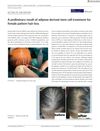 April 2021 in “Journal of Cosmetic Dermatology”
 Stem cell treatment improved hair density in female hair loss patient.
January 2020 in “Journal of Genetics and Gene Therapy” The combination of hair follicle stem cells and PRP shows promise for treating hair loss in Asian men and women.
 June 2019 in “Stem Cell Research”
 Scientists created MUSIi010-A, a stem cell line from a balding man's scalp, to study hair loss and develop potential treatments.
 October 2017 in “Journal of The European Academy of Dermatology and Venereology”
 Stem cells preservation in AGA could be a potential therapy, but more cases needed.
 April 2017 in “Journal of Investigative Dermatology”
 Stem cells can create hair follicles, potentially treating permanent hair loss, and healthy skin and hair depend on mitochondrial function and special fats.
January 2013 in “프로그램북(구 초록집)” Adipose stem cell-conditioned media improved hair density and thickness in women with hair loss.