60 citations
,
October 2009 in “PubMed” Intralesional steroid injections are safe and effective for treating severe alopecia areata.
2 citations
,
September 2024 in “Animal Cells and Systems” Hepatitis B virus alters steroid hormones in male mice, reducing dihydrotestosterone to inhibit viral replication.
57 citations
,
December 1960 in “Archives of Dermatology” Steroid injections can help regrow hair in some alopecia cases.
39 citations
,
March 1976 in “British Journal of Dermatology” Intralesional steroid therapy is useful for treating various skin conditions.
38 citations
,
May 1982 in “PubMed” Intralesional steroid injections can effectively treat calcinosis and ulcers in scleroderma.
 32 citations
,
March 2021 in “Journal of cosmetic dermatology (Print)”
32 citations
,
March 2021 in “Journal of cosmetic dermatology (Print)” COVID-19 infection may trigger alopecia areata in some patients.
18 citations
,
June 2020 in “Dermatologic Therapy” FCO2 laser is a better treatment for alopecia areata than intralesional steroids.
 13 citations
,
April 2001 in “Journal of The American Academy of Dermatology”
13 citations
,
April 2001 in “Journal of The American Academy of Dermatology” Using a vibrating device during injections can help reduce pain.
11 citations
,
January 2017 in “Skin Appendage Disorders” Use lower concentrations of triamcinolone acetonide to reduce steroid-induced scalp atrophy.
 March 2025 in “Pakistan Journal of Health Sciences”
 Intralesional steroids improve Alopecia Areata, and trichoscopy effectively tracks this improvement.
8 citations
,
January 2020 in “Indian Dermatology Online Journal” PRP works faster and is a safe alternative to steroids for treating alopecia areata.
 4 citations
,
July 2020 in “Journal of Dermatological Treatment”
4 citations
,
July 2020 in “Journal of Dermatological Treatment” Minoxidil injections can speed up hair regrowth in non-severe patchy hair loss, but combining it with steroids doesn't improve results.
 44 citations
,
January 2021 in “Dermatologic Therapy”
44 citations
,
January 2021 in “Dermatologic Therapy” COVID-19 may cause hair loss due to infection stress or treatments.
May 2022 in “Brazilian Journal of Health Review” COVID-19 infection can cause temporary hair loss due to stress, treatment drugs, psychological impact, and pandemic-related stress.
Kerion is a rare but serious scalp infection that needs proper treatment.
October 2021 in “The journal of investigative dermatology/Journal of investigative dermatology” Herpes simplex virus infections should be considered in pemphigus patients to avoid unnecessary changes in treatment.
11 citations
,
May 2011 in “Veterinary Record” A dog in France died from an African parasite infection after traveling from Senegal.
 January 2023 in “Journal of Cosmetic Dermatology”
 Some children may develop hair loss after having COVID-19.
18 citations
,
November 1989 in “Clinical and experimental dermatology” Griseofulvin is the best treatment for severe scalp infection caused by Microsporum canis.
December 2004 in “Microbial Ecology in Health and Disease” Pityriasis amiantacea is linked to Staphylococcus aureus infection and can be effectively treated with antibiotics, corticosteroids, and coal tar.
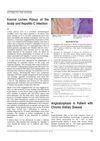
Patients with lichen planus should be tested for hepatitis C.
 May 2025 in “International Medical Case Reports Journal”
 Lichen planus pigmentosus may indicate undetected hepatitis C infection.
8 citations
,
February 2022 in “Frontiers in Medicine” COVID-19 may trigger severe skin flare-ups in people with autoimmune conditions like lupus.
 November 2022 in “Journal of the Endocrine Society”
 A woman with ectopic Cushing's syndrome and COVID-19 passed away despite treatment.
 178 citations
,
August 2016 in “Advances in wound care”
178 citations
,
August 2016 in “Advances in wound care” New effective scar treatments are urgently needed due to the current options' limited success.
178 citations
,
June 1994 in “Journal of Investigative Dermatology” Alopecia areata in these mice is inherited, more common in young females, and can be treated with triamcinolone acetonide.
113 citations
,
May 2007 in “Journal of the American Academy of Dermatology” The study found that steroids and tetracycline helped treat active Lichen planopilaris, and hair transplants were good for later stages.
 49 citations
,
December 2018 in “JAAD case reports”
49 citations
,
December 2018 in “JAAD case reports” Dupilumab may cause significant hair loss, which can reverse after stopping the drug.
 48 citations
,
October 1996 in “Dermatologic clinics”
48 citations
,
October 1996 in “Dermatologic clinics” Some treatments can help with hair regrowth in alopecia areata, but results vary and long-term use is often needed without changing the disease's outcome.
 46 citations
,
November 1995 in “The Journal of Dermatology”
46 citations
,
November 1995 in “The Journal of Dermatology” Alopecia areata was most common in people in their 30s and 40s, with some family history and a higher relapse rate, and larger bald areas responded better to specific immunotherapy.